Mirrors as Cures: Doubling Light, Food, and Good Views
A mirror is the most powerful everyday tool in feng shui, and the cheapest. It does three things no other object does: it doubles whatever it faces, it bounces light into dark corners, and it makes a small room feel larger. Those are not mystical claims; they are optics. And because a mirror doubles whatever it faces, the whole art of using mirrors as cures comes down to one question: what is this mirror reflecting? Point it at something good — daylight, a garden, a full dining table — and it doubles the good. Point it at clutter, a blank wall, or a bed, and it doubles the problem. This guide covers the good placements, the three placements to avoid, and how mirrors fix specific room problems.
Mirrors appear across this site because they touch almost every room: the mirror-facing-bed guide covers the bedroom problem in depth, and the entryway guide covers the front-door question. This guide pulls the mirror rules together as a cure in their own right.
The core rule: a mirror doubles what it faces
Stand where a mirror will hang and look at what it will reflect. That reflection is what the mirror adds to the room. A mirror facing a window doubles the daylight and the view; a mirror facing a dining table doubles the food and the gathering; a mirror facing a beautiful plant doubles the plant. Conversely, a mirror facing a pile of laundry doubles the laundry, a mirror facing a toilet doubles the toilet, and a mirror facing a blank wall doubles a blank wall. Before hanging any mirror, check the reflection — it is the whole cure.
This rule explains the classic placements. In a dining room, a mirror on a side wall reflecting the table is the textbook abundance cure: tradition says it doubles the food, symbolizing plenty, and practically it brightens the room and makes a small dining space feel generous. Our dining room guide covers the table itself; the mirror is its companion. In a living room, a mirror reflecting a window doubles the daylight, which is why living rooms with a well-placed mirror feel brighter even on grey days. The living room guide pairs with this one.
The rule also explains what to avoid. Never hang a mirror where it reflects something you want less of: clutter, a messy desk, a bin, a bathroom door left open. If the only available wall reflects clutter, fix the clutter first or choose another wall. A mirror is an amplifier, and amplifiers do not discriminate.
Making small rooms bigger and dark rooms brighter
A large mirror on one wall is the most reliable visual trick for a small room. It does not literally add space, but it doubles the visual depth in one direction, and the brain reads that as a larger room. The effect is strongest when the mirror reflects an open view — a window, a doorway into a larger room, a garden — rather than another wall. A mirror reflecting a wall makes the room feel like two small rooms instead of one larger one, which is why placement matters more than size.
Hallways benefit most. A long, narrow hallway feels like a tunnel; a mirror on one side wall, reflecting a window or an open door at the end, breaks the tunnel feeling and bounces light down its length. Our hallway guide covers the wider fixes; the mirror is the single cheapest one. The same trick works in a small dining room, a narrow living room, and a cramped entryway — anywhere the room's problem is that it feels closed in.
For dark rooms, pair the mirror with light. A mirror opposite or beside a window catches daylight and throws it deeper into the room, and a mirror near a lamp does the same at night — see our light guide for the layering principle. The combination is stronger than either alone: light without a mirror stays near its source, and a mirror without light has nothing to bounce. Together they can lift a north-facing room from gloomy to workable without any building work.
The three places never to put a mirror
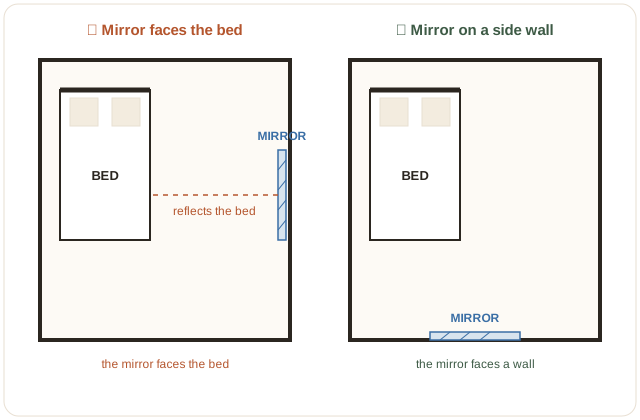
First, facing the bed. Tradition is firm on this, and the practical reason is stronger than the traditional one: reflected movement at night disturbs sleep. Your own movement, a partner turning over, a curtain shifting in a draught — all of it appears in the mirror, and the sleeping brain registers movement as something to wake for. Waking to your own reflection in the dark is startling even when you know what it is. If a mirror already faces the bed, move it to a side wall; if it cannot move, cover it at night with a cloth. The full reasoning is in our mirror-facing-bed guide.
Second, facing the front door. Tradition says a mirror facing the door bounces incoming energy straight back out of the house. Practically, it startles you with your own reflection the moment you arrive, doubles the draught and noise of the doorway, and makes the entryway feel exposed rather than welcoming. Put the entryway mirror on a side wall, where you can check yourself on the way out without facing the door. The entryway guide covers the arrival sequence in full.
Third, facing another mirror. Two mirrors facing each other create an infinite tunnel of reflections, which looks striking and feels unsettling — the eye cannot settle, and the room feels like it has no end. It is also a practical nuisance: every speck of dust and every smudge is multiplied. If two mirrored surfaces must face each other, as in a dressing area, angle one of them slightly so the reflections do not bounce directly back and forth.
Special cases: sharp corners, missing sectors, and desks
Mirrors are sometimes used to "complete" a missing sector in an irregular floor plan — a flat mirror on the wall where the floor plan juts inward, symbolically extending the room. This is a traditional bagua cure, and its practical value is modest: it brightens the wall and makes the irregularity feel less like a missing chunk. If your floor plan has a missing corner, our floor plan guide and bagua guide explain the mapping; a mirror is one option among several, and a plant or a light in the same spot does similar practical work.
Mirrors can also soften a sharp corner, or poison arrow, by reflecting it away — but a plant or a screen in front of the corner is usually simpler and safer, as our poison arrows guide explains. And at a desk, a small mirror that lets you see the door behind you is a genuine command-position fix: if your desk must face away from the door, a mirror on the wall or desk edge showing the doorway removes the startle of someone approaching from behind. Our home office guide covers desk placement; the mirror is the fallback when the desk cannot move.
Finally, keep mirrors clean and whole. A cracked mirror is traditionally unlucky and practically unpleasant — a distorted reflection is worse than no reflection — so replace cracked mirrors promptly. And clean them: a smeary mirror doubles smears, and a room with a dirty mirror feels neglected in a way a room with no mirror does not. The cure, like every cure, works best when it is cared for.
Start with one mirror, one reflection
Walk through your home and check every mirror's reflection, one by one. Move the ones facing beds and front doors to side walls. Point one at a window or a dining table. Clean them all. That single pass — no purchases, no new objects — is the mirror cure in its most practical form, and most homes improve measurably from it. A mirror is not magic. It is optics, pointed deliberately, and deliberate optics is what feng shui has always been about.
Go deeper with the book
Feng Shui Made Simple covers every room this way — bedroom, living room, kitchen, office, entryway — with diagrams and a 7-day plan for doing the whole house.
Frequently asked questions
Where is the best place for a mirror in a home?
On a side wall where it reflects something pleasant — a window with daylight, a garden view, or a dining table. A mirror reflecting a good view doubles it; a mirror reflecting a blank wall or clutter doubles that instead.
Should a mirror face the front door?
Tradition says no: a mirror facing the front door is said to bounce incoming energy straight back out. Practically, it also startles you with your own reflection on arrival and doubles the draught and noise of the doorway. Put it on a side wall of the entryway instead.
Is a mirror facing the bed bad?
Tradition says yes, and the practical reason is strong: reflected movement at night — your own, a partner's, a curtain moving — disturbs sleep, and waking to your own reflection is startling. Move it to a side wall, or cover it at night if it cannot move.
Can a mirror make a small room feel bigger?
Yes — it is the most reliable visual trick for a small room. A large mirror on one wall, reflecting a window or an open view, makes the room feel roughly twice as deep in that direction. It works best in living rooms, dining rooms, and hallways, not in bedrooms.
What about a mirror reflecting the dining table?
Tradition holds that a mirror reflecting the dining table doubles the food on it, symbolizing abundance. Practically, it also brightens the dining room and makes it feel larger. Hang it on a side wall reflecting the table, not facing the door.