Hallway and Corridor Feng Shui: Keep Energy Moving
Hallways are the most underrated space in the home. Nobody chooses a house for its hallways, nobody decorates them first, and yet you pass through them dozens of times a day. In feng shui, hallways are the home's arteries: they carry qi — the energy that flows through a space — from room to room. A hallway that is clear, lit, and pleasant makes the whole house feel connected. A hallway that is dark, cluttered, or dead-ended makes the house feel blocked, even if every room off it is lovely.
The hallway's job is movement. Everything in this guide serves that job: clear passage, good light, something worth looking at, and no place where energy — or a person — gets stuck. Hallways are also where small fixes pay off fastest, because you see the result every time you walk through.
Clear first: the passage rule
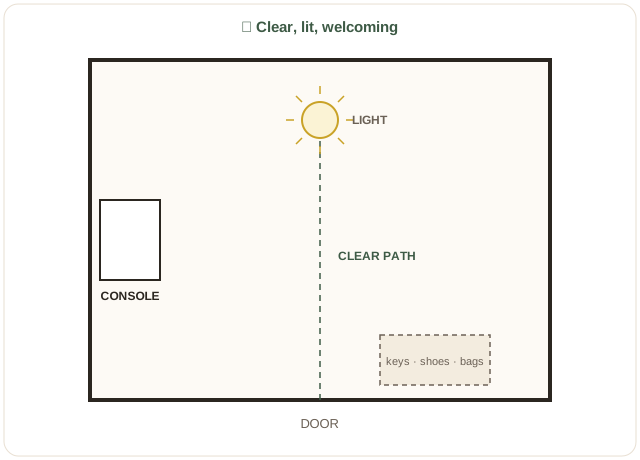
A hallway must be passable without thinking. That means no shoes piled by the door, no boxes "temporarily" in the corridor, no coat rack swallowing half the width, no laundry basket parked in the walkway. The test is simple: can two people pass each other, or one person carrying a laundry basket, without turning sideways? If not, something needs to move.
Shoes are the hallway's classic invader. A slim shoe cabinet or a single tray by the door holds the daily pairs; the rest live in bedrooms or closets. Coats follow the same rule: the hallway holds today's coat, not the household's entire outerwear collection. A narrow console table is fine if it leaves comfortable passage; a deep dresser in a hallway is not.
Clear also means clear at floor level and at head height. Low baskets to trip over and high shelves that shed things onto passers-by are both hallway failures. Keep the walls fairly bare below shoulder height, and keep anything stored above head height secure and infrequent. The entryway guide covers the front-hall version of the same discipline.
Light in rhythm, not one harsh bulb
Hallways are often the darkest part of a house: no windows, one ceiling light, long stretches of gloom. A dark hallway feels like a tunnel, and tunnels make people hurry and feel uneasy — the opposite of what a home's arteries should do. The fix is light in rhythm: several smaller lights spaced along the hallway rather than one bright fixture in the middle.
Wall lights, small ceiling spots, or even a lit picture light over art along the wall all work. Warm-toned bulbs, not cold white, keep the hallway feeling like part of the home rather than a service corridor. If the hallway has a window at one end, keep it uncovered — daylight at the end of a corridor pulls the eye forward and makes the whole passage feel open.
Night lighting matters too. A hallway you walk at 3 a.m. should be navigable without full lights: a low night light or a dimmer left on low is enough, and it keeps the household's sleep intact. Motion-sensor night lights in hallways are one of the cheapest genuine quality-of-life upgrades in any home.
Ends and turns: never a dead blank wall
Every hallway ends somewhere, and what it ends at matters. A long corridor ending in a blank wall feels like a dead end — energy arrives and has nowhere to go, and so does the eye. The fix is simple: give the end something worth arriving at. A piece of art, a mirror, a small table with a plant, a window with a view — any of these turns a dead end into a destination.
Mirrors deserve care here. A mirror at the end of a hallway brightens it and doubles the sense of space, which is genuinely useful in a narrow corridor. But a mirror that reflects a cluttered room, a bathroom door, or the front door directly can double the wrong thing. Hang the hallway mirror where it reflects something pleasant — art, a plant, a window — and check what it shows before fixing it to the wall. The mirror placement principles apply here too.
Turns and corners need the same attention. A sharp corner in a hallway creates a blind spot where people and energy collide — practically, it is where shoulders get bumped and children run into adults. A small round rug, a soft light, or a piece of art on the turn wall slows people slightly and signals the corner before they reach it. If the hallway meets a staircase, keep the junction clear and lit: the staircase guide covers what happens when stairs and doors line up.
Rugs, art, and making it pleasant
A runner rug is the hallway's best friend. It softens footsteps, warms cold floors, protects the flooring, and — visually — pulls the eye along the corridor instead of letting it stall. Choose a runner that fits the hallway's width with floor visible on both sides, and secure it so it does not slide or curl. A runner that bunches underfoot is a trip hazard, not a decoration.
Art in a hallway should be hung at eye level and spaced so each piece gets its own moment — a gallery wall crammed edge to edge in a narrow corridor feels busy rather than beautiful. Family photos work well in hallways: they turn a passage into a small story of the household, and people enjoy them precisely because they pass slowly enough to look. Keep frames secure and glass clean; a hallway is a high-traffic place and pictures take a beating.
Color in hallways should stay light and warm. Narrow spaces painted dark feel narrower; pale warm walls with a runner and art feel like a gallery. If the hallway is long, a slightly deeper tone on the end wall can pull the eye forward and make the corridor feel shorter — a painter's trick that works as well in feng shui as in design.
Doors along the corridor
Hallways collect doors, and doors facing each other across a narrow corridor are a classic feng shui talking point — traditionally, energy rushes between them. Practically, the issue is privacy and noise: a bathroom door facing a bedroom door across a hallway means sound and awkward encounters. The fixes are practical: keep doors closed when rooms are in use, add draft seals or soft-close hinges to reduce noise, and hang a small piece of art or a plant between facing doors to break the direct line visually.
Doors at the end of a long, straight hallway deserve attention too — especially a bedroom or bathroom door sitting directly at the end of the corridor's rush. A rug that stops before the door, a change of flooring, or a small table beside the door all slow the approach. If the corridor runs straight from the front door to a back door or window, energy — and drafts — shoot straight through the house; a rug, a screen, or a piece of furniture placed to one side of the line breaks the rush without blocking the passage.
Start with the passage test tonight: walk your longest hallway carrying a laundry basket. Move whatever you have to dodge. Then add light — one warm light where the darkest stretch is — and something pleasant at the end wall. Three small changes, and the hallway stops being dead space and starts doing its real job: carrying you, and the home's energy, smoothly from room to room.
Go deeper with the book
Feng Shui Made Simple covers every room this way — bedroom, living room, kitchen, office, entryway — with diagrams and a 7-day plan for doing the whole house.
Frequently asked questions
Why does my hallway feel like a tunnel?
Usually darkness plus emptiness: one ceiling light, no windows, bare walls. Fix it with light in rhythm — several smaller warm lights spaced along the corridor — and something worth looking at, like art or a runner rug, so the eye travels instead of stalling.
What should go at the end of a hallway?
Something worth arriving at: a piece of art, a mirror reflecting something pleasant, a small table with a plant, or a window. A long corridor ending in a blank wall feels like a dead end, for energy and for the eye alike.
Can I put a mirror at the end of a hallway?
Yes — it brightens a narrow corridor and doubles the sense of space. Check what it reflects first: art, a plant, or a window is good; a cluttered room, a bathroom door, or the front door directly is not.
Are doors facing each other across a hallway a problem?
Practically, the issue is privacy and noise. Keep doors closed when rooms are in use, add draft seals or soft-close hinges, and hang art or place a plant between facing doors to break the direct line visually.
What is the best rug for a hallway?
A runner that fits the width with floor visible on both sides, secured so it does not slide or curl. It softens footsteps, protects flooring, and pulls the eye along the corridor. A bunching runner is a trip hazard, not a decoration.