Mirror Facing Your Bed: Why It Drains You (and 3 Fixes)
Of all the classic feng shui rules, this is the one people argue about most — and the one with the most practical sense behind it.
First, what mirrors actually do. In feng shui, a "cure" is just an adjustment — a small, deliberate change that shifts a room's energy in a better direction. Mirrors do two real things: they bounce light and they visually double space. That's it — and honestly, it's plenty. Most of what mirrors "do" in feng shui comes down to these two very physical effects.
Now apply that to a bedroom. A mirror facing the bed reflects you, all night, every time you stir. It bounces light from the hallway, the streetlamp, the phone screen — and it bounces movement. In feng shui terms, the mirror keeps the room's energy restless. In plain terms: it's startling to half-wake and see a figure move in the dark, and it's hard for a room to feel still when a big reflective surface is doubling everything in it.
Your bedroom has one job — rest — and should be the most yin room in your home: quiet, dark, still, calm. A mirror facing the bed works directly against that job. That's the whole rule. (The other nine bedroom rules are in the bedroom guide.)
The 3 fixes (all free)
Fix 1: Move it. The best fix, when the room allows it. A mirror belongs on a wall that does not reflect the bed — a side wall, the inside of a wardrobe door, the hallway outside. If your mirror is freestanding, this takes thirty seconds.
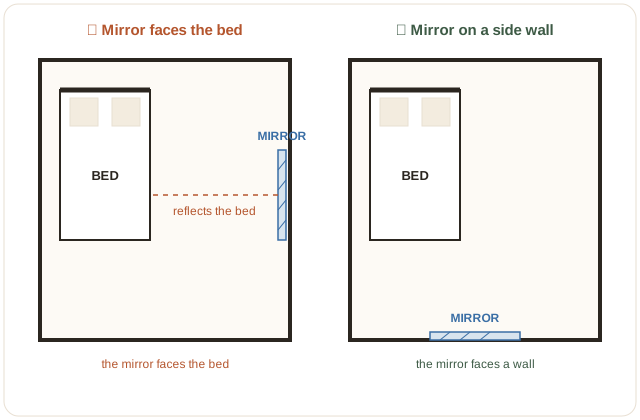
Fix 2: Cover it at night. The easiest fix, and the one to try first. A cloth, a folding screen, a curtain on a small rail — anything that blocks the reflection while you sleep. It costs nothing, takes ten seconds, and lets you test the difference tonight before committing to moving furniture. If you sleep noticeably better for a week, you have your answer.
Fix 3: Angle it away. If the mirror is fixed (a mirrored wardrobe wall, for example) and can't be moved or covered, angle it: tilt it slightly, or reposition the bed a few inches so the bed falls outside the mirror's reflection. Even a partial fix — the mirror reflecting the wall instead of the pillow — changes the room's feeling.
One of these three always works. Pick the easiest one tonight; upgrade to a better one when you have time.
Mirror mistakes beyond the bedroom
- Facing the front door. A mirror directly opposite the front door bounces entering qi right back out. Practically, it's also startling to walk in and face yourself. Move it to a side wall of the entryway instead.
- Cracked, spotted, or warped mirrors. Distorted reflections are genuinely unpleasant to look at, and that's the whole problem. Replace them.
- A wall tiled in mirror squares. The fragmented reflection is agitating, not expansive. One clear mirror beats a wall of fragments.
- Facing clutter. A mirror doubles whatever it reflects. Point it at a messy corner and you've doubled the mess. Point it at a garden, art, or a lovely view and you've doubled the beauty.
Where mirrors genuinely help
Mirrors aren't the enemy — misplaced mirrors are. Used well, they're the closest thing to a free renovation:
- Brighten a dark hallway or corner. Place a mirror opposite a window or lamp and watch the light travel down the hall.
- Make a small room feel larger. A big mirror on one wall can visually double a tiny room — just not the bedroom wall facing the bed.
- Symbolically "complete" a missing bagua area. Hang one on the wall facing the missing section; the reflection visually fills the gap.
- Let a cook or desk worker see the door behind them. The command-position fix from the kitchen guide — a small mirror behind the stove removes the exposed feeling of cooking with your back to the room.
- Reflect something beautiful. A mirror facing a garden, art, or a lovely view doubles beauty, which doubles its effect on your mood.
One good mirror, well placed, beats five bought out of anxiety. And "good" means clear, clean, and reflecting something worth doubling.
Start tonight: if a mirror reflects your bed, cover it before you sleep. It's the smallest change on this site and one of the most-reported ones — people notice the difference before they fully understand it, which is exactly how feng shui is supposed to work.
Go deeper with the book
Feng Shui Made Simple covers mirrors, plants, water features, crystals (the honest take), and light as cures — what each one genuinely does, what it doesn't do, and when to skip it.
Frequently asked questions
Why is a mirror facing the bed bad feng shui?
Mirrors bounce light and movement around the room. A mirror reflecting the bed keeps the room's energy restless, and in a room whose whole job is rest, restless energy means restless sleep. It is also startling to half-wake and see movement in the mirror.
What is the easiest fix for a mirror facing the bed?
Cover it at night with a cloth or a folding screen. It costs nothing, takes ten seconds, and you can test the difference tonight before committing to moving furniture.
Is a mirrored wardrobe door bad feng shui?
Only if it reflects the bed. If the mirrored doors face the bed, the same rule applies: cover them at night, angle them, or replace them. If they face a wall or a window, they are fine — mirrors facing a beautiful view double the beauty.
Where should mirrors go in feng shui?
Where they bounce light into a dark corner, make a small room feel larger, let a cook or desk worker see the door behind them, or reflect something beautiful like a garden. One good mirror, well placed, beats five bought out of anxiety.