Light as a Cure: Brightening Dark Corners
Every home has a corner that nobody uses: the end of a hallway, the space behind a door, the north-facing room that never quite wakes up. In feng shui, dark corners are where energy stagnates — and in plain language, dark corners are where clutter gathers, dust settles, and rooms quietly shrink, because people avoid what they cannot see clearly. Light is the simplest cure for all of that. It costs little, it requires no belief, and its effect is immediate: light a dark corner and the room gets bigger, cleaner, and more inviting in the same evening. This guide covers daylight first, then layered artificial light, then the specific dark spots that benefit most.
Light is also a cure that works by room. A bedroom needs different light from a kitchen, and a gym needs different light from a dining room. The guides for those rooms — bedroom, kitchen, home gym, dining room — each specify their light; this guide explains the principle behind them all.
Daylight first: uncover, clean, and use it
Before buying any lamp, check the daylight. Are the curtains open during the day? Are the windows clean? Is furniture blocking the window? In many homes the "dark room" problem is a curtain problem: heavy drapes that stay drawn out of habit, a bookcase in front of the only window, a window so dirty it filters out a third of the light. Open the curtains fully in the morning, clean the glass inside and out, and move tall furniture away from the window. That alone often fixes a room that felt gloomy for years.
Daylight does work no bulb can fully replace. It is brighter than indoor lighting by an order of magnitude, it changes through the day in a way that helps set a sleep rhythm, and it connects a room to the outside — a view, weather, time of day — which makes the room feel like a real place rather than a box. Morning daylight in particular matters: a bright room in the morning helps you feel awake, and a bright room by day makes a dim room at night feel like a genuine contrast, which helps sleep. Our nursery guide uses the same daylight principle for babies, and it applies to adults too.
If a room has no window — an internal bathroom, a windowless hallway, a basement corner — daylight is not an option, and artificial light must do the whole job. That is fine, but it means the artificial light needs to be better: brighter, layered, and on a timer or sensor so the space is never left dark for days. A windowless room that is always lit when you enter it stops feeling like a cupboard.
Layered light: three sources, not one
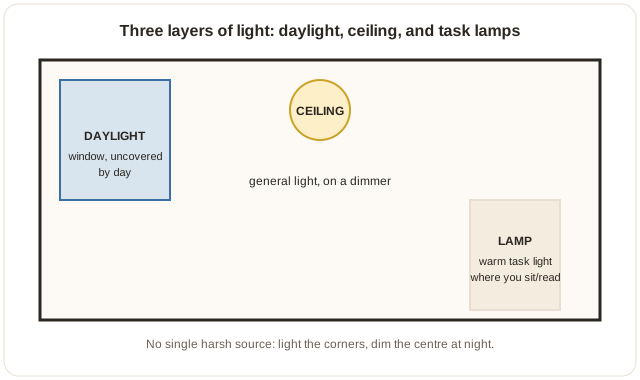
The most common lighting mistake is a single ceiling light on full blast. It flattens the room, creates harsh shadows, and makes the space feel like an office or a cafeteria. Good lighting is layered: three sources at different heights, each doing a different job. General light from the ceiling, on a dimmer, for overall brightness. Task light where work happens — a desk lamp, a reading lamp beside a chair, under-cabinet light in a kitchen. And accent light for warmth and depth — a small lamp in a corner, a picture light, candles on a dining table.
Layering matters because it lets you change a room's character without changing the room. Bright ceiling light plus task light for working; dim ceiling light plus a warm corner lamp for evening relaxation; one low lamp for winding down before bed. A room with one switch has one mood; a room with three sources has as many moods as it needs. Dimmers are the cheapest upgrade in this whole guide: a dimmer on the main ceiling light transforms every room it touches, because it turns a binary — on or off — into a range.
Color temperature matters too. Warm white, around 2700K, suits living rooms, bedrooms, and dining rooms, where the goal is relaxation; the light feels like evening sun and helps the body wind down. Cool white, around 4000K, suits kitchens, bathrooms, and gyms, where you need to see clearly and stay alert. Do not mix temperatures within a single room — a warm lamp beside a cool ceiling light looks wrong even if you cannot say why — but do mix them across rooms according to each room's purpose.
Dark corners, hallways, and missing sectors
Start with the darkest corner in the house and give it a light. A small lamp, a wall light, or even a battery-operated puck light on a timer — the form matters less than the fact that the corner is no longer dark. Once lit, the corner stops gathering clutter, because clutter hides in darkness and a lit corner is visible. Clean the corner first, light it second, and it will tend to stay clean, because a clean lit corner is pleasant and a dark cluttered corner is easy to ignore.
Hallways are the classic case. A long hallway with a single ceiling light in the middle is dark at both ends, and dark ends feel like tunnels. Light both ends — a ceiling light plus a small lamp or wall light at the far end — and add a mirror on a side wall to bounce the light along. Our hallway guide covers the wider fixes; light is the first and cheapest. Staircases deserve the same treatment: a light at the top and the bottom, never just one, for safety as much as for feng shui.
Light is also the traditional cure for a missing sector in an irregular floor plan: a bright light in the area where the floor plan falls short symbolically completes the missing piece. Practically, it does what light always does — it draws attention and use to a neglected area — and a floor lamp in a missing corner is a reasonable, low-cost version of that cure. The floor plan guide maps the sectors; light is one way to treat a gap, alongside plants and mirrors.
What not to do with light
Do not leave lights on all night in a misguided attempt to "keep energy up." Tradition sometimes suggests a light left burning in a dark sector, but a timer or motion sensor achieves the same presence without wasting energy, disturbing sleep, or heating the room. A light on a timer for the evening hours, or a sensor light that switches on when you enter, gives the corner its light when it matters and darkness when it does not.
Do not use a single harsh source where a room needs calm. A bedroom with a bare cool-white ceiling bulb is a room that fights sleep, however tidy it is — see our bedroom guide for the warm, dim alternative. And do not point bright lights at seating or at a bed: light in the eyes is glare, not cure, and a lamp that shines directly into someone's face makes the room less comfortable, not more. Aim light at walls, ceilings, and tasks, not at faces.
Finally, do not neglect the unglamorous part: replace dead bulbs promptly, dust lampshades, and clean light fixtures. A room with two dead bulbs out of four is a room that is slowly going dark, and the drift is easy to miss because it happens gradually. A monthly check — walk the house, note the dead bulbs, replace them the same day — keeps the whole home's light at full strength, which is the whole cure in miniature.
Start with the darkest corner tonight
Find the darkest corner in your home this evening. Clean it, put a lamp in it, and switch the lamp on. Notice how the room changes — not dramatically, but noticeably: a little bigger, a little cleaner, a little more inviting. That is light as a cure, and it is the easiest cure in this whole column to test, because you can test it in one evening with one lamp you already own.
Go deeper with the book
Feng Shui Made Simple covers every room this way — bedroom, living room, kitchen, office, entryway — with diagrams and a 7-day plan for doing the whole house.
Frequently asked questions
Why is light a feng shui cure?
Because light changes how a room feels and how it is used: a dark corner is avoided, gathers clutter, and feels stagnant, while the same corner lit well becomes usable. Light is the cure for the dark, unused, and neglected parts of a home.
Should lights be warm or cool white?
Warm white (around 2700K) for living rooms, bedrooms, and dining rooms, where the goal is relaxation; cool white for kitchens, bathrooms, and home gyms, where you need to see clearly and stay alert. Mix by room, not by bulb within a room.
What is the best fix for a dark hallway?
Layer the light: a ceiling light on a dimmer for general brightness, plus a small lamp or wall light at the darkest end, and a mirror on a side wall to bounce what light there is. A hallway that is lit at both ends stops feeling like a tunnel.
Do I need to leave a light on all night in a dark corner?
No. Tradition sometimes suggests a light left on in a dark or missing sector, but a timer or a motion-sensor light does the same job without wasting energy or disturbing sleep. A few hours in the evening, or light on arrival, is enough.
Is natural light better than artificial light?
Yes, where you can get it: daylight is brighter, more varied, and better for mood and for setting a day-night rhythm than any bulb. Uncover windows by day, keep them clean, and use artificial light to extend daylight's work, not to replace it entirely.