Feng Shui Home Office: Desk Position for Career Growth
Your home office has one job: help you do good work. Not impress visitors, not store the printer and the tax files and the spare cables — just give your brain a place where focus comes easily. Desk position is the single biggest factor, and it costs nothing to fix.
The core idea is the command position, the same principle behind bed placement in the bedroom guide. Sit where you can see the door, but not directly in line with it, with a solid wall behind you. The reason is practical, not mystical: when you can see who enters, your body relaxes. When your back is to the door, part of your attention stays on guard duty, listening for footsteps. That is attention you are not spending on your work.
Think of it as the difference between sitting in a restaurant with your back to the room versus facing it. Most people instinctively choose the facing seat. Feng shui just applies that instinct to your desk, deliberately, every day.
The command position, step by step
1. See the door. From your chair, you should be able to see the office door without turning around. Diagonal placement usually achieves this: the desk sits at an angle across from the door, not dead opposite it.
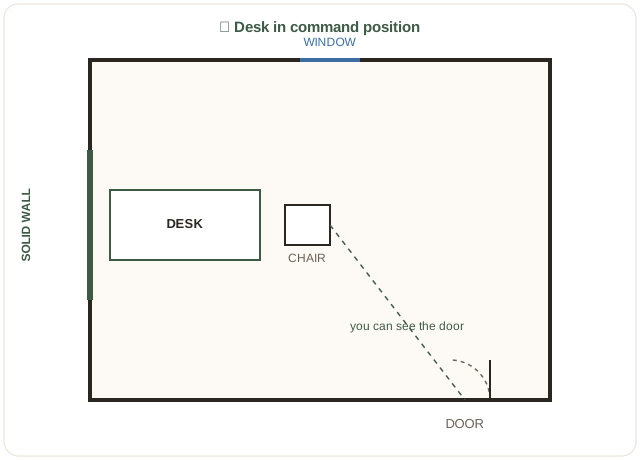
2. Do not sit in line with the door. Directly facing the door puts you in the path of incoming energy — in plain terms, every person, pet, and draft comes straight at you, which is distracting. Offset to one side.
3. Get a solid wall behind you. A wall behind your back means support: the classic image is a mountain at your back. It also means nobody walks behind you while you work. If your desk floats in the middle of the room, a tall bookshelf behind the chair can serve as the "mountain."
4. Leave open space ahead. The view in front of you should not be a blank wall inches from your face. Open space ahead symbolizes opportunity and room to grow — and practically, it stops the boxed-in feeling that makes long work sessions miserable. If a wall is unavoidable, hang a landscape picture or a vision board there to give the eye somewhere to go.
Windows, light, and glare
Natural light helps focus, but placement matters. A window to your side is ideal: daylight without glare on the screen or in your eyes. A window directly behind you creates backlight that strains your eyes and makes video calls look terrible. A window directly in front of you is distracting on bright days and glaring at sunset. If your only option is facing or backing a window, use a sheer curtain or a blind you can adjust through the day — practical light control beats perfect placement.
For artificial light, use a desk lamp from the side opposite your writing hand (left side for right-handed people), so your hand does not cast a shadow on your work. Overhead light alone creates flat, tiring illumination. One good lamp changes a home office more than most furniture purchases.
Clutter is a career problem
Clutter on a desk is not just untidy; it is a set of unfinished decisions staring at you. Every unfiled paper, unanswered letter, and orphaned cable is a small open loop, and open loops drain focus. The feng shui term is blocked qi (energy flow), but the modern description is the same: visual noise competes for attention.
Clear the desk to what the current task needs, plus one pen and one drink. File the rest at the end of each day — a five-minute shutdown ritual that pays for itself the next morning, when you sit down to a clean surface instead of yesterday's mess. Cables deserve a tray or a clip; a tangled nest under the desk is the office version of clutter under the bed, and it nags at you in the same way.
Keep career symbols visible but modest: a certificate, a plant, a small object that reminds you of work you are proud of. One or two such items motivate. A desk covered in awards and motivational posters becomes a museum, not a workspace.
Colors and elements for work
For steady focus, choose calm colors: soft green (Wood, growth), muted blue (Water, calm thinking), and warm neutrals (Earth, grounding). These suit long sessions. Bright red is stimulating and useful in small doses — a red notebook, a red mug — but a red wall behind you will hype you up rather than settle you down, which is the wrong energy for careful work.
A living plant on or near the desk is the classic office cure: it adds Wood energy, cleans the air a little, and gives your eyes a natural resting point during screen breaks. Choose something hard to kill — a pothos, a snake plant, a ZZ plant — because a dying plant on a work desk is worse than no plant at all. The plants guide lists the best choices and where each belongs.
Small spaces and shared rooms
If your office is a corner of the living room or bedroom, boundaries matter more than square footage. Mark the work zone: a rug under the desk, a screen, a bookshelf turned sideways, or even just a consistent "office" lamp that you switch on for work and off afterwards. The ritual of opening and closing the work zone tells your brain when work starts and ends — which is the real challenge of working from home.
If you share the room, agree on the basics: headphones mean do-not-disturb, the chair position is yours, and the desk is not a dumping ground for other people's things. Shared-space friction is usually about boundaries, not furniture.
One last rule, and it is the most career-relevant one here: face your work, not your phone. Put the phone face-down, in a drawer, or in another room during deep work. No desk position compensates for a screen that interrupts you every ninety seconds. Command position gives you control of the room; phone discipline gives you control of your attention. Together, they are the whole home-office system — and neither costs anything. For the rest of the house, the living room guide and kitchen guide apply the same thinking room by room.
Go deeper with the book
Feng Shui Made Simple covers the home office, every other room, and the five elements with diagrams and a 7-day plan for doing the whole house.
Frequently asked questions
Where should my desk face in a home office?
Face the door, from a position where you can see it without sitting directly in line with it. This is the command position: you see who enters, so your nervous system relaxes and you focus better.
Is it bad to sit with my back to the door?
Yes, it is the weakest position. With your back to the door you cannot see who approaches, which keeps you subtly on guard. If you cannot move the desk, place a small mirror so you can see the door's reflection.
Should my desk face a wall or a window?
A wall directly in front of you can feel blocking; a window directly behind you causes glare and distraction. Best is a solid wall behind you and an open view ahead, with a window to your side for daylight.
What colors help focus in a home office?
Calm, muted tones: soft greens and blues for steady focus, warm neutrals for grounding. Avoid all-white glare and large areas of bright red, which is stimulating rather than concentrating.
My office is a corner of my bedroom. What do I do?
Separate it as much as you can: a screen, a bookshelf, or even a different rug marks the work zone. Close the laptop and cover the desk at the end of the day, so rest energy can return to the bedroom.