The Bagua Map Explained: Find the 9 Areas of Your Home
The bagua (pronounced "bah-gwah") is feng shui's most useful tool. It's a simple map that divides any home into nine areas, each connected to a part of your life.
The nine areas
| Area | Element | Connected to |
|---|---|---|
| Wealth & Prosperity | Wood | Money, abundance, gratitude |
| Fame & Reputation | Fire | How the world sees you, visibility, recognition |
| Love & Relationships | Earth | Romance, partnership, close friendships |
| Family & Health | Wood | Family bonds, vitality, new beginnings |
| Center — Health & Balance | Earth | Overall well-being, the heart of the home |
| Children & Creativity | Metal | Kids, creative projects, playfulness |
| Knowledge & Wisdom | Earth | Learning, self-cultivation, quiet thinking |
| Career & Life Path | Water | Work, purpose, direction in life |
| Helpful People & Travel | Metal | Mentors, friends who show up, journeys |
Don't worry about memorizing this grid. What matters is the idea: different parts of your home support different parts of your life. The corner where you keep a dying plant and a pile of old magazines? That corner is quietly telling you something about the life area it represents.
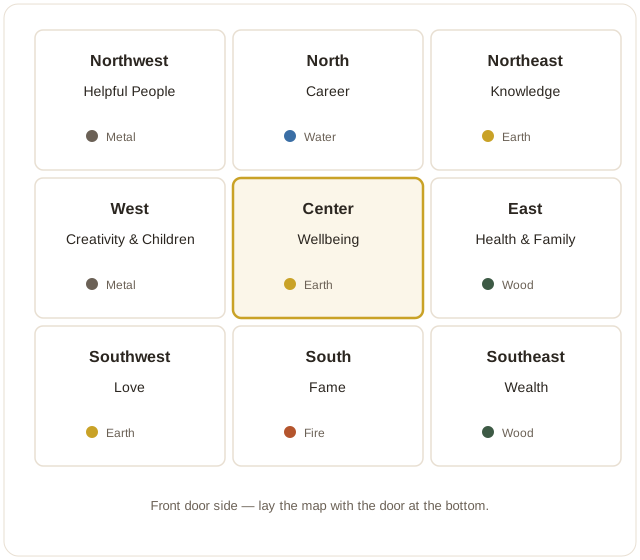
How to lay the map over your floor plan
This takes ten minutes and one piece of paper.
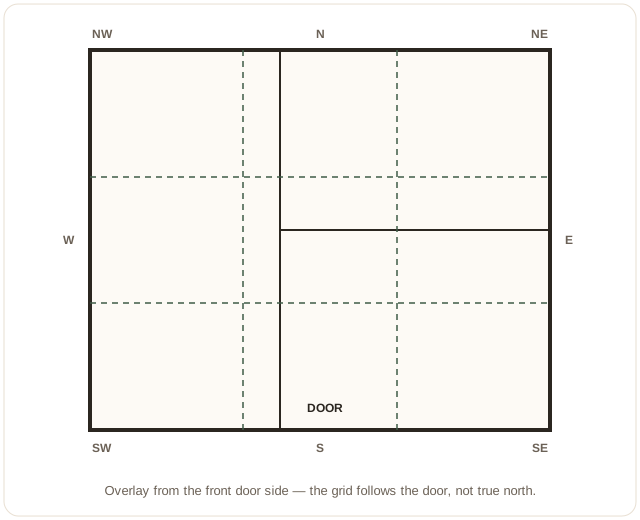
Step 1: Sketch your floor plan. It doesn't need to be architectural — a rough rectangle with the rooms labeled is fine. Draw the outer shape of your home as seen from above, and mark the front door clearly. Include every room, even the bathroom and closets.
Step 2: Stand at your front door, facing into the home. This is your orientation point. Everything on the map is read from this position — not from the compass, not from the street. Just you, at your door, looking in.
Step 3: Divide your sketch into nine equal sections — three rows of three, like a tic-tac-toe grid stretched over your floor plan. Don't worry about walls; the grid floats over them. A single room can hold two or three areas, and that's completely normal.
Step 4: Line up the bottom row with the entrance wall. The bottom three squares — Knowledge & Wisdom (left), Career & Life Path (center), Helpful People & Travel (right) — sit along the wall that holds your front door. The top row — Wealth & Prosperity (left), Fame & Reputation (center), Love & Relationships (right) — is the far side of your home.
That's it. Now look at your map. Find the area connected to whatever's on your mind lately — money stress, a relationship, your health, your career. Go look at that part of your home with fresh eyes. Is it cluttered? Dark? Used as a dumping ground? Most people are surprised how accurately the physical state of that area matches the state of that life area. The correlation won't prove anything, but it will make you think — and thinking is the first step.
Enhancing each area: a quick guide
Once you've mapped your home, you can give extra attention to the areas that matter most right now. "Enhance" just means: clean it, light it well, and add something representing its element.
- Wealth & Prosperity (back left). Add living green plants or purple accents. Keep it lush and alive — this area should feel abundant, not dusty. A healthy plant here is the classic enhancement, and it works because a thriving plant is a daily visual reminder of growth.
- Fame & Reputation (back center). Add light and Fire energy: a bright lamp, candles, red or orange accents, anything that says "be seen." Display awards, diplomas, or anything you're proud of. This area loves visibility — literally.
- Love & Relationships (back right). Think pairs and pinks: two candles, paired artwork, soft pink or peach tones. Avoid single, lonely objects — and photos of ex-partners.
- Family & Health (middle left). Green plants, family photos where everyone looks happy, wooden objects. This area supports vitality, so it should feel alive: fresh flowers, good air, nothing broken or wilting.
- Center (middle center). Keep it open, clean, and grounded — earth tones, a square rug, nothing piled up. The center is the heart of the home; when it is blocked, the whole home feels congested.
- Children & Creativity (middle right). Metal and white tones, playful objects, anything creative in progress. This is the place for the easel, the instrument, the project mid-flight.
- Knowledge & Wisdom (front left). Quiet and earthy: books, a reading chair, soft lighting. This corner should invite you to sit and think.
- Career & Life Path (front center). Water energy: dark blues, black accents, flowing shapes, a mirror or glass. Keep the path through this area clear — literally. A blocked entry path is a blocked career path, symbolically and practically.
- Helpful People & Travel (front right). Metal tones, photos of mentors and friends, travel mementos. This area is about the people who show up for you — keep it bright and welcoming.
One caution: enhance one or two areas at a time, the ones that match what you actually care about right now. Enhancing all nine at once is just redecorating under pressure. Pick the area, clean it properly, add one deliberate touch, and live with it for a few weeks.
What about missing areas?
If your home is L-shaped or has a notch cut out, part of the grid may fall outside your walls. That is called a missing area, and it is common — most homes aren't perfect rectangles.
The practical fix is simple: give the nearest inside wall extra attention. Light it well, hang a mirror on it (mirrors visually "complete" a space), and keep it clean and intentional. You are not repairing a cosmic defect; you are making sure no corner of your home feels neglected. A neglected corner and a neglected life area tend to travel together, and fixing the first is the only one of the two you can do with a lamp and a cloth.
If you want the full room-by-room method — including what to do when a bathroom lands in your wealth corner or the kitchen eats your love area — that is what the book is for. The five elements guide explains the elements behind every enhancement above, and the colors cheat sheet turns them into decorating choices. For goals specifically — wealth, love, career, health — see the Goals page.
Go deeper with the book
Feng Shui Made Simple includes the full bagua chapter with diagrams, plus a room-by-room walkthrough that shows how the nine areas play out in a real home — including the tricky cases like missing areas and bathrooms in the wrong corner.
Frequently asked questions
Is the bagua map based on compass directions?
Not in the version used here. This is the door-oriented bagua: you stand at your front door facing in, and the bottom row of the grid lines up with the entrance wall. Compass-based schools exist, but the door method is the one beginners can use tonight.
What if my home is not a rectangle?
Stretch the grid over the overall shape. A single room can hold two or three areas, and that is normal. If a section of the grid falls outside your walls, that is called a missing area — treat it by giving the nearest inside wall extra attention, light, and care.
Can one room hold more than one bagua area?
Yes, and it usually does. A large living room can hold three areas at once. The grid floats over walls; it is a way of seeing your home, not a set of property lines.
Does enhancing a bagua area guarantee results?
No. Enhancing an area means cleaning it, lighting it well, and adding something representing its element. That makes the space itself better and keeps the life area it represents on your mind. It is a practical and psychological tool, not a promise.