Feng Shui Living Room Layout: Command Position and Flow
The living room is where your home's energy gathers — family movie nights, long talks with friends, quiet evenings alone with a book. In bagua terms, it often holds several life areas at once. In practical terms, it's the room guests judge and you use most.
The goal: a room that invites people in, lets conversation flow, and helps everyone relax. A living room that does this well makes the whole home feel successful. One that doesn't — however nice the bedrooms are — makes the home feel off.
Here's how to get it right.
The sofa command position
Remember the command position: the main seat should face the door without being directly in line with it. The same principle that governs your bed governs your sofa — and for the same reason.
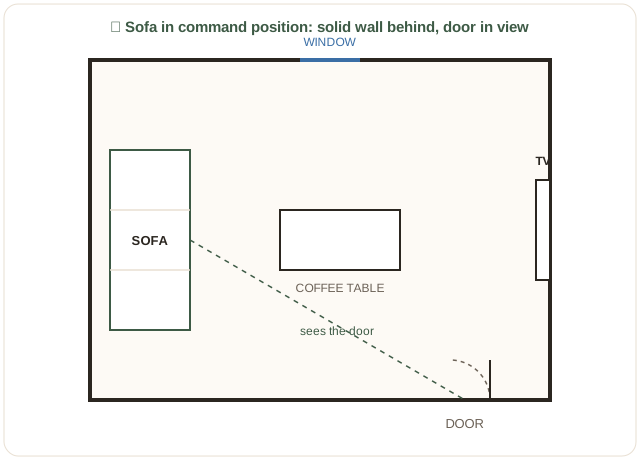
When you sit on the sofa, you should be able to see who's entering the room. People unconsciously tense up when their back is to a door. It's the same instinct that makes restaurant-goers quietly compete for the wall-facing table, and the same reason you feel exposed working with your back to an open office door.
A sofa with its back to the entrance makes every sitter subtly uneasy, even if nobody can articulate why. Conversations stay a little tenser. People leave a little earlier. The room never quite relaxes.
The fix: angle or move the sofa so the entrance is visible from the main seat. You don't need a perfect angle — even a diagonal counts. If the layout truly won't allow it, place a mirror where the seated person can see the door's reflection. It looks like a design choice. It functions like peace of mind.
Conversation first, TV second
Look at your current layout honestly: does every seat face the television? In most living rooms, the answer is yes — which means the room is designed around ignoring each other.
Try this instead: arrange the main seating — sofa plus chairs — so people face each other, or at least sit at angles that allow eye contact without neck strain. The TV goes to the side wall: visible when you want it, not the room's gravitational center when you don't.
You don't have to get rid of the TV or become the kind of person who lectures guests about screen time. Just demote it from "the thing the room worships" to "one of the things the room does." Conversation is yang energy at its best — lively, warm, connecting. Give it the best seats in the house.
A useful test: could four people sit in your living room and talk comfortably without anyone twisting around or shouting? If not, the TV has staged a coup. Rearrange.
The rug rule
Rugs do quiet, powerful work in living rooms. They define zones, soften sound, warm cold floors, and — in feng shui terms — they ground a room's energy so it doesn't scatter.
The rule: the front legs of all main seating should rest on the rug. A rug floating in the middle of the room with furniture marooned around it looks lost and makes the seating feel disconnected. A rug that anchors the furniture pulls the whole arrangement together into one conversational island.
Size up, not down. The most common rug mistake is buying one two sizes too small. When in doubt, go bigger — a generous rug makes a room feel larger, not smaller.
Lighting in layers
One harsh overhead light is the fastest way to make a living room feel like an interrogation room. Good living rooms use three layers, and you probably need fewer new purchases than you think:
- Ambient: the general light — a ceiling fixture on a dimmer is ideal. If you have no dimmer, a $10 plug-in dimmer for a floor lamp does the job.
- Task: reading lamps beside chairs, light where you actually need it. Every reading spot deserves its own lamp.
- Accent: a small lamp on a shelf, candles, string lights — the warm touches that make a room feel alive after dark.
Warm-toned bulbs (look for "warm white" on the box) beat cool white every time for living spaces. Cool light is for offices and hospitals. Your living room is neither, and cool bulbs will make it feel like both.
Evening test: turn off the overhead, turn on the lamps. If the room instantly feels better, your overhead was the problem all along.
Art at eye level, with intention
Bare walls make a room feel temporary, like nobody's really moved in. But art hung wrong is almost as bad: too high (gallery mistake — center it at eye level, about 57 inches from the floor), too small for the wall (a postage stamp on an ocean), or art you don't actually like.
Choose art for how it makes you feel, then check it against the bagua: the Wealth corner loves lush greens, the Fame area loves bold reds, the Love area loves pairs and soft tones. But feeling comes first — a print you adore in the "wrong" element beats a correct-but-meaningless poster every time. The colors cheat sheet helps with the element side.
Family photos belong in the living room more than anywhere: they're Wood energy (growth, life) and they tell everyone — including you — that this home is loved.
Tame the electronics
Every living room has a tangle: the TV cables, the chargers, the router blinking in the corner. Electronic clutter is yang energy at its most chaotic — buzzing, blinking, humming.
You don't need to hide everything. Just contain it: a cable box or even a shoebox for the router and its cables, one charging station instead of five scattered chargers, and the simple rule that cables don't cross walkways.
Also: the router. It's fine where it is for wifi, but it doesn't need to be the visual centerpiece. Behind a plant, inside a ventilated basket, on a high shelf — anywhere it works without glowing at you all evening.
The fireplace (if you're lucky enough)
A fireplace is a natural Fire element and a natural gathering point — feng shui gold, as long as it stays in its role. Keep the mantel clean and intentional (not a dumping ground for mail and keys), keep the fire itself safe and maintained, and arrange seating to enjoy it without blocking the room's flow. A fireplace nobody can see from the seats is a wasted heart.
Put it together this weekend: sofa to command position, chairs angled for conversation, rug under the front legs, lamps instead of the overhead. Four moves, no purchases, and the room will feel like a different place by Sunday night. The same approach works room by room through the whole house — the bedroom guide and kitchen guide follow the same pattern.
Go deeper with the book
Feng Shui Made Simple covers the living room and every other room with diagrams and a 7-day plan for doing the whole house in order.
Frequently asked questions
Where should a sofa go in feng shui?
In the command position: the main seat faces the room's entrance without being directly in line with it. When sitters can see who enters, everyone relaxes. If the layout truly won't allow it, place a mirror where the seated person can see the door's reflection.
Should all seats face the TV?
No. Arrange the main seating so people face each other, or sit at angles that allow eye contact. Put the TV on a side wall: visible when you want it, not the room's gravitational center when you don't.
How big should a living room rug be?
Big enough that the front legs of all main seating rest on it. The most common rug mistake is buying one two sizes too small. When in doubt, go bigger.
What lighting does a living room need?
Three layers: ambient (a ceiling fixture on a dimmer), task (reading lamps beside chairs), and accent (a small lamp, candles, string lights). Warm-toned bulbs beat cool white for living spaces.