Feng Shui Entryway: First Impressions Set the Energy
In feng shui, the front door is called the "mouth of qi" (pronounced "chee") — the mouth through which your home eats. Just as your body takes in nourishment through the mouth, your home takes in its vitality through the front door. A mouth that is clean, open, and welcoming takes in good nourishment. One that is blocked, broken, or neglected does not.
Think about it practically, too. Your front door is the first thing you see coming home and the last thing you see leaving. It is also what every guest, delivery driver, and neighbor judges first. A welcoming entrance sets the tone for everything inside. A neglected one does the opposite — and you absorb that message twice a day, every day. If you only fix one thing in your home, fix your entrance. It has the highest return on the smallest effort of any change in feng shui.
Start outside: clear the path
Qi has to reach your door before it can enter, so start outside. First, make the door findable: house numbers visible from the street, day and night, a doorbell that actually works, a path that is swept and lit. This sounds almost insultingly basic, but "energy can't find the door" is just the poetic version of "your friends circle the block twice before giving up."
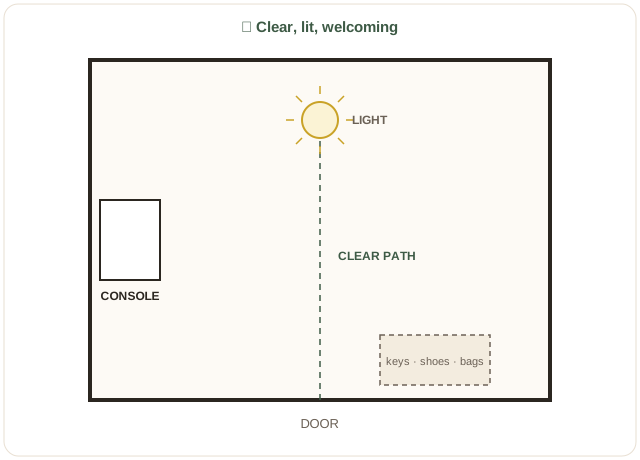
Next, remove obstacles. Bikes piled against the door, a dead plant in a cracked pot, last month's packages slowly fossilizing — clear them all. The approach to your door should feel like an invitation, not an obstacle course. Every object between the street and your door is something qi — and you — have to climb over.
Tend the threshold plants. If you have potted plants by the door, they should be alive and reasonably happy. A thriving plant says "life is welcome here." A dead one says the opposite, and you see it every single day. No plants at all is better than dead plants — do not let guilt grow by your doorstep.
If your "front door" opens onto a shared hallway, the principles shrink but do not change. Your doormat is your territory marker — keep it clean and intentional. The wall space immediately around your door, what you actually control, should be clean and well-lit; a small wreath or tasteful decoration marks it as yours. If your door faces a neighbor's door, an elevator, or a stairwell, do not worry — just make sure your side is the brighter, cleaner, more cared-for one. In hallways, relative care matters more than absolute perfection.
What the door opens onto
Now step inside. Stand in your doorway and look in. What do you see? The ideal is an open, bright view — a hallway with light at the end, a pleasant room, something alive like a plant or a piece of art you love. Energy enters and spreads out to explore. So do your eyes, and so does your mood.
A wall two feet away. If your door opens onto a blank wall right in front of you, energy hits it and stops dead. So does your sense of arrival. Hang a bright piece of art or a mirror on a side wall — not facing the door directly — to open the view visually. Even a well-lit piece of art changes the whole feeling.
A straight shot to the back door or a big window. If energy can rush straight through your home and out the back, it never settles — and neither do you. Slow it down with a rug, a plant, or a piece of furniture placed to gently redirect the flow. You are not blocking the path; you are giving it a reason to linger.
Stairs going straight up. Same idea — energy rushes up and away instead of spreading through the floor you are on. A runner rug, artwork on the stair wall, or a plant at the base softens the rush. (The full set of fixes is on the staircase facing the door page.)
The bathroom door in direct view. Nobody wants their first sight of home to be the toilet. Keep the bathroom door closed, or place something pleasant — a plant, a folding screen — to redirect the eye.
None of these require renovation. They are all about giving energy — and your eyes — something pleasant to land on instead of something jarring.
Light it like you mean it
A dark entrance feels unwelcoming, full stop. It does not matter how nice the furniture is — if the entry is dim, the whole home feels dim. Make your entryway the brightest-feeling spot it can be: a good ceiling light on a warm bulb, a lamp on a timer if you are often out after dark, and a fixture that is actually clean. Dust on a light cover can cut brightness noticeably — wipe it and see.
This applies outside too. A well-lit front door is safer, more inviting, and — in feng shui terms — calls good qi in. A motion-sensor light over the door is a cheap cure for a dark doorway, and it pays for itself in sheer welcome. If your entry has a window, keep it uncovered or sheer. Natural light at the entrance is the gold standard — it quite literally brings the outside world's energy in.
The landing zone: keys, shoes, bags
Here is where theory meets Tuesday evening. You walk in loaded with stuff. Where does it go? Without a designated landing zone, the answer is "the nearest flat surface," and that is how entryways become junk zones. With one, the chaos has a container. Set up, in this order of priority:
1. Hooks or a bowl for keys — near the door, at hand height. Never lose keys again. 2. A shoe spot — a tray, a rack, a mat. Shoes off or shoes contained; either is fine, scattered is not. 3. A bag drop — a hook, a bench, a basket. Bags live here, not on the dining chairs. 4. A mail station — a tray or wall file. Mail gets sorted weekly: act, file, recycle. No "I'll deal with it" piles.
This takes fifteen minutes to set up and saves you five minutes of hunting every single day. That is thirty hours a year returned to you by a three-dollar hook. The landing zone is also the first line of defense against clutter spreading through the house — and clutter, as the feng shui basics explain, is stuck energy you pay for in stress.
The doormat rule
Your doormat is small, but it does real work. Get one that is clean — shake it out weekly, hose it down monthly, replace it yearly, because a filthy mat is a filthy first impression, and it is the first thing your feet touch at home. It should be solid and flat — no curled edges to trip over, no wobbling — and big enough to fit both feet comfortably with room to spare. A postage-stamp mat looks apologetic.
That is it. No special symbols or "lucky" characters required, despite what souvenir shops will tell you. A clean, solid, generous mat is the whole teaching.
Small entries and rented homes
Most of us do not have grand foyers. If your front door opens directly into your living room, define the entry with a rug — it tells energy (and your brain) "you have arrived; this is a threshold." Add a small bench or wall hooks so keys, shoes, and bags have a home instead of colonizing the room. A tall plant or a folding screen can give the entrance its own zone without blocking light or flow.
Once the basics are handled, the entrance is the perfect place for small seasonal touches: a wreath in winter, fresh flowers in spring, a bright lantern in autumn. These are not feng shui requirements — they are joy, which is its own kind of good qi. Rotate them when the season changes. The ritual of refreshing your entrance four times a year keeps your attention on it, and attention is the real cure behind every cure.
Do it this weekend: sweep the path, wipe the door, fix the light, set up the hooks. Twenty-five minutes, and every arrival home after that feels different. When the entry is done, the same thinking carries into the rest of the house — start with the bedroom and the kitchen, or take the whole house through the 7-day reset plan.
Go deeper with the book
Feng Shui Made Simple covers every room this way — bedroom, living room, kitchen, office, entryway — with diagrams and a 7-day plan for doing the whole house.
Frequently asked questions
Why is the entryway so important in feng shui?
The front door is called the mouth of qi — the opening through which your home takes in energy, people, and opportunity. It is also the first thing you see coming home and the last thing you see leaving, so a neglected entrance sends you a negative message twice a day.
What if my front door opens directly into the living room?
Define the entry with a rug, a small bench or wall hooks for keys and bags, and a tall plant or folding screen to mark the zone. You do not need a separate foyer — you need a visible threshold that tells your brain you have arrived.
What should I do if my door faces a wall right in front of it?
Hang bright art or a mirror on a side wall — never directly facing the door — to open the view visually. A well-lit piece of art changes the whole feeling of arrival, even when the wall itself cannot move.
Does a mirror facing the front door cause problems?
Yes, in feng shui a mirror directly facing the door is said to bounce entering energy straight back out. Practically, it is also startling to walk in and face yourself. Put mirrors on a side wall instead, where they bounce light without blocking the entrance.
My door faces the stairs or the back door. Is that bad?
A straight shot through the house means energy rushes through instead of settling. Slow it down with a rug, a plant, or a piece of furniture placed to gently redirect the flow. You are not blocking the path — you are giving it a reason to linger.