Facing vs Sitting: The Two Directions of Every Home
Every home has two directions, and confusing them is the most common beginner mistake in classical feng shui. Facing is where your home looks. Sitting is where it rests. They are always opposite each other — and each one governs a different half of your feng shui decisions.
The simple picture
Imagine a person sitting in a chair, facing the room. The direction their eyes look is their facing. The direction their back rests toward is their sitting. A home works the same way. The front — the side with the main door, the main view, the most light and movement — is the face. The back — the solid, protected side — is where the home sits.
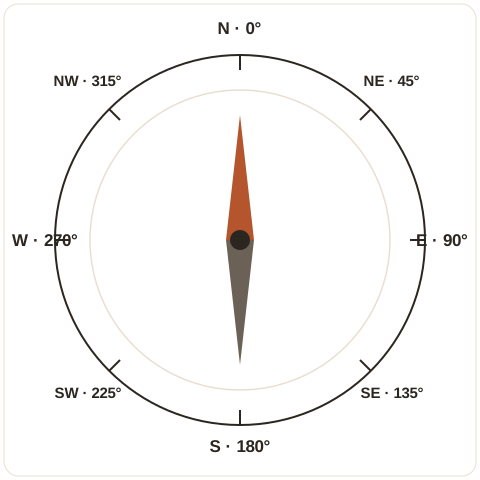
The two are always 180 degrees apart. A home facing South (170°) sits to the North (350°). A home facing East sits to the West. Once you know one, you know the other. The compass reading guide shows how to measure the facing direction; this article explains what to do with both numbers.
Why does the distinction matter? Because classical feng shui treats the two directions differently. Facing governs what comes into the home: light, air, visitors, and, in traditional language, opportunity. Sitting governs support: rest, stability, and protection. A home needs both — an open, welcoming face and a solid, protected back — and problems often come from getting the two mixed up.
How to find your facing direction
In most homes, the facing direction is the front door side. Stand at the front door facing outward and take a compass reading: that is your facing. But there are exceptions, and they are common enough to know:
- The daily-entrance rule. If you actually enter through a side door or garage door every day, and the formal front door faces a blank wall or is never used, the active entrance may be the true facing. Feng shui follows use, not formality: the "mouth of qi" is the door qi actually enters through.
- The view rule. In apartments and houses with a strong view — a river, a park, a city skyline — the facing may be the view side, even if the door is elsewhere. The face of a home is its most open, lively side.
- The light rule. The side with the most windows, the brightest rooms, and the most daytime activity is usually the facing side. A dark, blank front wall with a ceremonial door and a bright, busy garden side suggests the garden side is the face.
When the door, the view, and the light all agree, the answer is obvious. When they disagree, use the door you actually walk through most — that is the most defensible reading for home use, and it is the one most practitioners will accept.
What facing governs
Facing shapes everything about arrival and openness:
- The entryway. The facing side should be bright, clean, and welcoming. A blocked, dark, or unwelcoming facing side chokes the home's qi at the threshold. See the entryway guide.
- The front rooms. Living rooms and reception areas usually sit on the facing side, because they are the social, yang rooms. They should feel open and alive.
- The front door itself. Its color, condition, and surroundings are facing-side feng shui. Our front door color guide works through the choices.
- Annual stars on the facing side. When you lay out the 2027 flying stars, the stars on the facing side describe what is arriving at the home that year — for example, in 2027 the Southeast holds the 8 White and the Northwest the 1 White, both traditionally favorable sectors to keep active and well-lit.
What sitting governs
Sitting shapes everything about support and rest:
- The back of the home. Traditionally the sitting side wants protection: a solid wall, a hill, a taller building behind — the "support" that classical texts call the Black Tortoise. In a modern home, that means the back should feel solid and sheltered, not exposed or open to a busy road.
- The main bedroom. The bedroom usually sits toward the back of the home, and the bed itself follows the same logic: a solid wall behind the headboard, a view of the door. The bedroom guide explains why this feels safe.
- Your desk and seating. The same principle at furniture scale: sit with a solid wall behind you and a view of the room in front. This is the "command position," and it is sitting-side logic applied to a chair.
- Quiet and storage. The sitting side suits yin rooms: bedrooms, studies, storage. If the back of your home is noisy or chaotic, the whole home feels unsupported.
A useful shorthand: facing is yang (active, open, social), sitting is yin (quiet, solid, restful). The yin-yang guide explains that balance in room terms; facing and sitting are the same balance at the scale of the whole home.
Common facing-sitting mistakes
Mistake 1: Using the street address side by default. The postal front of a house is not always its feng shui face. Check the door you use, the view, and the light before deciding.
Mistake 2: Putting the bedroom on the facing side. A bedroom over a busy street-facing front, with traffic noise and headlights, is a sitting room in a facing position. If you cannot move the bedroom, strengthen the sitting side within the room: heavy curtains, a solid headboard wall, and quiet at night.
Mistake 3: Leaving the sitting side exposed. A back wall that is mostly glass facing a busy road, or a bedroom with the bed floating in the middle of the room, leaves the home — and the sleeper — without support. Add solidity: a wall, a tall bookcase, a solid headboard.
Mistake 4: Treating facing as the only direction that matters. Many beginner guides mention only facing. But a home with a beautiful face and a weak back feels like a stage set: impressive on arrival, unsupportive to live in. Both directions deserve attention.
Putting it together: a quick exercise
Take your compass reading at the front door and write down the facing direction. Add 180 degrees for the sitting direction. Then walk your home with two questions: does the facing side feel open, bright, and welcoming? Does the sitting side feel solid, quiet, and protected? If both answers are yes, your home's basic orientation is sound. If one side fails, you have found your next project — and the room guides on this site will show you how to fix it, starting with the entryway for the face and the bedroom for the back.
Facing and sitting are the frame that every other compass technique hangs on. The bagua, the elements, and the annual stars all make more sense once you know which way your home looks and which way it rests. Get those two numbers right, write them on your floor plan, and the rest of classical feng shui becomes much easier to use.
Go deeper with the book
Feng Shui Made Simple explains facing, sitting, and the compass in plain English, then walks every room in your home with the full rules, 9 original diagrams, and a 7-day reset plan.
Frequently asked questions
What is the difference between facing and sitting?
Facing is the direction the front of your home looks toward — usually the front door side, or the side with the most light, view, and activity. Sitting is the opposite direction: the back of the home, where it rests. They are always 180 degrees apart.
Is the facing direction always the front door?
Usually, but not always. Facing follows the most active, open side of the home — the side with the main view, the liveliest street, or the most windows. If your daily entrance is a side door and the formal front door faces a blank wall, the active side may be the true facing.
Which direction matters more?
Neither on its own. Facing governs what comes in — light, visitors, opportunities — so it shapes the entry and the front rooms. Sitting governs support and rest, so it shapes the back of the home, the main bedroom, and where you need a solid wall behind you.
How do I find my home's facing and sitting?
Take a compass reading standing at your front door facing outward. That is the facing direction. Add or subtract 180 degrees to get the sitting direction. A home facing 170 degrees (South) sits to the North.