Feng Shui Front Door Color by Direction
In feng shui, your front door is called the mouth of qi (pronounced "chee") — the place where energy enters your home. Everything else in the house depends on what comes through that door, so the entry deserves more attention than any other single spot. And one of the simplest ways to tune it is color.
Color is not decoration here. In the five elements system, every color carries an element: red is Fire, green is Wood, blue and black are Water, yellow and brown are Earth, white and metallic tones are Metal. Every compass direction also belongs to an element. When the door's color matches or supports its direction's element, the entry feels coherent and welcoming. When it clashes, the entry can feel subtly off — not disastrous, just less settled.
Before you buy paint, get one fact right: your door's direction is the direction you face when you stand in the doorway looking out of the house. Not the direction the house faces on a map, not the street direction — the direction you face walking out. Use a phone compass, step away from metal railings, and note the reading. That is the number this whole guide turns on.
The five elements in one minute
Wood feeds Fire. Fire creates Earth (ash). Earth produces Metal. Metal collects Water. Water nourishes Wood. That is the supporting cycle: each element strengthens the next. There is also a controlling cycle, where each element restrains another — Water puts out Fire, Fire melts Metal, and so on. For door colors, the rule of thumb is simple: pick a color from your direction's own element, or from the element that feeds it. Avoid colors from the element that controls it, at least for the whole door.
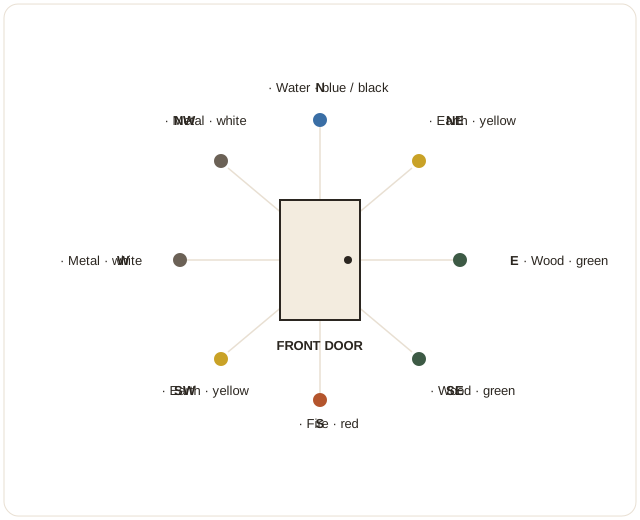
If this sounds abstract, the colors guide gives the full palette with examples. Here, we go direction by direction.
North-facing doors: Water
North belongs to Water. Best colors: black, navy blue, and deep blue. These are calm, deep, and inward — the feeling a north entry should give. Metal colors also work well, because Metal feeds Water: white, silver, and soft grey are good supporting choices. Avoid heavy Earth colors (yellow, brown) across the whole door, since Earth dams Water. A black door with a silver handle and a blue-grey doormat is a classic north entry, and it looks good on almost any house.
South-facing doors: Fire
South belongs to Fire, and this is the one direction where the famous red door truly belongs. Red, burgundy, coral, orange, and bright pink all suit a south-facing door. Wood colors support Fire too, so greens and warm browns work as accents or as a second choice. Avoid Water colors (black, dark blue) for the main door, since Water puts out Fire. A south-facing red door is the most traditional feng shui image there is — visible, warm, and inviting, exactly what an entry should be.
East and southeast-facing doors: Wood
East and southeast both belong to Wood, the element of growth and new beginnings. Best colors: greens of every shade, from sage to forest, plus warm browns and natural wood tones. Water colors support Wood, so blues and black work as accents. Avoid Metal colors (white, silver, grey) for the whole door, since Metal cuts Wood. A green door with wooden planters on either side is the textbook east entry — and it practically maintains itself visually, because plants belong here too.
West and northwest-facing doors: Metal
West and northwest belong to Metal: precision, clarity, and structure. Best colors: white, cream, silver, grey, and metallic finishes. Earth colors support Metal, so yellows, beige, and light brown are good second choices. Avoid Fire colors (red, bright orange) across the whole door, since Fire melts Metal. A crisp white or soft grey door with a metal handle and clean lines suits a west entry beautifully — and it photographs well, which never hurts curb appeal.
Southwest and northeast-facing doors: Earth
Southwest and northeast belong to Earth: stability, nourishment, and groundedness. Best colors: yellow, ochre, beige, terracotta, and warm browns. Fire colors support Earth, so reds and oranges work as accents — a terracotta pot by a beige door, for example. Avoid Wood colors (green) for the whole door, since Wood breaks up Earth. These entries should feel solid and settled, like the ground itself: warm tones, substantial planters, a door that looks like it belongs to the house rather than floating on it.
What matters more than color
Color is the finishing touch, not the foundation. Before you repaint, check the entry basics. Is the path to the door clear and easy to walk? Does the door open fully, without sticking or hitting clutter? Is there light at night — a porch light that actually works? Is the doorbell working, the number visible, the doormat clean? A red south door behind an overgrown path and a broken light is worse than a "wrong" color on a welcoming entry. Fix the basics first; they carry most of the effect.
Also keep the door itself in good shape. A door that squeaks, sticks, or has peeling paint sends a daily message of neglect, and you walk through that message every time you come home. Oil the hinges, tighten the handle, touch up the paint. Small maintenance is real feng shui, not just housekeeping.
If you cannot repaint
Renters, apartment dwellers, and anyone in a building with strict rules can still use direction color. Put the color next to the door instead of on it: a doormat, a planter, a wreath, a hanging decoration, or a painted pot in the direction's color all count. A north-facing apartment door with a navy doormat and a silver-framed house number is doing the same work as a navy door. The renters guide has more ideas in this spirit — feng shui that leaves no trace when you move out.
One more practical note: if you love a color that clashes with your direction, use it as an accent rather than the whole door. A red wreath on a west-facing white door gives you the warmth you want without repainting the whole entry against its element. Feng shui is a system of tendencies, not a set of traffic laws. Your home should feel like yours first, and harmonious second.
Start with the compass reading, pick from your direction's colors, and check the entry basics while you are out there. Then step back and look at the door the way a guest would. If it looks welcoming, clean, and easy to find, you have done the most important part — whatever shade it happens to be. For the full room-by-room picture, the bagua map shows how each direction shapes the whole house.
Go deeper with the book
Feng Shui Made Simple covers the entry, every room, and the five elements with diagrams and a 7-day plan for doing the whole house.
Frequently asked questions
How do I find my front door's direction?
Stand in your doorway facing out of the house, and read a compass. The direction you are facing is your door's direction. A phone compass works fine — just step away from large metal objects first.
What if my door color is wrong for its direction?
Nothing terrible happens. Color is one layer among many. A clean, well-lit, welcoming entry matters more than any single color. If you cannot repaint, use the right color in a doormat, a planter, or a wreath instead.
Can I paint my front door red?
Red suits south-facing doors best, since south belongs to the Fire element. On other doors it can still work as an accent, but a full red door facing north, for example, fights the Water energy of that direction.
Does door color matter more than the entry itself?
No. A clear path to the door, a working doorbell, good lighting, and no clutter blocking the entrance matter far more. Fix those first, then fine-tune the color.
What about apartment doors and rented homes?
Use removable color instead: a doormat, a painted planter, a door wreath, or a hanging decoration in the direction's color. See the renters guide for more no-renovation ideas.