Feng Shui Bedroom: 10 Rules for Better Sleep
Your bedroom has one job: rest. Not work, not scrolling, not folding laundry while half-watching a show, not serving as overflow storage for the rest of the house. In feng shui terms, the bedroom should be the most yin room in your home — quiet, dark, still, and calm.
This matters more than any other room, for a simple reason: you spend roughly a third of your life here, unconscious and defenseless. Sleep researchers will tell you what feng shui has always claimed — that the sleep environment shapes sleep quality, and sleep quality shapes everything: mood, immunity, memory, patience, even how you treat people the next day.
Most bedrooms fail at rest. They double as offices, gyms, and storage units. Every non-sleep thing in the room adds a little yang buzz — light, noise, visual clutter, mental association — that your body registers even when your mind has tuned it out. You can't willpower your way past a bad sleep environment. But you can fix the environment, usually in an afternoon.
The ten rules below will do that. None of them cost money. All of them work from the first night.
The 10 rules
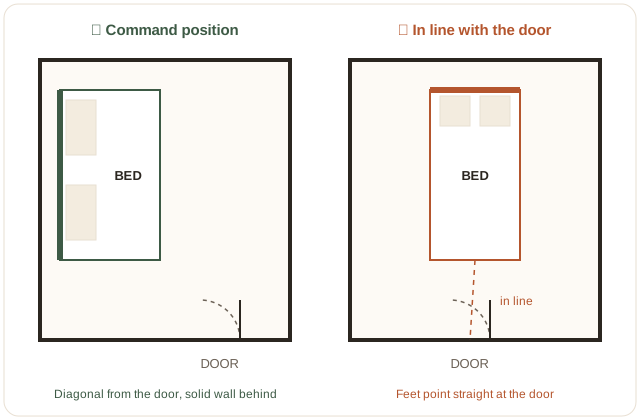
1. Put your bed in the "command position." Place your bed where you can see the door, but not directly in line with it. When you can see who's coming in, your body relaxes — you sleep deeper. That's the whole idea behind most feng shui rules: feeling safe.
2. Give your bed a solid wall. The head of your bed should rest against a solid wall, not under a window. A wall behind you means support and stability. A window behind you means your energy — and your sleep — leaks out.
3. Clear out under the bed. Qi (pronounced "chee") is the energy that flows through a space, and it needs to move freely. Boxes and clutter under the bed block that flow. As a bonus, it's just cleaner.
4. No mirrors facing the bed. Mirrors bounce energy around the room. In feng shui, a mirror reflecting your bed keeps the room's energy restless — and restless energy means restless sleep. Move it, cover it at night, or angle it away. (The full version, with three fixes, is on the mirror facing bed page.)
5. Keep work out. No desk staring at your bed, no laptop glowing on the pillow. Your bedroom should hold one kind of energy: rest. Mixing in work stress is like trying to sleep in your office.
6. Think in pairs. Two nightstands, two lamps, two pillows. Pairs symbolize partnership and balance. Even if you sleep alone, symmetry tells your brain the room — and your life — is in order.
7. Choose calm colors. Soft blues, gentle greens, warm neutrals. These are "yin" colors — quiet and restful. Bright red is beautiful but stimulating; save it for small accents, not the whole wall. See the colors cheat sheet for the full palette.
8. Fix what's broken. A squeaky door, a flickering lamp, a wobbly nightstand. In feng shui, broken things mean stuck energy. In real life, they just slowly drive you crazy. Either way — fix them.
9. Close the door at night. An open bedroom door lets energy — and your sense of privacy — drain out. Close it, and the room holds its calm in.
10. Go easy on plants. One or two soft-leaf plants are lovely. But plants are active, growing "yang" energy, and a bedroom should be mostly calm "yin." Skip the spiky cacti — they add sharp, restless energy where you least want it.
The bed itself
Feng shui cares about placement, but don't neglect the bed itself — it's the single most-used object in your home. The mattress should support you properly. A sagging, decade-old mattress undermines everything else in this guide. You don't need the most expensive one; you need one that doesn't hurt. If a new mattress isn't in the budget, a good topper is a genuine upgrade.
The bedding should feel good against your skin and look calm to your eyes. Natural fibers breathe better. And change the sheets weekly — fresh bedding is instant yin energy, clean and quiet and new. A solid headboard (wood or upholstered) gives the "solid wall" feeling even when the wall is far. A metal-bar headboard or no headboard at all feels less grounded — fine for a guest room, not ideal for your nightly eight hours.
Common bedroom mistakes
- The TV at the foot of the bed. It's the work-desk problem in entertainment form: yang buzz (light, noise, stories) pointed directly at where you sleep. If it must stay, cover it at night — a simple cloth works — and set a real off-time, not "one more episode."
- The phone as alarm clock. Which means the phone lives on your nightstand, glowing, buzzing, and inviting one last scroll. A ten-dollar alarm clock is the highest-ROI sleep purchase in existence. Charge the phone outside the bedroom.
- Exercise equipment. The treadmill in the bedroom is a monument to good intentions and bad energy. If it must live there, cover it at night — out of sight really does help it stay out of mind.
- Harsh overhead lighting. Bedrooms need lamps, not floodlights. Put the overhead on a dimmer or stop using it after dinner. Your evening light should step down gradually, the way the sun does.
- Too many photos of other people. A bedroom full of family photos and friends' faces is lovely socially but busy energetically. Keep the bedroom's imagery calm and romantic — this room is about you (and your partner), not the whole extended network.
Small bedrooms and shared bedrooms
Small bedrooms follow the same rules, just tighter. Prioritize in this order: command position first (even approximate), then clear under-bed, then no mirror facing the bed. In a tiny room, every change is magnified — which means small fixes pay off fast.
Kids' bedrooms want slightly more yang than adult ones — children are growing, active energy. Keep the command position and the calm colors, but allow the toys, the bright art, the creative chaos (contained, not eliminated). A kid's room should feel safe and alive.
Shared bedrooms (roommates, siblings) need one extra thing: a defined personal zone each. Even just "my side" with a personal lamp and a small shelf gives each person energetic ownership. Shared rooms without personal zones breed low-grade tension nobody can name.
Yin and yang, in one sentence: yang is active energy (daylight, noise, movement), yin is quiet energy (darkness, stillness, rest). A bedroom should lean yin. That's it — that's the whole theory behind this guide.
Start tonight: pick the two rules your bedroom breaks most obviously, and fix them. Move the mirror. Clear under the bed. Put the phone in the kitchen. You'll feel the difference before you fully understand it — which is exactly how feng shui is supposed to work. When the bedroom is done, the same thinking applies to the rest of the house — see the living room guide and the kitchen guide.
Go deeper with the book
Feng Shui Made Simple covers every room this way — bedroom, living room, kitchen, office, entryway — with diagrams and a 7-day plan for doing the whole house.
Frequently asked questions
What is the command position for a bed?
The bed goes where you can see the door from the pillow, but are not directly in line with it. Seeing who enters lets your body relax, which is the whole point: you sleep deeper when you feel safe.
Why should a mirror not face the bed?
Mirrors bounce light and movement around the room. In feng shui, a mirror reflecting the bed keeps the room's energy restless, and restless energy means restless sleep. Move it, cover it at night, or angle it away.
What colors are best for a bedroom?
Soft blues, gentle greens, and warm neutrals — quiet yin colors. Bright red is stimulating; save it for small accents, not the whole wall.
Can I have a TV in the bedroom?
It is better not to. A TV is light, noise, and stories pointed at where you sleep. If it must stay, cover it at night with a cloth and set a real off-time.
What if my bedroom is tiny?
The same rules apply, just tighter. Prioritize in this order: command position first (even approximate), then clear under the bed, then no mirror facing the bed. In a tiny room, every change is magnified.