Five Elements in Feng Shui: Wood, Fire, Earth, Metal, Water
Feng shui describes the world through five elements. Don't think of these as literal substances. Think of them as five flavors of energy, each with its own colors, shapes, materials, and mood.
The five, one by one
Wood — growth
Wood is the energy of spring: plants, green colors, tall columnar shapes, the feeling of things pushing upward. It brings vitality and fresh starts. In a room, Wood shows up as living plants, wooden furniture, green and teal tones, and vertical stripes or columns. Best for: home offices, living rooms, anywhere you want fresh thinking and momentum.
Fire — excitement
Fire is the energy of celebration: candles and sunlight, reds and oranges, triangular shapes, the feeling of a gathering. It brings passion and visibility. In a room, Fire shows up as lamps and candles, red and coral accents, pointed shapes, and animal prints. Best for: dining areas, living rooms, the Fame area of the bagua map. Use with restraint — Fire is the most powerful element, and too much of it agitates instead of energizing.
Earth — stability
Earth is the energy of solid ground: stone and clay, yellows and browns, square shapes, the feeling of being held. It brings calm and reliability. In a room, Earth shows up as ceramics, stone, square rugs and cushions, and sandy, beige, and chocolate tones. Best for: bedrooms (soft versions), living rooms, entryways — anywhere you want people to feel settled.
Metal — clarity
Metal is the energy of a crisp morning: white and gray, round shapes, clean lines and reflective surfaces. It brings focus and precision. In a room, Metal shows up as white walls, gray textiles, round mirrors, metallic frames, and uncluttered surfaces. Best for: offices, bathrooms, study areas — anywhere clarity matters. Too much Metal feels cold and sterile, like an operating room — balance it with Wood or Earth.
Water — flow
Water is the energy of a quiet lake: blues and black, wavy and irregular shapes, mirrors and glass. It brings calm depth and reflection. In a room, Water shows up as navy and sky blue, black accents, glass, mirrors, and flowing fabrics. Best for: bedrooms, bathrooms, meditation corners — anywhere rest and reflection matter.
How the elements relate: two cycles
The elements aren't a list; they're a system. Two cycles govern how they interact, and once you know them, you can fix almost any room.
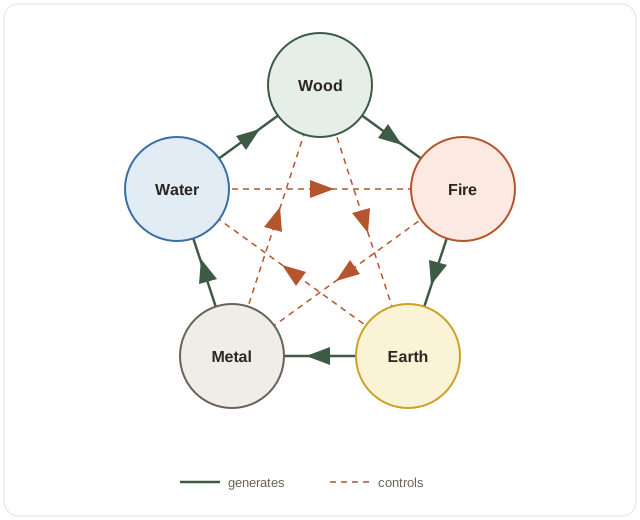
The generating cycle (each element feeds the next): Water feeds Wood (water grows plants), Wood feeds Fire (wood burns), Fire feeds Earth (ash becomes soil), Earth feeds Metal (ore comes from the earth), Metal feeds Water (metal collects condensation — or, in the old image, a metal vessel holds water).
Use the generating cycle when you want to strengthen an element: add its feeder. A creativity corner that needs more Metal? Add Earth tones — Earth produces Metal. A wealth area that wants more Wood? Add Water — Water feeds Wood.
The controlling cycle (each element checks another): Water controls Fire (water puts out fire), Fire controls Metal (fire melts metal), Metal controls Wood (an axe cuts a tree), Wood controls Earth (roots break soil), Earth controls Water (a dam holds a river).
Use the controlling cycle when you want to calm an element that is too strong. A room that feels too fiery — all red, all buzz — calms down with Water colors and shapes. A cold, all-white, all-metal office warms up with Fire accents. This is also the logic behind the classic cures: the 2027 Five Yellow star is Earth energy, and its traditional cure is Metal — because Earth produces Metal, so Metal quietly drains it. (See Five Yellow in the North 2027 for the full version.)
Using the elements in a real room
Start with the room's job, not with a shopping list. Ask: what should this room feel like?
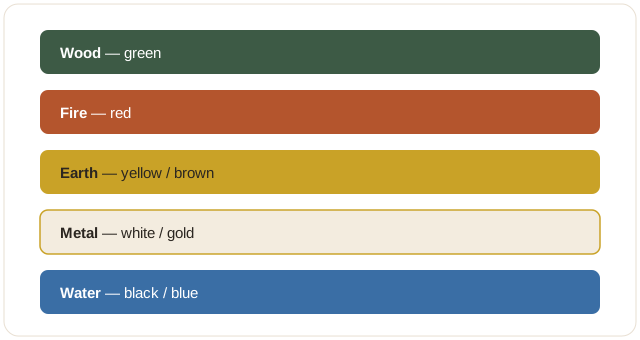
- Bedroom: restful — lean Water and soft Earth. Dusty blues, warm neutrals, gentle sage. (The full rules are in the bedroom guide.)
- Home office: alert and growing — lean Wood and Water. Greens and blues, a plant on the desk, a clear surface.
- Living room: welcoming and lively — an Earth base with Wood and Fire accents. Beige or warm gray walls, a green plant, terracotta pillows.
- Kitchen: nourishing — Earth and gentle Fire. Warm yellows, soft oranges, creamy whites. (And mind the fire-water clash at the stove and sink.)
- Bathroom: clean and flowing — Water and Metal. Blues, whites, sea-glass tones.
Then check the balance. A room dominated by a single element feels off in a specific way: all Fire feels agitated, all Metal feels sterile, all Water feels gloomy, all Earth feels heavy, all Wood feels restless. The fix is rarely to remove the dominant element — it's to add a little of its controller or its child in the cycle. One plant in a gray office. One blue vase in a red dining room. Small doses, big shifts.
The color version of this whole system — palettes, room-by-room color picks, and the 80/15/5 rule for how much of each color to use — is on the Feng Shui Colors Cheat Sheet.
Go deeper with the book
Feng Shui Made Simple turns the five elements into a room-by-room decorating system, with the color chart, the bagua overlays, and a 7-day plan for applying it all to your home.
Frequently asked questions
Are the five elements literal substances?
No. Wood, Fire, Earth, Metal, and Water are categories of energy and feeling — growth, excitement, stability, clarity, and flow. A wooden table carries Wood energy, but so does a green wall or a tall plant.
Which element should dominate my home?
No single one. A balanced home has all five, with each room leaning toward the element that matches its job: Wood and Water in an office, soft Earth and Water in a bedroom, warm Earth in a kitchen.
How do I weaken an element that is too strong?
Use the controlling cycle: Water controls Fire, Fire controls Metal, Metal controls Wood, Wood controls Earth, Earth controls Water. A room that feels too fiery calms down with Water colors and shapes; a room that feels too cold and metallic warms up with Fire accents.
Do I need to know my personal element?
No. Personal-element systems exist, but they are not needed for home feng shui. Room function and the five-element balance will take you all the way.