How to Take a Compass Reading in Your Home
Classical feng shui runs on directions. Before you can lay out the flying stars, find your wealth sector, or even say which way your home "faces," you need one number: a compass reading. Here is how to get one you can trust, with a phone or a traditional compass.
What a compass reading gives you
A compass reading tells you your home's facing direction — the direction the front of the home looks toward, measured in degrees. That single number unlocks the Compass School side of feng shui: it tells you which compass sector each room sits in, which way is your facing versus your sitting direction, and where the annual flying stars land in your home for a given year.
It does not require a Luo Pan. The Luo Pan is the traditional professional instrument, and it is beautiful, but a phone compass gives you the same facing direction, which is all you need for home use. Professionals use the Luo Pan for finer divisions — the 24 mountains, the precise degree bands — but a home reading to the nearest few degrees is enough for the annual stars and the room layout.
One caution: a compass reading is only as good as its conditions. Metal, electronics, and reinforced concrete all bend magnetic readings. Most "wrong" readings are not wrong technique — they are interference. The method below is designed to catch that.
Step 1: Calibrate your compass
If you are using a phone, calibrate first. On most phones, open the compass app and move the phone in a figure-eight motion a few times until the app confirms calibration. Do this away from metal — outside, or in the middle of a room, not next to the fridge.
Remove a magnetic phone case if you have one. Cases with magnetic mounts or card holders are the single most common cause of bad readings. Also take off a magnetic watch band, and empty your pockets of keys while you measure.
Step 2: Stand in the right place
Stand outside your front door, on the threshold line, with your back to the house and your body facing outward — the same direction the home faces. Hold the compass flat and steady at waist height, and read the direction you are facing. This is your facing direction.
If you cannot stand outside — an apartment with a shared corridor, for example — stand just inside the front door, facing out through it, with the door open. The reading should be nearly the same. Avoid standing in the doorway itself if the door is steel; step just outside or just inside instead.
For apartments, use the building's main entrance as a secondary reference, but your own front door is what counts for your unit. The floor plan guide shows how to record the reading on your sketch once you have it.
Step 3: Take three readings and average them
Take a reading at the front door, then step a few paces to the left and take another, then a few paces to the right and a third. If all three agree within a few degrees, you have a good reading. If they disagree wildly, something nearby is interfering — move further from the building, or try the back of the house and reverse the number by 180 degrees.
Take a cross-check reading inside, standing at the door facing out. It should match the outdoor reading within a few degrees. If the indoor reading is very different, trust the outdoor one: indoor steel, wiring, and appliances are the usual culprits.
Write the number down immediately, with the date. A reading like "facing 170° (South)" is what you want. Note it on your floor plan sketch — it will anchor every compass-based analysis you do later.
Step 4: Convert degrees to a direction
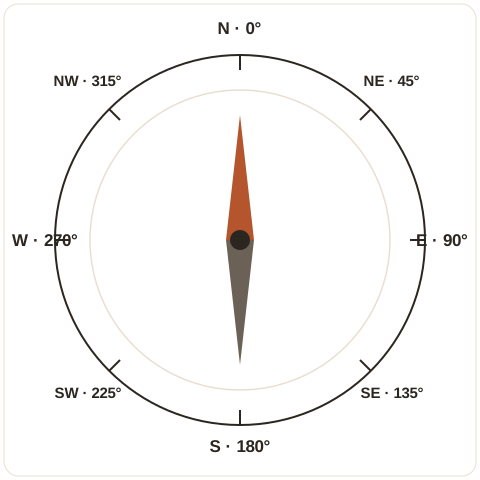
Feng shui divides the compass into eight sectors of 45 degrees each:
| Direction | Degrees |
|---|---|
| North | 337.5° – 22.5° |
| Northeast | 22.5° – 67.5° |
| East | 67.5° – 112.5° |
| Southeast | 112.5° – 157.5° |
| South | 157.5° – 202.5° |
| Southwest | 202.5° – 247.5° |
| West | 247.5° – 292.5° |
| Northwest | 292.5° – 337.5° |
So a facing of 170° means your home faces South. Your sitting direction — the opposite side, where the back of the home is — is 180 degrees away, in this case North. The facing vs sitting guide explains why both matter and which one to use for what.
Common traps
Steel front doors. Stand a step back from the door, not pressed against it. A steel door can pull a needle 10–20 degrees.
Reinforced concrete and underground parking. If your building sits over a car park or has heavy steel framing, outdoor readings may still wobble. Take readings from several spots around the building and use the most consistent one.
Electronics in your hand. Holding a second phone, a tablet, or a laptop while measuring will skew the result. One device, held flat, nothing else in your hands.
Measuring from the wrong door. Use the door you actually enter through most often — the "mouth of qi." In many homes that is a side or garage door, not the formal front door. If your daily entrance is the side door, measure there.
Forgetting the reading. It sounds trivial, but a reading scribbled nowhere is a reading lost. Write it on the floor plan sketch, in your phone notes, or both. Every future feng shui job in that home starts from this number.
What to do with your reading
Once you have a facing direction, three things open up. First, you can lay the compass-based bagua over your home — the eight directions instead of the door-oriented grid — and see which life area each room truly occupies. Second, you can place the annual flying stars: for 2027, for example, you would put the 5 Yellow in the North sector of your home and the 8 White in the Southeast, following the 2027 chart. Third, you can analyze facing versus sitting, which shapes advice about the entry, the main rooms, and the back of the home.
None of this requires perfection. A reading within five degrees is fine for home use. The classical texts argue over single degrees; your home does not need that precision. What it needs is a consistent, honest number, taken carefully, and written down. That is a compass reading done right.
Go deeper with the book
Feng Shui Made Simple walks you through the compass reading, the floor plan, and the bagua step by step, with 9 original diagrams and a 7-day reset plan for putting the whole system into practice.
Frequently asked questions
Can I use my phone compass for feng shui?
Yes, for most home use. A phone compass is accurate enough for finding your home's facing direction and laying out the annual flying stars. Calibrate it first, take several readings, and step away from metal objects and electronics.
Why do my compass readings keep changing?
Usually metal interference: steel doors, appliances, reinforced concrete, wiring, or a phone case with a magnet. Move a few steps, remove the case, and take readings in two or three spots, then average them.
Where exactly do I stand to take a reading?
Stand outside your front door, facing out along the direction the home faces, with your back to the house. Take a second reading inside the doorway as a cross-check. The two should be close.
Do I need a Luo Pan for a basic reading?
No. A Luo Pan is the traditional professional tool, but a phone compass gives you the facing direction, which is all you need for the bagua by compass, the annual flying stars, and the facing-versus-sitting analysis.