Crystals in Feng Shui: Amethyst, Citrine, and Clear Quartz
Crystals are where feng shui meets the gift shop, and the gift shop usually wins. Walk into a crystal store and every stone promises something: wealth, love, protection, healing, confidence, sleep, all for the price of a polished rock. Strip away the marketing, and a calmer truth remains. In feng shui, crystals are used the way color is used — by their color and their element — as beautiful, deliberate objects that mark a room's purpose. A purple stone in a quiet corner says "this is a calm place." A golden stone on a desk says "this is a place for focused work." That is a real, modest effect, and it is enough. This guide covers the three most common feng shui crystals — amethyst, citrine, and clear quartz — what each is traditionally used for, where each goes, and what none of them can do.
One framing note first: in classical feng shui, crystals are a modern addition, not an ancient core cure. The classic cures are placement, light, sound, water, and metal — the subjects of our other guides. Crystals entered feng shui largely through the Western, bagua-based school, which maps stones to sectors by color. Treat crystal claims accordingly: useful as decoration and intention, not as medicine or magic.
How crystals are actually used: color and element
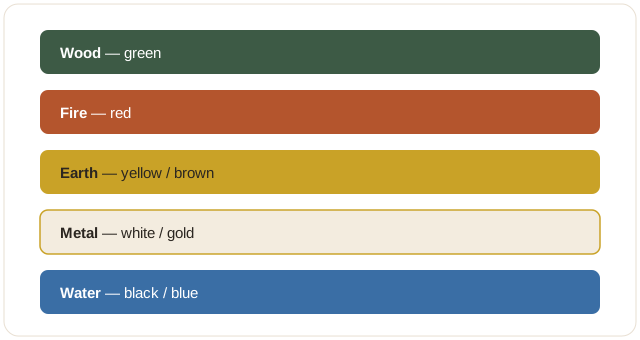
The feng shui logic for crystals runs through color, and color runs through the five elements. Purple is a Fire color; golden yellow is an Earth color; clear and white are Metal colors. So amethyst, being purple, carries a Fire association; citrine, golden yellow, carries an Earth association; clear quartz, being colorless, is treated as neutral — it does not push any element strongly, which is why it is called a general-purpose stone. Our colors guide and five elements guide lay out both mappings, and crystal placement follows from them rather than from the stone's supposed powers.
That color logic also explains where crystals go. The bagua map — North Career and Water, Northeast Knowledge and Earth, East Health and Family and Wood, Southeast Wealth and Wood, South Fame and Fire, Southwest Love and Earth, West Creativity and Children and Metal, Northwest Helpful People and Metal, Center Wellbeing and Earth — gives each sector a color family. A stone whose color matches the sector's element harmonizes with it; a stone whose color clashes with it, used in large quantity, can feel visually jarring even if you do not believe in elements at all. The bagua guide shows the full map.
Amethyst: the calm stone
Amethyst is purple quartz, ranging from pale lilac to deep violet, and it is traditionally the stone of calm and clarity. Its purple color links it to Fire in the five-element color system, but its traditional use is quieter than Fire usually suggests: bedrooms, meditation corners, and study areas, where the goal is a settled mind rather than excitement. A small amethyst cluster on a bedside table or a study shelf marks that spot as a calm zone, and the stone's deep color is visually restful in a way a bright red object would not be.
Placement follows that purpose. In a bedroom, an amethyst on the bedside table or a dresser suits the room's yin character — see our bedroom guide for the wider calm. In a study or the Northeast Knowledge sector, an amethyst on the desk or a shelf marks the learning zone. Avoid placing a large, dramatic amethyst geode in a room that needs energy, like a home gym — its visual weight pulls the room toward stillness, which is the opposite of what a gym needs.
Care is easy but has one caution: amethyst fades in prolonged strong sunlight. A windowsill that gets direct afternoon sun will bleach a deep purple stone to a pale grey over months. Keep amethyst out of direct sun, dust it with a soft cloth, and do not soak it in harsh cleaners. A faded amethyst is not "dead" in any meaningful sense, but it is less beautiful, and beauty is the point.
Citrine: the warm stone
Citrine is golden-yellow quartz — natural citrine is pale gold, while much of what is sold as citrine is heat-treated amethyst in a deeper amber — and it is traditionally the stone of warmth, focus, and welcome. Its yellow color links it to Earth, the element of stability and nourishment, and its traditional placements follow: the home office, where focused work happens; the Southeast Wealth sector, where a warm, bright accent suits the room's purpose; and near the front door, where a welcoming object sets the tone for arrivals. Our home office guide and Southeast wealth guide cover those rooms.
Citrine's practical strength is that yellow is a naturally cheerful, attention-holding color. A citrine on a desk catches the eye without shouting, and in a dim office or hallway it adds a point of warmth that a grey or white object would not. That is why citrine suits workspaces better than bedrooms: in a bedroom, a bright golden accent can feel too alert for sleep, while on a desk it feels appropriately awake.
The wealth claim deserves a plain word. Citrine is marketed as a "money stone" more aggressively than any other crystal, and the claim should be treated as marketing. A citrine on your desk will not bring clients, raise prices, or change your income. What it can do is mark your workspace as a place you take seriously — and a workspace you take seriously is one you are more likely to sit down in and work at. The work brings the income; the stone, at most, reminds you to do the work.
Clear quartz: the neutral stone
Clear quartz is colorless, transparent quartz — the plainest-looking of the three, and the most versatile. Because it has no strong color, tradition treats it as neutral: it does not push any element hard, so it suits any sector without clashing. That makes it the safe choice when you like the look of crystals but do not want to think about elemental matching, and the practical choice for a room whose color scheme is already settled.
Clear quartz's real gift is light. A clear crystal on a windowsill or near a lamp catches and throws light in a way no opaque object can — small rainbows on a wall in morning sun, a bright point on a dark shelf. That light effect is the same principle as our light guide and mirrors guide: brightening a dark corner changes how a room feels, and a crystal is one small way to do it. In a dark hallway or a dim corner of a living room, a clear quartz cluster near a light source adds brightness without adding a lamp.
Clear quartz is also the hardest-working decorative stone because it goes with everything. It does not compete with artwork, furniture, or other colors, and a single clear point on a shelf looks intentional without looking themed. If you buy one crystal, buy clear quartz — not because it is powerful, but because it is the least likely to look wrong anywhere.
Buying, placing, and the honest limit
Buy small and buy what you like looking at. A palm-sized cluster or a single polished point is enough; a shelf of twenty stones is a collection, not a cure, and a collection needs dusting more than it needs meaning. Check that the stone is stable where you put it — crystal clusters are top-heavy and a falling cluster can chip a table or break a toe — and keep crystals out of reach of small children, who will mouth them.
On "cleansing and charging": tradition offers many methods — rinsing in water, sunlight, moonlight, burying in salt — and if a ritual helps you treat the object as intentional, it does no harm, with two practical cautions. Some stones fade in sun (amethyst) and some are damaged by water or salt, so check the specific stone before soaking or sunbathing it. The useful core of the ritual is simpler: clean the crystal when you clean the room, and place it deliberately rather than tossing it on a shelf. Intention plus housekeeping covers most of what the ritual claims.
And the limit, plainly: crystals do not bring wealth, heal illness, attract love, or protect a home. They are beautiful stones with traditional color associations, and their honest benefits are aesthetic and psychological — a prettier room, a more intentional corner, a small daily reminder of what a room is for. Those benefits are worth having. They are not worth paying miracle prices for, and any seller promising more is selling a story, not a stone.
Go deeper with the book
Feng Shui Made Simple covers every room this way — bedroom, living room, kitchen, office, entryway — with diagrams and a 7-day plan for doing the whole house.
Frequently asked questions
What is amethyst used for in feng shui?
Traditionally for calm and clarity: its purple color links it to the Fire element and to the center and south in some mappings, but in practice it is placed in bedrooms and study corners as a calm, beautiful object that marks a quiet zone.
What is citrine used for in feng shui?
Traditionally for warmth, focus, and a welcoming feeling, linked to the Earth element through its golden-yellow color. It is commonly placed in a home office, a wealth corner such as the Southeast, or near the front door as a warm, bright accent.
What is clear quartz used for?
Traditionally as a general-purpose stone for light and clarity: clear and colorless, it is said to suit any sector without adding a strong color or element. Practically, it catches light beautifully and works as a neutral, bright accent.
Do crystals need to be cleansed or charged?
Tradition says yes — rinsing, sunlight, or moonlight are common methods. Practically, the useful part is simpler: clean your crystals when you clean the room, and handle them gently. Some crystals fade in strong sun or are damaged by water, so check before soaking or sunbathing any stone.
Will crystals bring wealth or heal illness?
No. Crystals are decorative objects with traditional associations, not treatments and not guarantees. They can make a room more beautiful and more intentional, which is a real benefit — but anyone promising wealth or healing from a stone is overselling.