Feng Shui Colors Cheat Sheet: What Color for Each Room
Color is the most practical decorating tool in feng shui. Each element has colors associated with it. When you understand which colors carry which energy, you can tune any room's feeling without moving a single piece of furniture. New throw pillows become a feng shui adjustment. A different duvet cover becomes an energy shift.
This isn't about following rules rigidly. It's about having words for what you already sense: why the red dining room feels exciting, why the all-gray office feels dead, why the blue bedroom helps you sleep. Once you can name it, you can change it on purpose.
The five palettes, in detail
| Element | Colors | Energy | Best for |
|---|---|---|---|
| Wood | Greens, teals | Growth, vitality | Offices, living rooms |
| Fire | Reds, oranges, pinks, purples | Excitement, visibility | Dining areas, fame area |
| Earth | Yellows, beiges, browns | Stability, comfort | Bedrooms (soft), entryways |
| Metal | Whites, grays, metallics | Clarity, precision | Offices, bathrooms, study |
| Water | Blues, black (accent) | Flow, calm depth | Bedrooms, bathrooms |
Wood — greens and teals. The energy of growth and vitality. Think leafy green, sage, eucalyptus, teal, deep forest tones. Wood colors wake a room up gently — like spring, not like an alarm clock. They say "things are growing here."
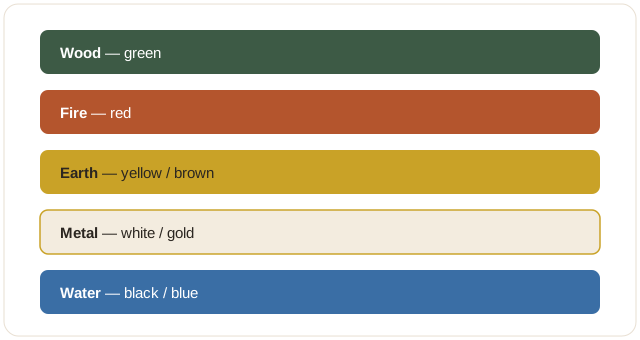
Fire — reds, oranges, pinks, purples. The energy of excitement and visibility. Think terracotta, coral, warm brick red, magenta, plum. Fire colors add passion, appetite, and social buzz. They say "look at me, gather round." Use with restraint — Fire is the most powerful element, and too much of it agitates instead of energizing.
Earth — yellows, beiges, browns. The energy of stability and comfort. Think sand, clay, warm beige, oatmeal, chocolate. Earth colors ground a room and make it feel safe and settled. They say "you can relax; nothing's going to surprise you."
Metal — whites, grays, metallics. The energy of clarity and precision. Think crisp white, soft gray, silver, champagne gold, brushed bronze. Metal colors sharpen a room and help thinking stay clean. They say "focus." Too much Metal feels cold and sterile, like an operating room — balance it with Wood or Earth.
Water — blues and black. The energy of flow and calm depth. Think navy, sky blue, slate, ink black (as accent). Water colors soothe a busy mind and slow a racing heart. They say "breathe."
The element theory behind these palettes — including how the elements feed and control each other — is on the Five Elements page.
Which room wants what
- Bedroom: Water and soft Earth — dusty blues, warm neutrals, gentle sage. Calm, yin, restful. This is the room where color mistakes cost you sleep. (See the bedroom guide.)
- Living room: Balanced — an Earth base (beige, warm gray) with Wood and Fire accents (green plant, terracotta pillows). Welcoming but lively, the social heart.
- Kitchen: Earth and gentle Fire — warm yellows, soft oranges, creamy whites. Nourishing and appetizing. (There's a reason fast-food chains use red and yellow — appetite colors. Use the homey versions.)
- Home office: Wood and Water — greens and blues. Growth plus calm focus. Avoid all-gray (draining) and all-red (agitating).
- Bathroom: Water and Metal — blues, whites, sea-glass tones. Clean, flowing, fresh.
- Entryway: Warm and bright welcomes everyone — soft yellow light, an Earth-toned rug, one lively accent. Or match the bagua area your entry falls in.
Notice the pattern: active rooms get active colors, restful rooms get restful colors. Yin and yang again — the whole system keeps rhyming, which means once you internalize it, you can improvise forever.
The front door color
The classic question deserves its own section: what color should my front door be?
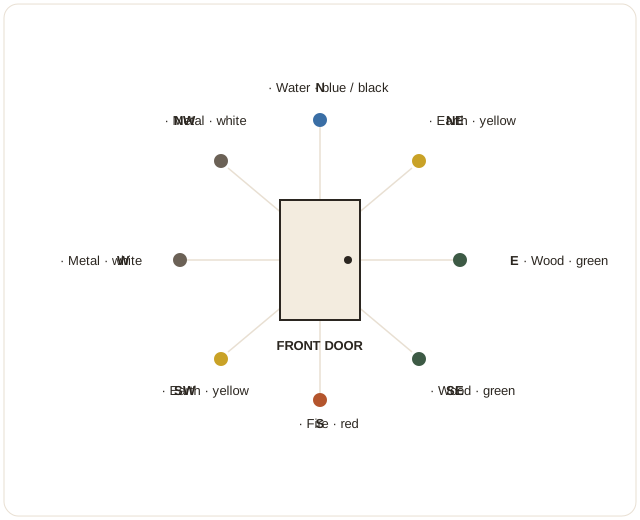
Traditional feng shui links door color to the direction the door faces: green for east (Wood), red for south (Fire), yellow for southwest (Earth), white for west (Metal), black or dark blue for north (Water). It's a lovely system, and if you know your door's direction, it's a fine guide.
But here's the practical truth: a well-maintained door in any color beats a peeling door in the "correct" one. A clean, freshly painted door — in a color you love, that stands out from the facade — does 95% of the work. Red doors are famous in feng shui because red is visible, welcoming, and bold — not because the color itself performs magic.
So: pick a color that makes you happy to come home to, keep it in good repair, and you've done the feng shui of front doors.
How much: the 80/15/5 rule
Here's where people go wrong: they learn that red means prosperity and paint an entire bedroom red. Or they read that blue is calming and drown the living room in navy. Don't do that.
- 80% — your base. Walls, large furniture, flooring. Keep these neutral and calm: whites, beiges, soft grays, warm wood tones. The base should never shout. It's the stage, not the actor.
- 15% — your supporting color. Curtains, rugs, bedding, the sofa. This is where the room's element color lives — the green bedding in a Wood-supporting bedroom, the terracotta rug in a Fire-warmed living room.
- 5% — your accent. Pillows, art, a vase, candles, a throw. This is where you can be bold — the Fire-red pillow, the Metal-gold frame, the Water-blue vase. Small doses, big impact.
A room done this way feels intentional but not themed. It whispers its energy instead of yelling it. And when your needs change — a new job, a new season, a new mood — you swap the 5%, not the sofa. That's the whole advantage: flexibility.
Ceilings and floors: the forgotten surfaces
Ceilings should almost always be white or very light. In feng shui terms, the ceiling is the "heaven" of the room — it should feel light and lifting, not pressing down. A dark ceiling can work in a cozy restaurant; in your home, it usually just feels heavy. When in doubt, white.
Floors are the "earth" — they should feel grounded and stable. Wood floors, warm-toned tile, rugs with substance. Cold, glossy, slippery-feeling floors subtly unnerve people. A good rug fixes most floor problems instantly — which is one more reason rugs are feng shui heroes.
Start with what you already own. Walk through your home and notice what colors dominate each room. Then ask one question: does this room's color story match its job? If not, change the 5% first. You'll be surprised how far a pillow can go.
Go deeper with the book
Feng Shui Made Simple includes the full color chapter with the original color-chart diagram, plus the bagua overlays that show which colors belong in which corner of your home.
Frequently asked questions
What is the best feng shui color for a bedroom?
Water and soft Earth tones: dusty blues, warm neutrals, gentle sage. These are quiet yin colors that support rest. Bright red belongs only in small accents in a bedroom.
What color should my front door be?
Tradition links door color to facing direction: green for east, red for south, yellow for southwest, white for west, black or dark blue for north. But a well-maintained door in any color you love beats a peeling door in the "correct" one.
What is the 80/15/5 rule in feng shui colors?
80% of a room is the neutral base (walls, large furniture), 15% is the supporting element color (curtains, rugs, bedding), and 5% is the bold accent (pillows, art, a vase). It keeps a room intentional without turning it into a theme park.
Can I repaint just one wall?
Yes — and you often don't even need paint. Swapping pillows, bedding, or a throw changes the 5% accent and shifts a room's feeling in an afternoon.