Home Gym Feng Shui: Energy for Movement
A home gym is the opposite of a bedroom. Where a bedroom should be yin — quiet, dim, and still — a gym should be yang: bright, open, and full of movement. That contrast is the whole point, and it is also why so many home gyms fail. Put energetic equipment in a dark corner, or squeeze a treadmill into a bedroom, and neither the workout nor the sleep works well. A good home gym is not about expensive machines. It is about clear space, good air, daylight, and a room you actually want to step into.
Most home gyms die from friction, not laziness. The mat is buried under boxes, the dumbbells are in another room, the space is so cramped that every exercise involves moving furniture first. Feng shui's answer is the same as a coach's: remove the friction. Make the room ready to use in thirty seconds, and you will use it. This guide covers layout, light, mirrors, color, and the one rule that protects your sleep.
Clear floor first, equipment second
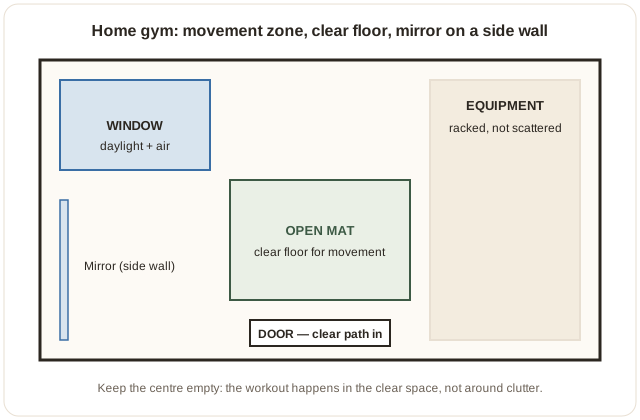
The most important thing in a home gym is empty floor. Before you buy anything, clear a rectangle at least the size of a yoga mat with arm's reach on every side — enough to lie down, stretch out, and step sideways without hitting furniture. That clear rectangle is the gym. Everything else is optional. Bodyweight training, yoga, stretching, and most dumbbell work fit in it, and if the rectangle stays clear, the room stays usable.
Equipment should live at the edges, racked and visible, not scattered across the middle. Dumbbells on a rack against the wall, bands on hooks, a mat rolled upright in a corner. When gear creeps into the movement zone, every session starts with tidying, and sessions that start with tidying often do not start at all. The same closed-storage logic in our closet guide applies here: gear you cannot see is gear you will not use, so keep it visible but contained.
Buy for the workouts you actually do, not the ones you imagine. A mat, a pair of adjustable dumbbells, and resistance bands cover most home training. A large machine you use twice a month is not a gym; it is a clothes rack with a power cord. If a machine earns its floor space, keep it; if it does not, sell it and reclaim the rectangle.
Light and air: the two free upgrades
A gym needs bright light and fresh air more than any other room except the kitchen. Daylight is best: a window you can open, uncovered during workouts, makes exercise feel easier and helps you keep going. If the room has no window, use bright, cool-white ceiling light for workouts — this is one room where the warm dim light of a bedroom would be wrong. Our light guide explains why different rooms need different light, and a gym is the clearest example.
Air matters because you are breathing hard in a small space. Open the window before you start, run a fan if the room is stuffy, and wipe down mats and equipment after use so the room does not smell of old sweat. A gym that smells stale is a gym you avoid, and no amount of motivation survives a room you dread entering. A plant or two helps the room feel alive, but keep plants out of the movement zone and out of the path of swinging weights — the plants guide lists sturdy choices.
Sound helps too. Music is a legitimate feng shui cure in its own right — see sound as a cure — and in a gym it does practical work: it sets pace, masks household noise, and marks the room as a place where something active happens. A small speaker, kept at a volume that does not disturb the rest of the house, is worth more than most gadgets.
Mirrors: on a side wall, for form, not vanity
A gym mirror has a job: letting you check your form. Put it on a side wall, at a height where you can see your full body from the mat, and stand sideways to it for most exercises. A mirror directly in front of you for a whole session is distracting, and one facing the door bounces every arrival into your workout. The mirror-placement diagram in our mirrors guide shows the same side-wall principle in a bedroom, and it applies here too.
In a small gym, a mirror also does spatial work: it doubles the room visually and bounces daylight deeper into the space. That is a real benefit in a garage or spare room with one small window. But do not mirror every wall. A room wrapped in mirrors feels exposed rather than energizing, and it makes the space hard to relax in after the session ends. One good wall is enough.
If the gym shares a room with anything else — an office, a guest bed — the mirror should not face the bed or the desk. Reflected movement behind you while you work or sleep is distracting in exactly the way a mirror facing a bed is distracting at night, which our mirror-facing-bed guide covers in detail.
Color and energy: one bold accent, calm background
Gym color should be lively but not aggressive. Warm neutrals on the walls — pale grey, warm white, soft sage — with one energetic accent: a red mat, a bright poster, a colored accent wall. Fire colors like red and orange raise energy, which is what you want in a workout, but a whole room of saturated red is exhausting to be in for more than a few minutes. The colors guide explains the balance: background calm, accent energy.
In five-element terms, movement belongs to Wood and Fire — growth and activity — so natural wood floors or a wooden accent suit a gym well, and a touch of red suits it too. Metal, by contrast, is the element of contraction and cutting; a room full of cold steel and grey can feel clinical rather than motivating. If your equipment is mostly metal, warm it up with a wooden shelf, a colored mat, and warm-toned light for the cool-down.
Keep the room's message simple. One motivational poster is fine; a wall of slogans, flashing lights, and screens competing for attention is not. A gym should tell you one thing when you walk in: move. Everything that says something else is noise.
The bedroom rule: keep the gym out of the sleeping room
The single most important rule in this guide is also the most commonly broken: do not put the gym in the bedroom. A bedroom must be calm, dim, and associated with rest; a gym is bright, noisy, and associated with effort. Sharing the room trains your brain to associate the bed with activity, and the workout corner with sleep, and both suffer. If you sleep where you train, sleep gets lighter and training gets half-hearted.
If you genuinely have no other room, separate them as firmly as you can: a folding screen or curtain between bed and equipment, equipment covered with a cloth at night, and a strict rule that workout gear never piles up beside the bed. Exercise in the morning rather than late at night in a shared room, so the room has hours to settle back into a sleeping room before bedtime. The bedroom guide covers the calm side of this bargain; this guide covers the active side, and the two only work if they have separate territory.
Wherever the gym lives, give it a beginning and an end. A short ritual — open the window, roll out the mat, start the music — tells your body the session has started. Rolling the mat away and closing the window tells it the session is over. Rooms work by association, and a gym with a clear start and finish is a gym your body learns to use.
Start with thirty seconds
Test your gym by this standard: can you start a workout within thirty seconds of deciding to? If the answer is yes — mat accessible, floor clear, light and music one switch away — the room will get used. If the answer involves moving boxes, hunting for shoes, or clearing a chair, fix that friction first, before buying anything new. The best home gym is not the best-equipped one. It is the one with nothing in the way.
Go deeper with the book
Feng Shui Made Simple covers every room this way — bedroom, living room, kitchen, office, entryway — with diagrams and a 7-day plan for doing the whole house.
Frequently asked questions
Where should a mirror go in a home gym?
On a side wall, where you can check your form without the mirror facing the door or reflecting you head-on for the whole session. A mirror that doubles the room visually also makes a small gym feel larger, but it should not face a bed or a desk if the gym shares a room.
Is it bad feng shui to have a gym in the bedroom?
It is not bad luck, but it works against both purposes: the bedroom should be calm for sleep, and a gym needs energy and noise. If you must share the room, screen the equipment off, cover it at night, and never let workout gear pile up beside the bed.
What colors suit a home gym?
Lively but not aggressive: warm neutrals with one energetic accent, such as a red mat or a bright poster. All-red walls or flashing lights overstimulate and tire you out; a calm background with one bold accent keeps energy up without shouting.
How much space does a home gym really need?
A clear rectangle about the size of a yoga mat plus arm's reach on every side is enough for most bodyweight, yoga, and dumbbell work. The clear floor matters more than the equipment list — if you cannot move freely, you will not use the room.
Should a home gym face a window?
Yes, if you can: daylight and fresh air make exercise feel better and help you keep going. Just avoid exercising with your back to an uncovered glass door, and keep the mat out of direct harsh sun at midday.