Feng Shui Kitchen: Stove, Sink, and the Fire-Water Clash
In traditional feng shui, the kitchen is second only to the front door in importance. The reasoning is simple: the kitchen is where nourishment is made. What feeds your body, in this view, feeds your prosperity too — the two have always been linked, from harvest festivals to the phrase "bringing home the bacon."
You don't need to accept the symbolism to use the advice. Kitchens are also where most homes accumulate the most chaos — expired food, broken gadgets, junk drawers that reproduce on their own, counters buried under appliances nobody uses. A kitchen that works well feels abundant and generous. One that doesn't feels draining and vaguely guilty. Feng shui just gives you the checklist for telling the difference — and fixing it.
The stove is the star
The stove is the most important object in the kitchen. In feng shui terms, it represents wealth and nourishment — the fire that "cooks" your prosperity. Treat it like it matters, because energetically, it does.
Give it the command position: ideally, the person cooking can see the kitchen door without turning fully around. Nobody likes being startled while holding a hot pan, and that low-grade tension — the flinch when someone walks in behind you — is exactly what bad qi feels like in practice. A cook who feels safe cooks better and enjoys it more.
If your stove faces a wall and you can't move it (most of us can't), hang a small mirror on the wall behind or beside the stove — or simply notice the oven's reflective surface. Being able to catch movement behind you removes that exposed feeling instantly. It looks like a design choice. It functions like calm.
Also: use all your burners, not just the favorite front one. In feng shui, an unused burner is unused opportunity — wealth you're not "cooking." In practical terms, rotating burners keeps the stove working evenly and reminds you the whole thing is there to serve you, not just the front-left burner.
The fire-water clash
Here's a classic feng shui rule with a very practical core: don't put the stove (fire) directly next to the sink or refrigerator (water).
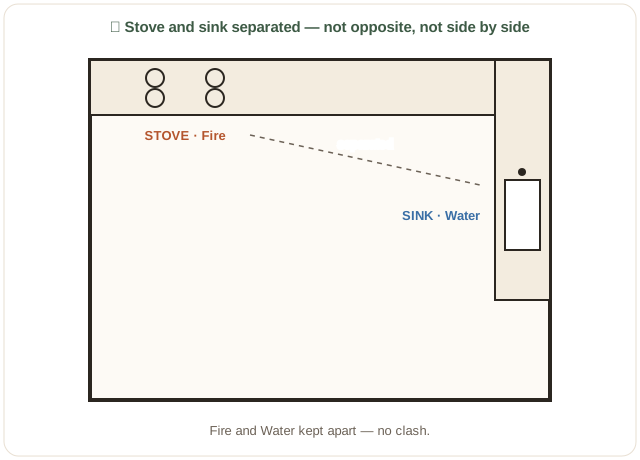
The traditional explanation is that fire and water are opposing elements, and placing them side by side creates conflict energy in the home's nourishment center — arguments, tension, money friction. The practical version is less mystical but equally real: a cramped stove-sink corner is awkward to use, things get knocked over, tempers shorten, and the whole cooking flow suffers. Conflict, indeed — just the ordinary kind.
The fix: if your stove and sink (or fridge) are adjacent, place something representing the Wood element between them — a green cutting board, a small potted herb, a wooden utensil holder. Wood sits between Water and Fire in the generating cycle (Water feeds Wood, Wood feeds Fire), so it harmonizes them instead of letting them clash. Even if you skip the theory entirely, the visual buffer makes the corner feel less cramped and more intentional.
Kitchen herbs (basil, mint, rosemary) are Wood energy you can eat. A small pot on the windowsill is a feng shui cure, a cooking upgrade, and a tiny daily pleasure all at once.
Keep everything working
A kitchen with broken things sends one message: neglect. And a kitchen is the worst room to neglect, because it's where you make the food that becomes you. Walk through yours and check:
- All stove burners light properly — not just the favorite one
- The oven heats evenly (when did you last actually check?)
- No dripping faucets — in feng shui, leaking water means leaking wealth; in real life, it's money literally down the drain, plus the maddening drip-drip at midnight
- The refrigerator seals shut, runs quietly, and isn't groaning like it has opinions
- Small appliances you keep: do they all work? The dead blender is just a monument.
Fix the small things this week. A kitchen where everything works feels capable and generous. That's the energy you want around your food — and around the person making it.
The refrigerator: inside matters too
Here's a quick diagnostic: open your refrigerator and look inside without judgment. What do you see?
An organized fridge with fresh food says abundance — there's plenty, and it's cared for. A fridge full of expired condiments, fossilized leftovers, and jars of "what IS that" says neglect. Feng shui reads your fridge as the state of your nourishment, physical and otherwise. It's not wrong.
Spend twenty minutes: throw out everything expired (check the dates — you'll be shocked), wipe the shelves, group like with like, put the good stuff where you can see it. It's the highest-impact twenty minutes in this entire guide, and you'll feel it every time you open the door.
While you're at it: the top of the fridge. It's not storage — it's a dust farm. Clear it.
Colors and light for the kitchen
Kitchens love warm, earthy energy: soft yellows, warm whites, light browns, gentle greens, creamy tiles. These are Earth and Wood tones — stable, nourishing, easy to be around while you chop and stir. The full palette logic is on the colors cheat sheet.
Avoid turning the whole kitchen fire-engine red. Red is the Fire element, and while a red kettle, a bowl of red apples, or red bar stools are lovely accents, large amounts of red in a room that already contains an actual fire source is overkill. It makes the space feel agitated rather than warm — all yang, no balance.
Light matters enormously here, more than in almost any room. Kitchens need bright, clear task lighting: under-cabinet lights are the single best upgrade for most kitchens, turning a gloomy counter into a pleasure to work at. Dim kitchens feel gloomy and make cooking feel like a chore; bright ones invite you in and make food look better. If your kitchen has a window, keep it clear — daylight is the original and best kitchen light.
The dining area: where nourishment becomes connection
If your kitchen opens into a dining area, treat it as part of the same system. A round or oval table helps conversation flow (no sharp corners, no "head of the table" hierarchy); a rectangular table works fine if the seating is balanced on both sides. Keep the table clear between meals — a dining table buried under mail and chargers stops being a place where people gather, and the kitchen's nourishment energy has nowhere to land.
One last kitchen rule, and it's the simplest: cook something tonight. A stove that's used, a fridge that's fresh, a counter that's clear — that is the kitchen's feng shui, working exactly as intended. The bedroom guide and living room guide apply the same thinking to the rest of the house.
Go deeper with the book
Feng Shui Made Simple walks the kitchen and every other room with diagrams, the full fire-water section, and a 7-day plan for doing the whole house.
Frequently asked questions
What is the fire-water clash in a kitchen?
The stove (Fire) placed directly next to the sink or refrigerator (Water). Tradition says opposing elements side by side create conflict energy; practically, a cramped stove-sink corner is awkward to use and tempers shorten. The fix is a Wood buffer between them — a green cutting board, a potted herb, a wooden utensil holder.
Where should the stove go in feng shui?
In the command position: the cook can see the kitchen door without turning fully around. If the stove faces a wall and can't move, hang a small mirror behind or beside it so the cook can catch movement behind them.
Should I use all my stove burners?
Yes. In feng shui, an unused burner is unused opportunity. In practical terms, rotating burners keeps the stove working evenly and reminds you the whole thing is there to serve you, not just the front-left burner.
What colors suit a kitchen?
Warm, earthy energy: soft yellows, warm whites, light browns, gentle greens, creamy tiles. Avoid turning the whole kitchen fire-engine red — a room that already contains an actual fire source does not need a full coat of Fire.