Feng Shui for Renters: No Renovation Needed
Renters are often told feng shui is not for them — that it requires repainting, rebuilding, and reshaping a home you do not own. That is wrong. Most of feng shui is not construction. It is placement, color, light, plants, cleanliness, and habits. All of those are fully available to renters, and all of them leave no trace when you move out.
The principle is simple: work with what you can move, and let the rest go. You can move furniture, textiles, plants, lamps, and mirrors. You cannot move walls, windows, or plumbing. Fortunately, the movable things carry most of the effect. A rental arranged with renter-friendly feng shui will feel dramatically better than the same rental left as found — and your deposit stays intact.
Start with placement — it is free
Placement is the biggest lever and it costs nothing. In the bedroom, put the bed in command position if the room allows: see the door from the pillow, not directly in line with it, headboard against a solid wall. The bedroom guide and bed direction guide give the full rules. In the office corner, put the desk in command position too — see the home office guide. On the sofa, sit where you can see the room's entrance. These three moves alone transform how a rental feels, and they require no permission from anyone.
If the ideal position is impossible — the bed only fits against one wall, the desk only fits facing a wall — use the renter's compensations. A small mirror on the desk lets you see the door behind you. A folding screen at the foot of a bed that faces the door breaks the direct line. A tall bookshelf behind a floating desk acts as the "mountain" that a wall would provide. Screens and bookshelves are furniture, not fixtures: they move with you.
Color without paint
Landlords who forbid painting have not forbidden color. A room's color feeling comes mostly from textiles and objects, not wall paint. Bedding, curtains, cushions, throws, rugs, and towels carry the palette. Want the calm blues of a bedroom? Blue bedding and curtains do it. Want Earth tones in a bathroom? Terracotta towels and a beige bath mat do it. Want your door direction's color? A doormat, a wreath, and a planter do it — see the front door color guide for the direction chart.
Removable options extend further: peel-and-stick wall decals, removable wallpaper on one accent wall, and washi tape borders all come off cleanly if applied correctly. Test a small hidden patch first, follow the product's removal instructions, and photograph the walls on move-in day so you can prove the original condition. The colors guide gives the element palette to choose from.
Light, plants, and mirrors — the renter's toolkit
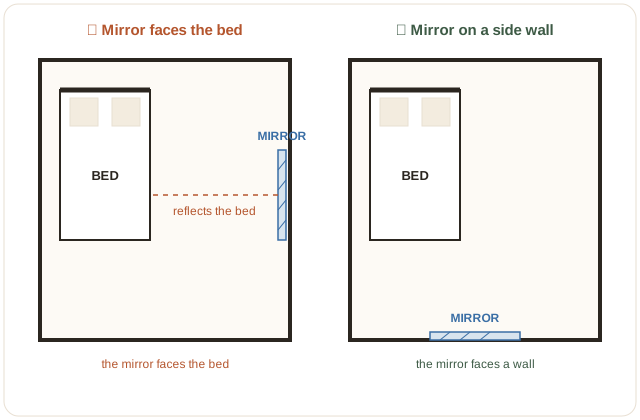
Three tools do outsized work in rentals. Light: landlords provide overhead lights; you provide lamps. A warm floor lamp in a dark corner, a desk lamp for work, a bedside lamp for evenings — lamps reshape a room's feeling more than any fixture change, and they pack into a box when you move. Plants: the ultimate renter cure. They soften sharp corners, fill empty corners, add life to a beige box, and travel with you. The plants guide lists the hardiest ones. Mirrors: a leaning floor mirror (no drilling) can brighten a dark hallway, let you see a door from your desk, or make a small room feel larger. Just keep mirrors from facing the bed — the mirror guide explains why.
Rugs deserve a mention too. A rug defines a zone without a wall: a work zone in a studio, a dining zone in an open plan, a calm zone in a bedroom. In a studio apartment, rugs plus a screen are the entire room-division system, and both move with you.
Habits that need no permission
The highest-impact feng shui in any home, rented or owned, is habitual. Keep the bathroom door closed and the toilet lid down (see the bathroom guide). Clear clutter weekly — in a small rental, clutter accumulates faster and hurts more. Fix what you can: a squeaky hinge, a loose handle, a flickering bulb. Report what you cannot fix to the landlord in writing, promptly — a leak in a rental is the landlord's job, and letting it run is bad for the flat and for you.
Annual feng shui also applies to renters. The 2027 flying stars sectors — the Southeast wealth corner, the Southwest Tai Sui quiet zone — are about which sector of your current home you use and how, not about construction. A renter can honor Tai Sui simply by not drilling in the Southwest, and can activate the wealth corner with a lamp and a plant. The year's chart travels with you to the next flat, where you just re-read the compass.
What to skip until you own
A short honest list: structural changes, repainting (unless permitted), retiling, moving plumbing, replacing doors, and built-in shelving. None of these are necessary for good feng shui, and all of them risk your deposit. If a rental has a genuinely bad feature — a bathroom in the center, a staircase at the door, a bedroom over a garage — manage it with the habit and furniture cures in the relevant guides, and put the renovation fantasy away until you own a place. Good feng shui in a rental is not a compromised version of the real thing. It is the real thing, practiced with the tools a renter actually has: placement, textiles, light, plants, and care. When you move, pack the lamps, roll up the rugs, take the plants, and start again in the next place — a little faster each time, because the principles are already yours.
One practical habit makes renter feng shui repeatable: a move-in walk-through. On the day you get the keys, walk each room with a notebook and note the command positions, the mirrors, the sharp corners, and the year's flying stars sectors for the new layout. Photograph the walls and floors for the deposit record at the same time, so one walk does two jobs. On move-out day, reverse it: pack the cures, restore the furniture layout as found if the lease requires it, and leave the place cleaner than you found it. The next tenant inherits a calm room, and you carry the whole system — knowledge, plants, lamps, rugs — to the next front door.
Go deeper with the book
Feng Shui Made Simple covers every room this way — placement, colors, and cures — with diagrams and a 7-day plan for doing the whole house.
Frequently asked questions
Can renters do feng shui without renovating?
Yes. Most feng shui is placement, color, light, plants, and habits — none of which require changing the structure. Furniture arrangement alone covers the biggest rules: command position, clear paths, and uncluttered rooms.
What if my landlord will not let me paint?
Use color through textiles and objects instead: bedding, curtains, cushions, rugs, throws, planters, and artwork. A room's color feeling comes mostly from these, not the wall paint.
Can I fix a bad layout in a rental?
Often, yes, with furniture and screens. A folding screen, a bookshelf, a curtain, or a rug can redefine a space without touching walls. If the bed or desk cannot move, a mirror, a screen, or a bench can soften the worst placements.
What about the front door if I rent an apartment?
Use removable color: a doormat, a wreath, a planter, or a hanging decoration in your door direction's color. Keep the entry clean, lit, and unblocked — those matter more than paint.
Do I need to redo feng shui every time I move?
Yes, but it is quick. Each new home gets a fresh compass reading and a fresh walk-through: command positions, mirrors, clutter, and the year's flying stars sectors. The principles travel with you; only the layout changes.