Feng Shui Bed Direction: Which Way Should You Sleep?
Search for "best sleeping direction feng shui" and you will get confident, contradictory answers: sleep north, sleep south, never sleep north, never sleep west. This article gives you the honest version: direction is a secondary factor, position is the primary one, and your own sleep quality is the final judge.
First, a clarification. "Bed direction" usually means the direction your head points when you lie down — the direction of the headboard. Some sources mean the direction your feet point, or the direction you face when sitting up. If you read advice elsewhere, check which one it means before following it. Here, bed direction means headboard direction: the compass direction your head points while you sleep.
Position first, direction second
Before touching a compass, get the position right, because position is what your body actually feels at night. The full rules are in the bedroom guide, but the essentials are: command position (see the door from the pillow, but not directly in line with it), headboard against a solid wall (not under a window), no mirror facing the bed, clear space under the bed, and a calm, dark room. If your bed already does all five, you have done roughly ninety percent of bedroom feng shui, whatever direction it faces.
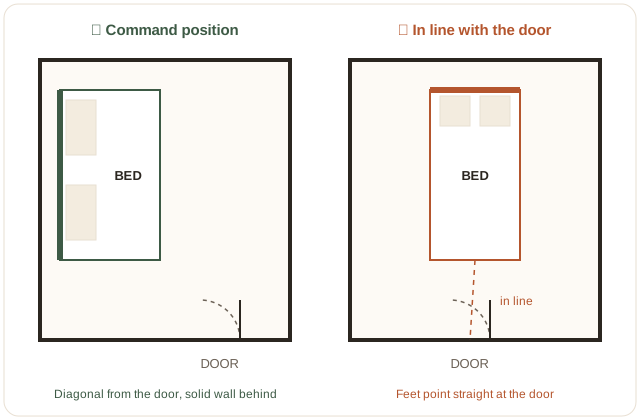
Why does position beat direction? Because position controls what you sense: who might enter, whether light hits your face, whether drafts cross the bed, whether the room feels enclosed or exposed. Direction controls none of those directly. A perfectly "auspicious" direction in a bad position — headboard under a window, feet to the door, mirror reflecting the bed — will still sleep badly. A "neutral" direction in a great position will sleep well. Fix position first, then fine-tune direction if you can.
The four directions, honestly
Head to the south. South is Fire in the five elements: warm, active, outward. Traditionally favored for restful sleep and good relationships, and often recommended as the default. If your room allows a south headboard with command position, it is a solid choice. The caveat: Fire energy can feel stimulating for very light sleepers, so if you run hot and wake easily, south may not be your best.
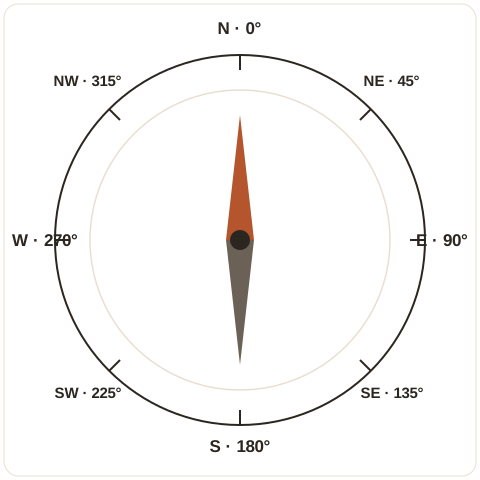
Head to the east. East is Wood: growth, new beginnings, morning energy. Traditionally good for young people, students, and anyone starting something new. East-facing sleep is associated with fresh energy in the morning — which matches the simple fact that east bedrooms get morning light, and morning light is genuinely good for waking up. If you struggle to get up, east is worth trying.
Head to the north. North is Water: deep, still, inward. Some traditions recommend north for deep sleep; others warn against it, claiming it disturbs the body's magnetic alignment. There is no reliable evidence for the magnetic claim, and the traditions disagree with each other, which is itself informative: north is not specially good or specially bad. If you sleep well facing north, there is no reason to change.
Head to the west. West is Metal: completion, rest, winding down. Traditionally associated with contentment and good sleep for older people, but sometimes described as too yin — too still — for young, active people. As with north, the honest assessment is that west is fine, and personal experience beats tradition here.
Notice what this list does not contain: a warning that one direction will ruin your health, or a promise that another will transform your life. Bed direction is a nudge, not a verdict. Try a direction for two weeks, note how you sleep, and trust the data over the doctrine.
The directions to actually avoid
Two placements deserve real avoidance, and neither is about compass direction. The first is feet directly pointing at the door — the so-called coffin position. It feels exposed because it is exposed: anyone entering sees you fully, and your body registers that. If you cannot move the bed, put a bench, a trunk, or a folding screen at the foot of the bed to break the line. The second is headboard under a window, especially a window that rattles or drafts. The head needs a solid wall behind it — support you can feel, even asleep. Both fixes are in the bedroom guide, and both matter more than any compass reading.
Beams over the bed are the third. A heavy beam crossing above where you sleep creates a feeling of pressure, like the ceiling is coming down. If the bed cannot move, paint the beam the ceiling color or hang fabric below it to soften the edge — the same cure used for sharp corners.
When your room limits you
Most bedrooms allow only one or two sensible bed positions, and the compass direction is whatever it happens to be. That is normal, and it is not a failure. Small rooms, shared rooms, rooms with one usable wall — all of these constrain direction, and feng shui has always adapted to real rooms rather than demanding ideal ones. Prioritize in this order: solid wall behind the headboard, command position (or as close as you can get), no mirror facing the bed, no feet directly to the door, then direction if any choice remains.
For couples, the shared rules matter more than direction: both partners should be able to get in and out without climbing over each other, both should have a nightstand and a light, and the headboard should be one solid piece you both rest against. A bed that works for both people beats a bed that faces the "right" way for one of them.
For children, east and south are traditionally favored — growth and warmth — but the same position-first rule applies. A child's bed in command position, against a solid wall, in a calm room, will serve them better than any compass-correct placement in a chaotic one.
The practical test: change one thing, sleep on it for a fortnight, and notice. Do you fall asleep faster? Wake less? Feel more rested? That is your answer for your body in your room. Feng shui gives you the variables to try — position, wall, mirror, direction — but you are the instrument that measures them. Start with position, try a direction if you have a choice, and let your sleep decide. The renters guide covers the same ideas for rooms you cannot remodel.
Go deeper with the book
Feng Shui Made Simple covers the bedroom, every other room, and the five elements with diagrams and a 7-day plan for doing the whole house.
Frequently asked questions
Which direction should my head point when sleeping?
There is no single best direction for everyone. In general feng shui, south and east are favored for restful sleep, while north is also traditionally good. What matters more is command position: seeing the door, headboard against a solid wall, and no mirror facing the bed.
Is sleeping with your head to the north bad?
No. In some traditions north is avoided, in others it is preferred. There is no consistent rule, and no evidence that north sleep harms you. If you sleep well facing north, keep it.
What matters more: bed direction or bed position?
Position, by far. Command position (seeing the door, not in line with it), a solid wall behind the headboard, and a clear, calm room affect sleep far more than which compass direction your head points.
What if my bed must face the door directly?
That is the coffin position in traditional terms, and it feels exposed. If you cannot move the bed, place a bench, a trunk, or a screen at the foot of the bed to break the direct line between door and bed.
Should couples sleep in the same direction?
Yes, in the same bed you naturally face the same way. The shared direction matters less than both partners having equal access to the bed, matching nightstands, and a headboard you both rest against.