Feng Shui for New Beginnings: Moving, Changing Jobs, Fresh Starts
A new chapter — a move, a new job, a marriage, a child leaving home, a life rebuilt after a hard year — deserves a home that supports it. Feng shui treats beginnings as physical events, not just mental ones: the space you wake up in either reminds you of the old chapter or makes room for the new one. This guide is about making room.
The key idea is sequence. People starting over usually try to do everything at once: redecorate, reorganize, buy new things, fix everything that was ever wrong. That leads to exhaustion, and exhaustion looks a lot like the old life. The feng shui approach is slower and more deliberate: clear first, then set up the two rooms that carry your daily life, then mark the beginning with one visible change. The rest can wait.
Step one: clear the old chapter out
Before you arrange anything, remove what belongs to the past. In a new home, that means anything the previous occupant left behind that you do not actively want: old curtains, forgotten shelf liners, a broken appliance in a cupboard, keys you will never use. Clean the place thoroughly before your own belongings arrive — floors, windows, inside cupboards — so the first thing your things meet is a clean shell, not someone else's dust.
If you are not moving but starting over in the same home, the clearing is harder and more important. Go room by room with one question per object: does this belong to the life I am living now, or to a life that has ended? Old work files from a job you left, gifts from a relationship that ended, clothes for a version of yourself you no longer are — these are not clutter in the ordinary sense. They are anchors. You do not have to throw everything away; boxing it up and storing it out of sight is enough to break the daily reminder. But it does have to leave the rooms you live in.
Repair what is broken while you are at it. A dripping tap, a door that sticks, a light that flickers — each one is a small daily irritation, and a home full of small irritations drains exactly the energy a fresh start needs. Fixing them is also a statement of intent: this home is being looked after now. See the 7-day home reset plan for a room-by-room version of this clearing.
Step two: the entryway first
Set up the entryway before anything else, even before the living room. The entryway is the first thing you see when you come home and the first thing guests see, so it sets the tone for the whole house. In feng shui terms it is where qi — the flow of air, light, and movement — enters, and a blocked entrance means a blocked start.
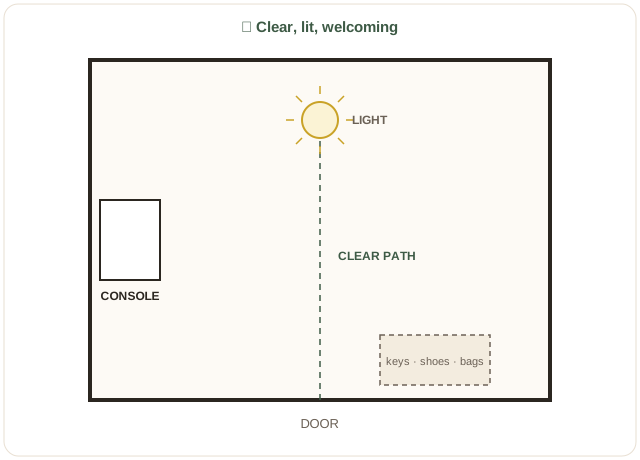
Practically, a good entryway needs four things: a clear path in (no boxes stacked by the door), a place to put shoes and bags, a mirror or light that brightens a dark hall, and one thing that is yours — a plant, a picture, a color you chose. If you are moving, unpack the entryway box first. If you are starting over in place, clear the entryway completely and rebuild it from empty. The full guide is on the entryway page.
Step three: the bedroom second
The bedroom comes next because sleep carries everything else. A new job, a move, a fresh start of any kind is physically tiring, and tired people make poor decisions and feel worse about everything. So before you hang pictures or arrange bookshelves, make the bed properly: clean sheets, a headboard against a solid wall if possible, and space to walk around both sides where the room allows.
The bedroom guide covers the command position — bed facing the door but not directly in line with it — and why it matters: you sleep better when your body is not guarding the entrance all night. For a fresh start, add one more step: new bedding. It is the cheapest full-room reset available. Old bedding carries the old chapter in the most literal sense; new sheets make the first night in the new life feel like a beginning rather than a continuation.
Mark the beginning: East and Southeast
Once the clearing and the two key rooms are done, mark the beginning with one visible change. Tradition points to the East and Southeast sectors of the home. On the bagua map, East is linked to health, family, and new growth, and Southeast to steady growth and prosperity; both are Wood-element sectors, and Wood is the element of spring and sprouting things. The classic marker is a healthy green plant — lucky bamboo or a money tree are the traditional choices — placed in the East or Southeast where it gets the light it needs.
The plant is not magic, and this guide will not pretend otherwise. Its value is that it is alive, growing, and visibly your choice: every time you water it, you are tending the new chapter. If plants are not your thing, the same sector can hold a wooden object, a green accent, or a picture of a landscape with growing trees. What matters is that the marker is deliberate and visible, not that it follows a formula. The bagua map guide explains how to find these sectors in your own floor plan.
Work beginnings: the desk reset
If the new beginning is a job change rather than a move, apply the same sequence to your workspace. Clear the desk completely — every paper, every cable, every object — then put back only what the new role needs. Old project files, reference books for work you no longer do, and the mug from the old team all belong in a box, not on the desk. Then set the desk in the command position, facing the door, as the home office guide describes. A person starting a new job with a cleared, well-placed desk has done the workspace equivalent of cleaning a new flat before moving in.
One more work rule: do not fill the empty space immediately. A new role brings new tools, new papers, and new habits, and they need somewhere to go. Leave one empty drawer and one empty shelf on purpose. Empty space is not waste; it is room for the new chapter to arrive.
What not to do
- Do not redecorate everything at once. Big spending in the first weeks of a new chapter usually buys things for the old taste, not the new life. Live in the space for a month first.
- Do not keep a "maybe" pile in the main rooms. Undecided boxes in the living room keep the transition feeling unfinished for months. Decide, store, or let go — then close the door on it.
- Do not renovate during the move itself. Noise, dust, and workmen in the first weeks make a home feel unsettled. Settle first, renovate second.
- Do not skip the bedroom for the public rooms. Guests see the living room; you live in the bedroom. Prioritize the room that carries your sleep.
Beginnings are fragile. They need less noise, less clutter, and fewer demands — and one clear, visible sign that something new has started. Clear the old, set up the entrance and the bed, plant something green in the East, and give the rest time. The new chapter will fill the space you made for it.
Go deeper with the book
Feng Shui Made Simple covers every room this way — bedroom, living room, kitchen, office, entryway — with diagrams and a 7-day plan for doing the whole house.
Frequently asked questions
What is the first thing to do in a new home?
Clean it thoroughly before your belongings arrive, then set up the entryway and the bedroom first. A clean, clear entrance and a bed you can sleep well in give you a calm base, and everything else can follow at a normal pace.
Should I get rid of the previous occupant's things?
Remove anything they left behind that you do not want or need, and repair anything broken. This is partly practical — you need the space — and partly psychological: a home full of a stranger's leftovers never quite feels like yours.
Which part of the home suits a fresh start?
Traditionally, the East sector is linked to new growth and family health, and the Southeast to steady growth, both Wood-element sectors. A healthy green plant or a piece of living wood in either sector is the classic marker of a new chapter.
Is there a good day to move house?
Traditional Chinese almanacs list auspicious moving days, and many people still check them. Practically, the best moving day is one with good weather, enough help, and no rush — a calm move sets a calmer tone than any date on its own.
What if the new beginning is a job change, not a move?
Apply the same sequence to your workspace: clear the desk completely, remove old projects and broken supplies, then set up the desk in the command position facing the door. A clear desk is the workspace version of a clear entryway.