Lucky Bamboo: How Many Stalks, Where to Put It
Lucky bamboo is the most gifted plant in feng shui — given for new jobs, new homes, new years, and new babies — and also one of the most misunderstood. First, the surprise: it is not bamboo at all. It is Dracaena sanderiana, a tough African houseplant that happens to grow in straight, jointed stalks. That is good news, because true bamboo would be a terrible houseplant: it spreads aggressively and needs far more light. Dracaena is content on a desk in a jar of water, which is exactly why it became the classic feng shui gift.
This guide covers the two questions everyone asks — how many stalks, and where to put it — and then the question that matters more: how to keep it alive, because a yellowing, rotting plant in the wealth corner sends the opposite message of the one you intended.
How many stalks: the traditional associations
Stalk numbers carry traditional associations in Chinese culture, and they are worth knowing because they explain why arrangements are sold in particular counts. The common ones are: two stalks for love, three for happiness, five for health, eight for wealth (eight sounds like prosperity in Chinese), and nine for overall good fortune. Twenty-one stalks, traditionally, stands for a great blessing. Four stalks are traditionally avoided, because the word for "four" sounds like the word for "death" in Chinese — so a four-stalk arrangement is a gift you should not give, whatever your own beliefs.
Be clear about what these numbers are: cultural associations, not mechanisms. Eight stalks will not make anyone wealthy, and no serious feng shui teacher claims otherwise. Their real value is as a gift language — giving someone three stalks says "I wish you happiness" in a form they can recognize — and as a reminder of intention. If you buy lucky bamboo for yourself, pick a number whose meaning you like and a size that fits the spot. A healthy three-stalk plant beats a struggling twenty-one-stalk arrangement every time.
Where to put it: East and Southeast
On the bagua map, lucky bamboo belongs to the Wood element — it is a green, growing plant — and Wood's home sectors are East (health and family) and Southeast (wealth and steady growth). Placing it in either sector matches element to sector, which is the basic feng shui logic: put the thing where its nature is supported rather than fighting the room.
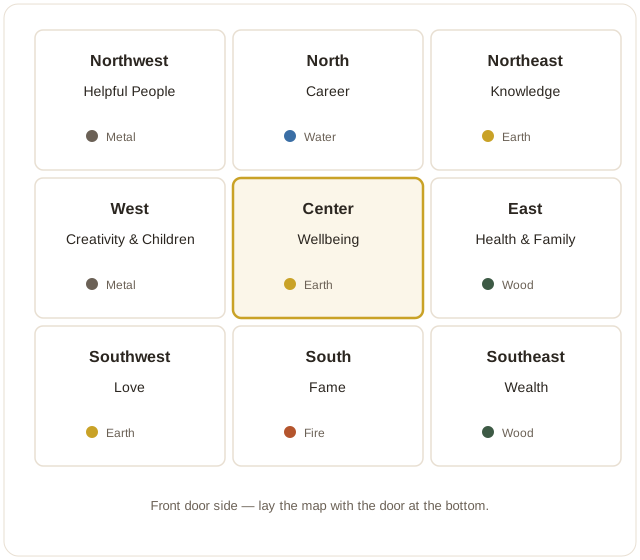
But the sector is secondary to the light. Lucky bamboo needs bright, indirect light — near a window with a sheer curtain, or a few feet from a bright window. Direct midday sun scorches the leaves yellow, and a dark corner slowly starves it. If your East sector is a windowless bathroom corner, put the plant where it will live and let the sector go; a thriving plant in the "wrong" sector is better feng shui than a dying plant in the right one. Good spots in most homes are a living room side table, a desk, or the entryway console — places you see it daily. The general plants guide covers the same rule for all houseplants: light first, symbolism second.
Water or soil: both work, both have rules
Water-grown lucky bamboo is the classic look: stalks in a glass container held upright by pebbles, roots visible in the water. It works, but it demands a routine. Change the water every one to two weeks, rinse the container and pebbles, and keep the water level steady at the roots — about two to five centimeters up the stalks. Stale water grows algae, smells, and eventually rots the roots, and rotting roots spread to neighboring stalks fast. Use water that has sat out overnight so chlorine dissipates, or filtered water; straight chlorinated tap water is a common cause of yellow leaf tips.
Soil-grown lucky bamboo is lower maintenance once established. Use a pot with drainage holes and ordinary potting mix, water when the top two centimeters of soil feel dry, and never let it sit in a saucer of water. Soil plants grow faster and taller than water plants, which is worth knowing if the spot has a low shelf above it. Either way, remove a stalk that turns yellow and soft at the base promptly — it will not recover, and leaving it risks the rest of the arrangement. The five elements guide explains the Water-feeds-Wood logic behind growing it in water at all: Water nourishes Wood in the generating cycle, which is why the water-jar presentation feels symbolically complete.
Containers, size, and the bedroom question
Container choice is practical first. Glass shows the water level, which helps you remember changes, but it also grows algae faster in bright light; ceramic hides algae but hides the water level too. Whatever you choose, the container should be heavy enough that the arrangement cannot tip — tall stalks in a light glass on a high shelf are an accident waiting for a cat or a child. Keep arrangements modest: a desk plant should be under 40 centimeters, and a floor arrangement should not block a walkway or a door swing.
One common question: is lucky bamboo suitable for the bedroom? A small arrangement is fine — it is quiet, needs no machinery, and adds green to a room that often lacks it. A large arrangement is not ideal, mainly because bedrooms should stay calm and uncluttered, and a big plant plus its water routine adds one more thing to tend. If the bedroom is where your East or Southeast sector falls and you want the plant there, keep it small and healthy. And never place it in a bathroom: bathrooms are damp, often dark, and symbolically about draining away, which is the opposite of what a growth symbol wants.
Buy stalks that are firm and evenly green, with no yellow patches and no soft spots at the base. A healthy plant, in the right light, with fresh water, will grow for years — and a plant that grows steadily is the best version of whatever luck you wished for when you bought it.
Go deeper with the book
Feng Shui Made Simple covers every room this way — bedroom, living room, kitchen, office, entryway — with diagrams and a 7-day plan for doing the whole house.
Frequently asked questions
Is lucky bamboo real bamboo?
No. Lucky bamboo is Dracaena sanderiana, a hardy houseplant that happens to look like bamboo. Unlike true bamboo, it grows happily indoors in water or soil and does not spread aggressively.
How many stalks should lucky bamboo have?
Traditional associations are: 2 for love, 3 for happiness, 5 for health, 8 for wealth, and 9 for good fortune. Four stalks are traditionally avoided because the word for four sounds like the word for death in Chinese. These are cultural associations, not guarantees of any outcome.
Where is the best place for lucky bamboo?
In the East or Southeast sector of a room or home, where its Wood element matches the sector, and anywhere it gets bright indirect light. Avoid direct midday sun, which scorches the leaves, and avoid dark corners where it slowly weakens.
Should lucky bamboo grow in water or soil?
Both work. Water-grown plants need the water changed every one to two weeks and the container cleaned, or algae and rot set in. Soil-grown plants need a pot with drainage and soil that dries slightly between waterings.
Why are my lucky bamboo leaves turning yellow?
The most common causes are direct sun, chlorinated tap water left un-aired, and dirty water. Move it out of direct sun, use water that has sat out overnight, change the water regularly, and trim yellow leaves so rot does not spread to healthy stalks.