Money Tree (Pachira): Placement and Care
The money tree — Pachira aquatica, sold with its trunks braided together — is feng shui's most popular plant, and its story explains its appeal. Legend says a poor farmer in Taiwan prayed for prosperity, found this unusual plant, grew it, and sold its seeds; the braided trunk is said to "lock in" good fortune. It is a good story, and it has made the plant a standard gift for new businesses and new homes. What this guide will not do is pretend the story is a mechanism: no plant attracts money by itself. What a money tree genuinely offers is a living symbol of steady growth that you tend — and tending something daily is a habit that spills into the rest of your life, including your finances.
Start, then, with the honest framing: the money tree is worth having because it is attractive, hardy, and meaningful, not because it pays rent. Everything below follows from that.
Where to put it: Southeast first, light always
Tradition places the money tree in the Southeast sector of the home or office. On the bagua map, Southeast is linked to wealth and steady growth, and it is a Wood sector — and Pachira is a Wood-element plant, so element and sector agree. That is the traditional logic, and it is consistent with the rest of the system.
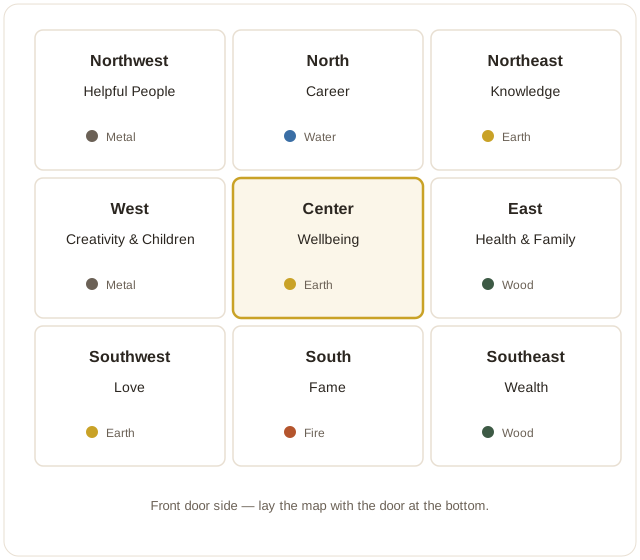
But as with lucky bamboo, light outranks sector. Pachira wants bright, indirect light — a spot near an east or west window, or a few feet back from a south window with a sheer curtain. Direct midday sun scorches its leaves, and a dark corner makes it drop leaves within weeks. If your Southeast is a windowless hall, put the plant where it will thrive and bring the Southeast association along in a smaller way, such as a green accent in that sector. The Southeast sector guide and the general plants guide both make the same point: a thriving plant in the "wrong" place beats a dying plant in the right one.
Good spots in most homes: a living room corner near a window, a home office beside the desk (where the growth symbolism suits work), or an entryway console if the light is adequate. Avoid the bathroom — damp, often dark, and symbolically about draining — and avoid placing a large tree where it blocks a doorway, a walkway, or the view from the command position of a desk or bed.
Size: buy for the room you have
Money trees are sold from desk size (30 centimeters) to floor specimens over 1.5 meters, and Pachira grows steadily indoors, so size is a decision with a future. A desk or tabletop plant suits an office or a small flat; a floor plant suits a living room corner with space around it. The rule is proportion: the plant should be clearly smaller than the room's main furniture, not competing with it. A huge tree in a small room dominates the space and blocks light; a tiny plant lost on a big empty floor looks like an afterthought.
The braided trunk deserves a note. The braid is made when the plant is young, and as the trunks thicken they fuse into an attractive pattern. Do not re-braid an adult plant or tie the braid tighter — you will damage the bark. If a trunk in the braid dies (it happens, usually from overwatering), remove it carefully rather than leaving a dead trunk woven through the living ones. A money tree with one dead trunk is not bad luck; it is a plant that needs attention, and attention is the whole point.
Watering: the one rule that matters
Overwatering kills more money trees than every other cause combined. Pachira stores water in its thick trunk, so it tolerates drought far better than flood. The routine: water thoroughly until water runs from the drainage holes, empty the saucer, then do not water again until the top five centimeters of soil feel dry — usually every one to two weeks indoors, less in winter. Always use a pot with drainage holes. A pot without drainage is a slow drowning, however careful the watering.
Signs you are overwatering: leaves yellowing from the base up, leaves dropping while still green, and a trunk that feels soft at the base. If the trunk is soft, the rot is advanced — let the soil dry completely, remove rotted roots if you repot, and accept that recovery is uncertain. Signs of underwatering are different: leaves droop and crisp at the edges, but the trunk stays firm, and the plant recovers quickly once watered. When in doubt, wait a day: a money tree would rather be slightly thirsty than slightly drowned.
Light, temperature, and everyday care
Keep the plant between about 15 and 28 degrees Celsius, away from radiators, air-conditioning vents, and cold drafts from windows in winter. Sudden moves — from shop to home, from one room to another — often cause a leaf drop in the first two weeks; this is shock, not failure, and the plant usually regrows once it settles. Rotate the pot a quarter turn every few weeks so growth stays even instead of leaning toward the window.
Feed lightly: a half-strength houseplant fertilizer once a month in spring and summer is plenty, and none in winter. Wipe the large leaves occasionally with a damp cloth — dusty leaves photosynthesize poorly, and clean leaves look dramatically better. Prune leggy stems back to a leaf node in spring to keep the shape compact. None of this is esoteric; it is ordinary plant care, and ordinary plant care is what keeps a symbolic plant looking like a symbol of growth rather than a symbol of neglect.
That is the real feng shui of the money tree. A thriving plant in a bright Southeast corner, watered on a sensible rhythm, quietly says the household is tended and growing. A struggling plant says the opposite. Choose the size your room can hold, give it light before sector, water it less than you think, and let the symbolism do its proper work: reminding you, daily, to tend the things you want to grow.
Go deeper with the book
Feng Shui Made Simple covers every room this way — bedroom, living room, kitchen, office, entryway — with diagrams and a 7-day plan for doing the whole house.
Frequently asked questions
Does a money tree actually attract money?
No plant attracts money by itself. The money tree is a traditional symbol of steady growth and prosperity, and its real value is practical: a thriving plant you tend regularly is a daily reminder to tend your finances too. Treat the symbolism as motivation, not as a mechanism.
Where should a money tree go?
Traditionally in the Southeast sector, linked to wealth and steady growth, or anywhere it gets bright indirect light. The Southeast is the traditional spot; light and room to grow matter more than the exact sector.
How often should I water a money tree?
Water thoroughly, then let the top five centimeters of soil dry out before watering again — usually every one to two weeks indoors. Overwatering is the most common killer: soggy soil rots the roots, and a money tree with rotten roots drops leaves fast.
Why is my money tree losing leaves?
The usual causes are overwatering, a cold draft, or a sudden move. Check the soil first: if it is wet deep down, stop watering and let it dry. Keep the plant away from radiators, air-conditioning vents, and cold windows.
Can a money tree go in the bedroom?
A small one is fine, but large money trees belong in living areas or offices. Bedrooms should stay calm and uncluttered, and a big plant with a big pot works against that. Keep bedroom plants small and few.