7-Day Home Reset Plan
You understand qi (pronounced "chee"), yin and yang, the five elements, and the bagua map. Now put them to work — not someday, this week. This plan takes twenty to thirty minutes a day for seven days. Each day has one focus, one clear set of actions, and one reason why it matters. By Sunday, your home will feel noticeably different: calmer, brighter, more yours.
The rules: one day at a time, timer on, done beats perfect. If a day's task does not fit your home — no garden? skip the path-sweeping — do the closest equivalent. Each day builds on the last, but every day also stands alone. A single day done well is worth more than seven days planned perfectly.
What you will need this week: a box or bag for decluttering, a notepad, basic cleaning supplies, and — optionally, for later in the week — a small mirror, a healthy plant, and a brighter bulb or two. Nothing exotic. Optional but smart: spend fifteen minutes on day zero gathering all of it in one spot, so the week itself is pure doing.
Day 1: The Entryway (25 min)
Clear everything out of your entryway — shoes, bags, mail piles, all of it. Start from zero. Clean the floor and wipe down the door itself, inside and out. Clean the light fixture. Put back only what belongs: a clean doormat, a working light, keys in one spot, shoes contained. If you have an outdoor path, sweep it. If you have hallway territory, tidy it.
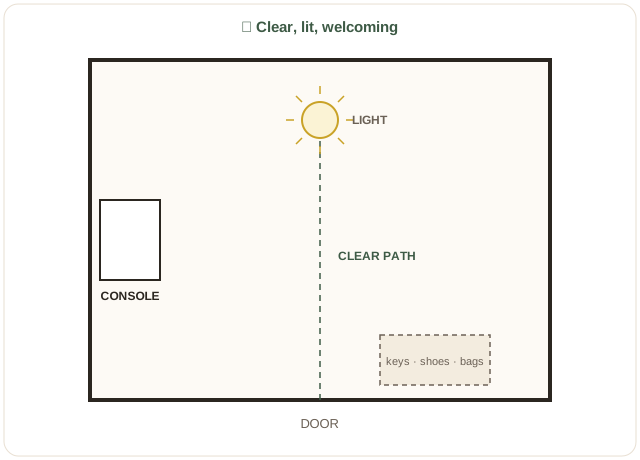
Why: the entrance is the mouth of qi — where all energy enters your home and your life. A clear, bright, welcoming entry tells your home (and your nervous system, twice a day) that good things are welcome here. Tonight, pay attention to how it feels to walk in. That small lift? That is qi moving freely. Remember it. The full reasoning is on the entryway guide.
Day 2: Command Positions (20 min)
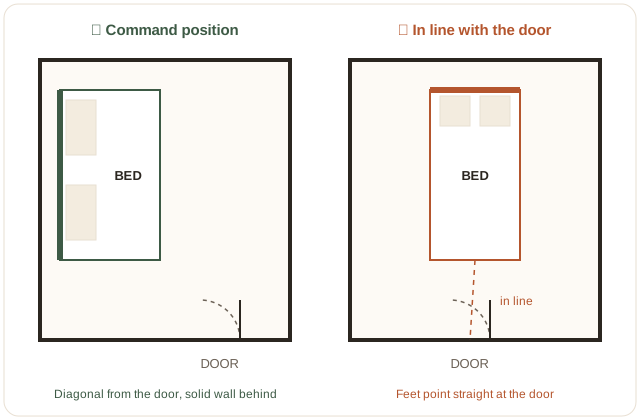
Bed: can you see the door without being directly in line with it? Move it if you can — even a few inches of angle counts. Sofa: same check; the main seat should face the entrance zone. Desk: same check, plus a solid wall (or tall furniture) behind your chair. For anything you cannot move, note where a small mirror would solve it. Add "small mirror" to a shopping list — do not buy yet.
Why: seeing the door while you rest, relax, and work removes a constant low-grade alertness you did not know you were carrying. Of all furniture moves in feng shui, these three have the highest impact per minute of effort. Sit in each spot after adjusting. The right position feels subtly but unmistakably more settled — like exhaling.
Day 3: The Declutter Sprint (30 min)
Grab a box or bag and set a timer for thirty minutes — two fifteen-minute rounds with a water break. Attack the single worst clutter spot in your home: the junk drawer, the chair of clothes, the counter of doom, the closet floor. For each item: keep (put it where it belongs right now), donate, or trash. No "maybe" pile — maybe is how clutter reproduces. When the timer rings, stop. Donations go by the front door to leave with you tomorrow. Trash goes out today.
Why: clutter is stuck energy and measured, hormonal stress. One cleared spot proves the rest is doable — and momentum, not perfection, is the real cure. The cleared spot will draw your eye all evening, in the best way. That is your brain rewarding you with calm. It is supposed to feel disproportionately good.
Day 4: Fix What's Broken (25 min)
Walk through your home with a notepad — every room, including bathrooms and closets. Write down everything broken, dripping, flickering, squeaking, sticking, or dead: the burner that will not light, the faucet drip, the wobbly handle, the burnt-out bulb, the drawer that jams. Fix what you can today — most items on this list take under ten minutes, which is why they have been postponed, not because they are hard, but because they are small. Schedule the rest: one item per day next week, in your calendar, like appointments.
Why: broken things are stuck qi and daily micro-irritations you pay for in mood without noticing. A home where everything works feels capable — and quietly makes you feel capable too. Fixing three tiny things often lifts your mood more than one big project. Completion energy is real.
Day 5: The Bedroom Reset (25 min)
Clear everything from under the bed. All of it. Move or cover any mirror facing the bed. Remove work stuff: laptop to another room, papers filed, work bag by the front door. Change the sheets — fresh bedding is instant yin energy. Dim check: can you make the room properly dark? Note what is needed — blackout curtains, an eye mask, tape over the LED.
Why: you spend a third of your life here, unconscious and defenseless. The bedroom repays attention faster than any other room — starting tonight. Lie in bed tonight and feel the difference before sleep: quieter mind, heavier limbs, faster drift-off. That is not placebo — it is environment. The full checklist is on the bedroom guide, and the mirror problem has its own page at mirror facing bed.
Day 6: Kitchen and Bathroom (30 min)
Kitchen: clean the stove (all burners), check everything works, toss expired food, wipe fridge shelves, clear the top of the fridge. Bathroom: close all toilet lids (leave them closed from now on), toss expired products, wipe the mirror, add one pleasant thing — a plant, a candle, a decent soap. Close the bathroom door. Make it a habit from today.
Why: the kitchen is nourishment — what feeds your body feeds your life. The bathroom is where energy and water drain; keeping it clean and closed stops the drain. Both rooms punish neglect visibly, and both reward care immediately. Cooking tonight will feel slightly better in a clean, working kitchen. That is the "abundance" the old texts talked about — not mystical, just a kitchen that says "there's plenty here." See the kitchen guide for the deeper version.
Day 7: The Walkthrough (20 min)
Walk slowly through your whole home, room by room, as if seeing it for the first time — or as if you are a guest. Notice what changed this week. Say it out loud if you like: "the entry is bright," "the bedroom is calm." Notice what still bothers you. Pick one thing — the one connected to your biggest current goal — and give it the full treatment: clean it, light it well, add something you love.
Why: feng shui is a practice, not a project. This walkthrough teaches the real skill underneath all the rules: noticing how spaces feel, and trusting that noticing enough to act on it. Compare today to last Sunday. The difference you are feeling is what a week of attention does. Imagine a month.
Optional, and worth it: lay the bagua map over your floor plan now, with fresh eyes, and see which area wants attention next. If your goals for the year are bigger than one room — career, health, relationships — the goals page maps each one to the sector and the habits that support it. The reset got your home's attention. The bagua tells you where to point it next.
Go deeper with the book
Feng Shui Made Simple covers every room this way — bedroom, living room, kitchen, office, entryway — with diagrams and a 7-day plan for doing the whole house.
Frequently asked questions
How much time does the 7-day reset take each day?
Twenty to thirty minutes a day, timer on. Each day has one focus and one clear set of actions. Done beats perfect — a single day done well is worth more than seven days planned perfectly.
What if I miss a day?
Just do the next day. Each day stands alone as well as building on the last, so a missed day costs you nothing except that day's task. You can always come back to it the following week.
Do I need to buy anything for the reset?
No. You need a box or bag for decluttering, a notepad, and basic cleaning supplies. Optionally, later in the week, a small mirror, a healthy plant, and a brighter bulb or two — but nothing exotic and nothing required.
What if a day's task does not fit my home?
Do the closest equivalent. No garden? Skip the path-sweeping and tidy your hallway territory instead. No separate office? Check the command position of wherever you work. The plan adapts to any home.
What happens after day 7?
Do the walkthrough, pick the one thing still bothering you that connects to your biggest current goal, and give it the full treatment. Then lay the bagua map over your floor plan with fresh eyes and see which area wants attention next.