Feng Shui for Health: The Whole-Home Checklist
Health feng shui is often sold as a cure. It is not one. No arrangement treats, cures, or prevents any illness, and nothing here is a substitute for medical care — see a doctor for health problems, and use your home to support the habits that help you stay well.
What a home genuinely influences is the daily background of health: how well you sleep, how much you move, how much daylight and fresh air you get, whether cooking feels easy or like a chore, and whether rest feels possible or guilty. Those background factors, repeated daily, matter enormously — and they are almost entirely arrangement. This checklist walks the whole home, room by room, in order of impact.
1. The bedroom: sleep first
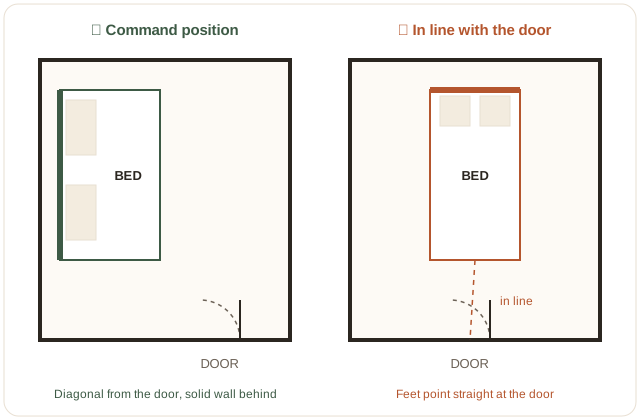
Sleep affects nearly everything else — mood, focus, appetite, recovery — so the bedroom is the highest-value health room in the home. The essentials are simple and covered in full in the bedroom guide: a bed in the command position (facing the door, headboard against a solid wall), a dark room at night, a cool temperature, and quiet. Add blackout curtains if street light enters, and keep the phone charging outside the bedroom or at least out of arm's reach — the last hour of scrolling is the most common thief of sleep.
Remove the television if you can. A bedroom TV keeps the room in entertainment mode, pushes sleep later, and fragments sleep with light and sound even when you fall asleep with it on. The TV guide covers gentler alternatives for people who like sound as they drift off. And keep the bedroom for sleep and rest: a desk full of work in the bedroom teaches the body that the room is for effort, which is the opposite of what you want at 11 p.m.
2. Air and light: the daily background
Open windows daily, even briefly, in every room you use. Stale indoor air — cooking fumes, dust, cleaning products, plain human stuffiness — builds up invisibly, and the fix is free. If outdoor air quality is poor where you live, open windows when it is best and use an air purifier as a supplement, not a replacement for ever opening a window. Keep filters, vents, and extractor fans clean: a kitchen extractor choked with grease is not extracting anything.
Daylight is the other free background factor. Spend the first part of the day in the brightest room you have, keep daytime curtains open, and place your desk or breakfast seat near a window where possible. Daylight in the morning helps set the body's clock, which in turn helps sleep at night — the bedroom and the morning room work as a pair. The light guide covers daytime and evening light as one system.
3. The kitchen: make healthy eating the easy option
You will eat what is easy to eat. A kitchen arranged so that fruit is visible, vegetables are at eye level in the fridge, and cooking tools are within reach makes healthy eating the path of least resistance. The reverse is also true: if the fruit bowl lives behind the cereal boxes and the chopping board is buried under appliances, takeout wins. The kitchen guide covers layout; for health, the rule is visibility and reach — put the foods you want to eat where you see them first, and the treats where you have to look for them.
Keep the kitchen clean enough to cook in without a prior cleaning project. A kitchen that needs twenty minutes of clearing before you can start cooking is a kitchen you will avoid, and avoided kitchens produce delivery orders. Clear counters, a working stove with all burners usable, and a fridge you can see into are health infrastructure, not housekeeping trivia.
4. The bathroom: hygiene without harshness
The bathroom's health job is cleanliness and calm. Keep it clean, dry, and ventilated — damp bathrooms grow mould, and mould is a real respiratory irritant, not a symbolic one. Run the extractor fan, wipe down wet surfaces, and fix leaks promptly. Keep the door closed when not in use, which also keeps bathroom moisture and odors out of the rest of the home. The bathroom guide covers layout and the door question.
Make the bathroom a place you do not rush through miserably: warm light rather than harsh white, a mirror at a comfortable height, a place to sit if you need it, and products you actually use rather than a shelf of aspirational bottles. Small comforts here pay off daily, because the bathroom is where the day starts and where it winds down.
5. Movement: a home that invites walking
The healthiest homes make movement unavoidable in small ways. Clear paths between rooms, stairs that are pleasant and well-lit rather than dark and cluttered, a front door that invites you out for a walk rather than a hallway that discourages leaving. Keep the entryway ready for going out: shoes, coat, keys, and bag in one place, so a walk or a trip to the shops has no friction. If you exercise at home, give it a defined spot — the home gym guide covers small-space setups — rather than equipment that lives in the way and gets resented.
The center sector matters here too: the middle of the home should be easy to move through, not an obstacle course. The center sector guide explains why clear central passage supports the whole home's feeling of ease. A home you can move through freely is a home you move through more.
6. The east sector: health and family in the bagua
In the bagua map, health is the east sector, shared with family, and its element is Wood — green, tall, growing. Keep the east tidy, green, and well-lit: a healthy plant, green textiles, or wooden objects, with natural light where possible. Water produces Wood, so a small water feature or blue and black accents can support the east if they suit the room. The east sector guide covers the sector in detail. But keep proportion: the east is one input among many, and a green corner does not compensate for a dark bedroom or a kitchen you never cook in. Do the big rooms first, the sector second.
Whole-home health checklist
- Bedroom: command position, dark, cool, quiet, no TV, phone out of reach.
- Air: windows opened daily, extractor fans and filters clean, leaks fixed.
- Light: bright mornings near a window, warm dim evenings, no bright screens late.
- Kitchen: clear counters, visible fruit and vegetables, working stove, clean fridge.
- Bathroom: clean, dry, ventilated, door closed, comfortable light.
- Movement: clear paths, lit stairs, entryway ready for going out, exercise spot defined.
- East and center: east tidy and green; center clear and easy to walk through.
Work through this list one item a week, starting with the bedroom. No single item will make you healthy, and no arrangement guarantees any health outcome — but a home that helps you sleep, move, breathe, and cook is a home pulling in the right direction, every day, without you having to think about it. That quiet background support is what health feng shui is actually for.
Go deeper with the book
Feng Shui Made Simple covers every room this way — bedroom, living room, kitchen, office, entryway — with diagrams and a 7-day plan for doing the whole house.
Frequently asked questions
Can feng shui improve my health?
No arrangement treats, cures, or prevents any illness, and feng shui is not a substitute for medical care. What a home can do is support healthy habits: better sleep, more movement, cleaner air, more daylight, and a kitchen that makes cooking easy. See a doctor for health problems, and use your home to support the habits your doctor recommends.
What is the health sector of the bagua?
The east sector, shared with family, whose element is Wood. Keep the east of your home tidy, green, and well-lit. The center sector, which governs overall wellbeing, matters just as much: keep the middle of your home clear and easy to move through.
What is the single most important health change in a home?
The bedroom. Sleep affects nearly everything else — mood, focus, appetite, and recovery — so a dark, quiet, cool bedroom with a bed in the command position is the highest-value change most homes can make.
Should I remove the TV from the bedroom for health?
Yes, if you can. A bedroom TV keeps the room in entertainment mode and pushes sleep later, and its light and sound fragment sleep even when you fall asleep with it on. The TV guide covers alternatives for people who like falling asleep to sound.