Center Sector: Wellbeing and Balance
The center of your home has no direction, no view, and usually no room of its own — and yet in the bagua it is the most important sector of all. It is the sector of wellbeing and balance, the still point that the other eight sectors revolve around.
Think of it this way: every other sector is a part of life — career, love, wealth, family, creativity. The center is the whole. When the middle of a home is calm, open, and easy to move through, the whole home feels calm. When the middle is blocked, cluttered, or dark, the whole home feels cramped and uneasy, even if every other room is beautiful. The center is not where life happens most visibly, but it is where the feeling of the home is set.
What the center means
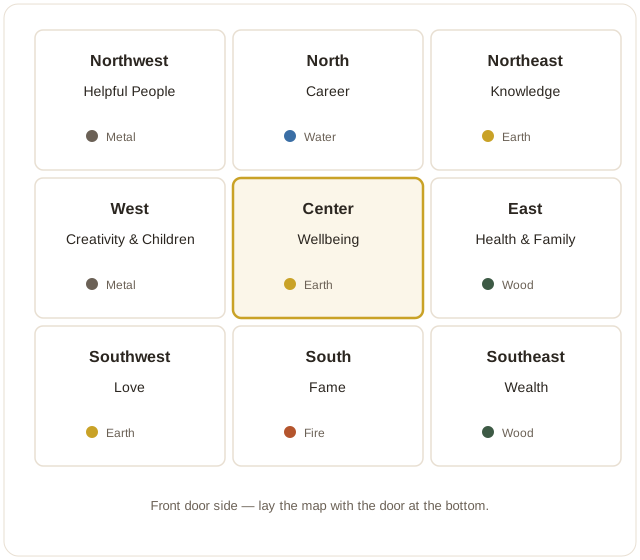
In the bagua map, the center square represents overall wellbeing, balance, and groundedness. Its element is Earth — the element of stability, nourishment, and the ground under your feet. Earth colors are yellow, ochre, warm brown, and beige; Earth's shapes are square and flat, like a low table or a level floor. Nothing here is dramatic, and that is the point. The center is not supposed to shout. It is supposed to hold steady.
Because the center touches all eight surrounding sectors, it is traditionally said to influence all of them. The practical version of that idea is easy to see: the middle of your home is where paths cross. Every trip from bedroom to kitchen, from front door to living room, passes through or near the center. If that crossing is pleasant — light, clear, unhurried — daily life flows. If it is an obstacle course, daily life snags, several times a day, every day. Small frictions in the center multiply because everyone uses it.
Finding the center in your home
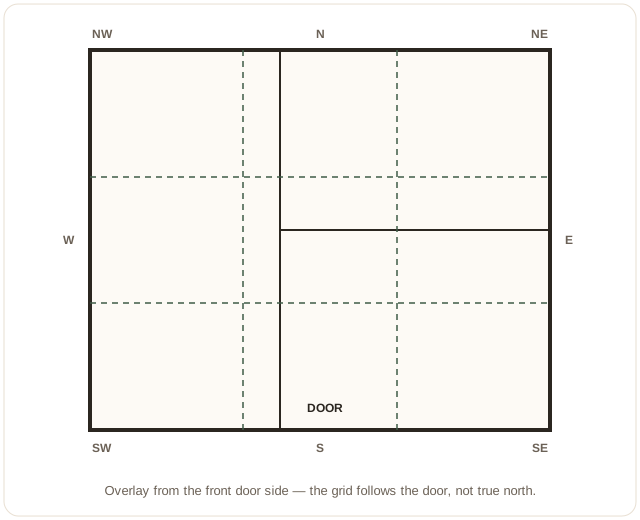
Divide your floor plan into nine equal sectors, three across and three down, using the compass directions from your front door. The center sector is the middle square. In most homes it does not correspond to a single room: it may be a hallway, a landing, the middle of an open-plan living area, or a slice of several rooms. That is normal. The bagua map guide and the floor plan guide explain the overlay, including how to handle irregular shapes and extensions.
Once you know where your center falls, walk it. Walk from each room to every other room and notice where you hesitate, sidestep, or squeeze. Those are the center's problem spots.
Colors, materials, and shapes
Earth colors suit the center: warm yellow, ochre, sand, beige, and soft brown. These do not need to dominate — a yellow cushion, a terracotta pot, a beige rug, a wooden bowl on a low table all bring Earth in gently. Natural materials help too: clay, stone, ceramic, wood, and wool all feel grounded, and the center rewards anything that feels solid and real rather than shiny and temporary. The earth element guide and the colors cheat sheet cover the palette in full.
Fire produces Earth in the generating cycle, so warm Fire accents — a soft red, a terracotta tone, a warm lamp — also support the center. But keep them warm rather than loud: the center wants a hearth feeling, not a bonfire. Square and low shapes suit Earth best. A low square coffee table in the middle of a living area, a flat rug, a level shelf — these give the center its stable, grounded character.
What to keep in check: Wood, which controls Earth in the controlling cycle. A forest of tall plants or a wall of dark green in the center works against its Earth character. A plant or two is fine — the center is a living home, not a museum — but the dominant feeling should be earthy and settled, not a thicket.
What belongs in the center
First, clear passage. The center's main job is movement, so its first requirement is that people can move through it easily, in daylight and in the dark, carrying things, without thinking. Hallways and landings in the center should be lit, free of tripping hazards, and wide enough for two people to pass. If your center is open-plan living space, the equivalent rule is a clear path between the main zones — door to kitchen, kitchen to seating — that does not force a detour around furniture.
Second, one grounding feature. A rug that anchors the middle of the room, a low table, a ceramic vase, a bowl of stones, a piece of art in warm earth tones — one thing that says "this is the heart of the home" is enough. The center does not need a collection. One solid, well-chosen object beats five competing ones, because the center's virtue is calm, and calm comes from simplicity.
Third, light. A dark center makes a home feel heavy, whatever the rooms around it are like. If the center has no window, use warm artificial light on a dimmer, a light-colored rug or wall, and a mirror to borrow light from a nearby room — the mirrors guide explains how to do this without creating glare. The dark hallways guide is useful if your center is a windowless corridor.
What weakens the center
Storage is the center's great enemy. Because the middle of the home is nobody's room, it becomes everybody's overflow: boxes waiting to be unpacked, bags waiting to go out, furniture waiting for a decision. This is understandable and fixable. Give everything in the center a real home elsewhere, and enforce a simple rule: nothing lives in the center unless it belongs there — a rug, a table, a lamp, art. Everything else is passing through.
Heavy, looming objects also weigh the center down. A tall bookcase blocking light in the main path or a massive wardrobe in the middle of the home makes the heart of the home feel oppressive. Where you cannot move the object, lighten it: open shelving instead of solid doors, a lamp at its base, a lighter color.
If your center holds a staircase, bathroom, or kitchen, do not treat that as a defect. A central staircase needs good lighting, a clear tread, and a handrail that works. A central bathroom needs cleanliness and a door that closes. A central kitchen needs tidiness and clear counters. Any room, well kept, can carry the center's job. The renters guide has more on working with fixed layouts.
Annual stars in the center: 2027 and 2028
Keep the permanent sector and the annual stars separate. The center's permanent element is always Earth. The visiting stars change each year, and tradition treats the center's yearly star as especially important because the center touches everything. In 2027 (4 February 2027 to 3 February 2028), the center hosts the 9 Purple star, a Fire star. Fire produces Earth, so this is traditionally read as a supportive combination — a good year to refresh the center with warm light and earth tones. In 2028 (4 February 2028 to 3 February 2029), the center hosts the 8 White star, an Earth star, which sits naturally in its own Earth sector and is traditionally read as steady and favorable. For both years, the practical advice is the same: keep the center clear, lit, and calm, and avoid major renovation or loud drilling there during those years. Do not redesign the center for a one-year star; the permanent Earth character is what you live with every day.
Small changes this week
- Walk the center and remove one thing that blocks or narrows the main path.
- Fix the light: replace a dead or flickering bulb in the middle of the home, and add a warm lamp if the center is dark.
- Add one Earth touch: a beige or ochre rug, a ceramic bowl, a terracotta pot — something solid and warm.
- Clear the dumping ground: give every box, bag, and stray object in the center a real home, or let it go.
- Put one grounding object in view: a piece of art, a stone, a plant in a clay pot — one thing that makes the middle of your home feel like its heart.
The center asks for less than any other sector: not a new room, not a new color scheme, just clear passage, warm light, and one solid thing to come home to. Do those three, and the whole home feels different — not because the center is magic, but because the place everyone passes through every day finally stops getting in everyone's way.
Go deeper with the book
Feng Shui Made Simple covers every room this way — bedroom, living room, kitchen, office, entryway — with diagrams and a 7-day plan for doing the whole house.
Frequently asked questions
Where is the center sector of my home?
It is the middle square when you divide your floor plan into nine equal sectors — the center of the three-by-three bagua grid. In most homes it falls in a hallway, a landing, or the middle of an open-plan living space rather than in a single room.
What colors suit the center sector?
Earth colors: yellow, ochre, warm brown, and beige. Fire colors such as soft red and terracotta also support Earth, because Fire produces Earth in the generating cycle. Keep the palette warm and calm rather than loud.
What if my center is a staircase, bathroom, or kitchen?
Work with the room you have. Keep a central staircase well-lit and uncluttered, keep a central bathroom clean with the door closed, and keep a central kitchen tidy. The center's job is circulation and calm, and any well-kept room can do that job.
Should the center of the home be completely empty?
No — it should be clear, not empty. A rug, a low table, a plant, or a piece of art is fine. What hurts the center is blockage: piles of storage, a dumping ground for things with no home, or furniture that forces everyone to squeeze past. Clear passage matters more than bare floors.