TV in the Bedroom: Feng Shui Verdict and Fixes
The feng shui verdict on a TV in the bedroom is short: it is better not to. A TV is light, noise, and stories pointed directly at where you sleep — active yang energy in a room whose whole job is calm yin rest. But verdicts are easy and bedrooms are real, so this page also covers the honest middle ground: when a bedroom TV is acceptable, and the five fixes that actually work when the TV must stay.
Start with why it matters, because the reason is not mystical. Your bedroom has one job: rest. Every non-sleep thing in the room adds a little yang buzz — light, noise, visual clutter, mental association — that your body registers even when your mind has tuned it out. A TV adds all four at once, and it adds them in the most stimulating form available: moving images and narrative, engineered to hold your attention.
Three problems in one box
Problem one: light. A TV is a light source you stare at in a dark room, and bright screens delay sleep onset. Sleep researchers and feng shui agree here completely — this is one of the places where ancient practice and modern science say the same thing in different words. The blue-rich light of a screen tells your brain it is still daytime, and your brain believes the light more than it believes the clock.
Problem two: stories. Television is narrative, and narrative keeps the mind alert. A tense drama, a news cycle, even a comedy with a cliffhanger — all of them give your brain something to chew on after the screen goes dark. Falling asleep to a show also trains a bad association: the bed becomes a place for entertainment rather than rest, and over weeks that association makes it harder to drift off without the show. The bed should mean one thing: sleep.
Problem three: the mirror you forgot. A TV that is switched off is a dark, reflective screen — and if it faces the bed, it is a mirror facing the bed. That is the classic problem covered on the mirror facing bed page: reflected movement keeps the room's energy restless, and restless energy means restless sleep. Many people who "do not have a mirror facing the bed" actually do — it is just shaped like a television.
Add the smaller issues and the case is complete: the standby LED glowing all night, the remote on the pillow inviting "one more episode," the arguments about what to watch and when to stop. A bedroom TV is rarely just a TV. It is a bundle of small sleep taxes, paid nightly.
The best fix: move it out
The cleanest solution is the living room, where yang energy belongs — social, active, awake. A TV in the living room is not a feng shui problem at all; it is a TV in the resting room that causes trouble. If you move it, give yourself two weeks before judging the result. The first few nights without the show can feel strangely quiet, and that quiet is the point — it is what sleep actually feels like when nothing is competing with it.
If moving it out is genuinely impossible — a studio apartment, a shared house, a partner who falls asleep to it — the fixes below are ranked by impact. Use as many as you need.
Fix 1: Cover it at night
A simple cloth over the screen, every night, is the best compromise available. It removes the mirror reflection, it removes the visual presence of the TV from the room, and — just as important — the ritual of covering it signals to your brain that viewing time is over. Rituals matter: the act of covering the TV is a small ceremony that separates "awake" from "asleep," the same way changing into nightclothes does. Keep the cloth attractive — a nice piece of fabric, not a towel — because you will look at it every night and it should please you, not remind you of a chore.
Fix 2: Put it behind doors
A cabinet with doors is nearly as good as removing the TV. Closed doors hide the screen completely, remove the mirror problem, and turn the TV from a permanent presence into an occasional one. If you are buying bedroom furniture anyway, a TV armoire or a cabinet with sliding doors is the single best purchase for this problem. In a small apartment, a cabinet also gives you storage, which is a second win.
Fix 3: Set a real off-time
"One more episode" is not an off-time. A real off-time is a clock time — say, 10pm — after which the TV stays off, covered, until morning. Use the TV's own sleep timer as a backstop, not as the plan: set it for thirty minutes so a show cannot run all night if you drift off mid-episode, but aim to switch off deliberately before that. Pair the off-time with a replacement ritual — reading, stretching, a warm drink — so the evening does not end in a vacuum the TV rushes back to fill.
Fix 4: Move it off the bed axis
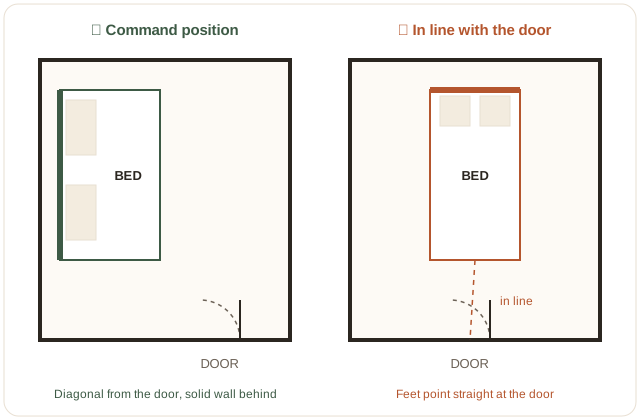
If the TV must stay visible, at least get it out of the direct line of the bed. A TV at the foot of the bed, aimed straight at the pillow, is the worst placement: it dominates the sleeper's view and maximizes the mirror problem. An angled placement on a side wall, or a TV that swivels away when not in use, reduces both the visual dominance and the reflection. This fix alone does not solve the light and story problems, but combined with covering and an off-time, it meaningfully reduces the TV's presence.
Fix 5: Kill the standby glow
Small, but real: tape over the standby LED, or switch the TV fully off at the wall. A tiny red or blue light in a dark room is a surprisingly effective sleep irritant — your eyes find it even closed, in the sense that your brain registers light through the eyelids. While you are at it, move the phone off the nightstand too. The phone-as-alarm-clock is the same problem in a smaller box, and a ten-dollar alarm clock is the highest-return sleep purchase in existence. Charge the phone outside the bedroom.
The honest summary: a bedroom without a TV sleeps better than a bedroom with one, and no fix fully closes that gap. But a covered, doored, timed TV in a bedroom that otherwise follows the ten bedroom rules — command position, solid wall, calm colors, clear under-bed — is a bedroom that will still let you rest well. Feng shui is about the best overall arrangement, not about winning one rule while losing the rest of your life. Start tonight: cover the screen, set the off-time, and notice how the room feels when the TV stops staring back.
Go deeper with the book
Feng Shui Made Simple covers every room this way — bedroom, living room, kitchen, office, entryway — with diagrams and a 7-day plan for doing the whole house.
Frequently asked questions
Is a TV in the bedroom bad feng shui?
Yes. A TV is light, noise, and stories pointed directly at where you sleep — active yang energy in a room that should be calm yin. It also doubles as a mirror when off: a dark screen facing the bed reflects the bed, which is the classic mirror problem.
Can I keep the TV if I cover it at night?
Covering it at night is the best compromise if the TV must stay. A cloth over the screen removes both the mirror reflection and the visual presence of the TV, and the ritual of covering it signals to your brain that viewing time is over.
Does watching TV in bed really hurt sleep?
Yes, and sleep research agrees with feng shui here: bright screens delay sleep onset, stimulating content keeps the mind alert, and falling asleep to a show trains your brain to associate the bed with entertainment rather than rest.
What about a TV inside a cabinet with doors?
A cabinet with doors is one of the best fixes. Closed doors hide the screen completely, remove the mirror problem, and turn the TV from a permanent presence into an occasional one. It is nearly as good as removing the TV.
Where should the TV go instead?
The living room, where yang energy belongs — social, active, awake. A TV in the living room is not a feng shui problem at all; it is a TV in the resting room that causes trouble.