Earth Element at Home: Yellow, Square Shapes, and Stability
Earth is the element of grounding. In the five-element system it stands for stability, nourishment, patience, and care — the energy of solid ground underfoot, a meal shared at a steady table, a home that feels safe and settled. At home, earth shows up as yellow and brown tones, square and flat shapes, ceramics and stone, and low, heavy furniture. It is the element that makes a room feel dependable. Too much of it, though, and the same room feels heavy, dull, and stuck.
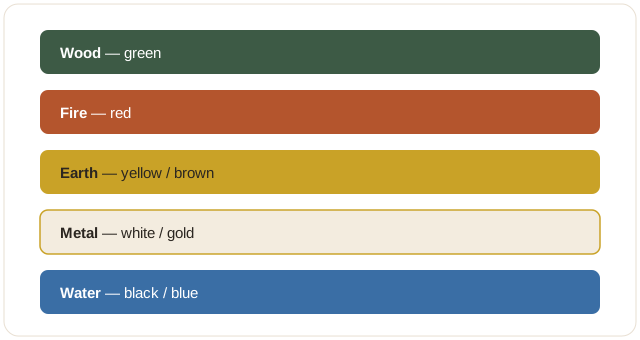
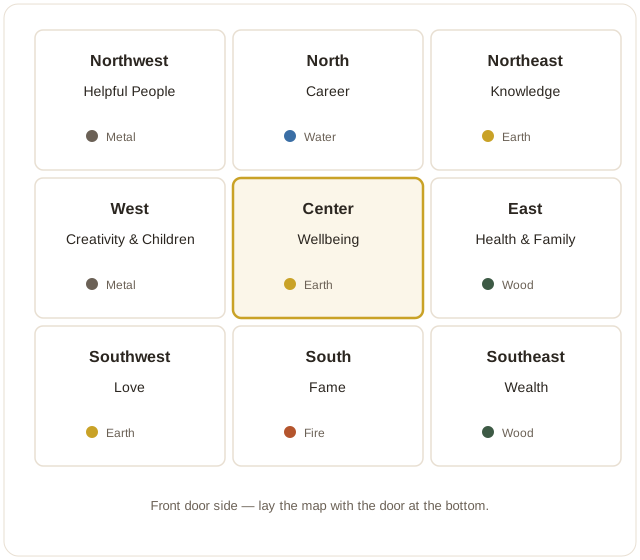
Earth is the center of the five-element cycle in more ways than one. It sits in the middle of the bagua — the Center sector, Wellbeing — and it also holds the northeast (Knowledge) and southwest (Love) sectors. Its colors are yellow, ochre, terracotta, and brown. Its shape is the square and the flat horizontal line. Its materials are ceramics, clay, stone, and brick. The cycle around it is simple: fire feeds earth, earth feeds metal, wood controls earth, and earth controls water. If you remember only that, you can balance almost any earth decision.
Earth's gift is that it slows things down. A room with good earth energy feels calm, settled, and safe. People sit longer, talk more slowly, and feel less rushed. That is why earth suits the rooms where you rest, gather, and care for each other. It is also why earth is the element to reach for when a home feels anxious, chaotic, or transient — when you have just moved, when life is changing fast, or when a room feels like a corridor people pass through rather than a place they stay.
Yellow, brown, and the colors that ground a room
Yellow is earth's brightest color, and it needs handling with care. A soft, warm yellow — butter, ochre, pale gold — warms a room beautifully and suits kitchens and dining rooms, where nourishment is the theme. A loud, acidic yellow on all four walls, by contrast, can feel agitating rather than grounding, especially in bright sun. The rule is the same as with every strong element color: use the bold version as an accent and the soft version for large areas.
Brown and terracotta are earth's workhorse colors, and they are much harder to get wrong. A brown leather sofa, wooden floors with a warm tone, terracotta pots, a stone or brick feature — all of these ground a room without shouting. They work because they are the colors of materials that are literally heavy and solid. If a room feels flighty or insubstantial, adding one or two brown or stone elements is often enough to settle it.
Neutral tones — cream, beige, sand, warm grey — also carry earth energy when they are warm rather than cold. A cold, blue-grey room feels like metal or water, not earth. A warm cream room feels like earth even without a single yellow object. When you are choosing paint, hold the sample against a piece of wood or terracotta: if it harmonizes, it is warm earth; if it clashes, it is probably a cooler tone than you think.
Square shapes, ceramics, and low furniture
Square and rectangular shapes are earth's geometry: the flat plain, the field, the stable base. A square coffee table, a rectangular rug, square cushions, a low flat sideboard — each adds a small amount of earth. This is genuinely useful in rooms that feel too busy or too vertical. A tall, narrow room full of vertical lines feels calmer when you add a low, wide, square piece that anchors the eye at ground level.
Ceramics are earth's most expressive material. A ceramic vase, a stoneware bowl, a clay pot, a porcelain lamp base — these are earth you can hold. They suit every room, and they are the easiest earth cure to add: a ceramic bowl on a hall table, a stoneware mug collection in the kitchen, a large terracotta pot by the front door. Stone works the same way at a larger scale: a stone countertop, a slate hearth, a pebble tray under a plant.
Low, heavy furniture is earth's furniture. A low sofa, a solid wooden chest, a heavy bookcase sitting flat on the floor rather than on legs — these make a room feel rooted. This is why a room with only light, leggy, floating furniture can feel unsettled even when it is beautiful: nothing in it touches the ground with weight. One solid, low piece changes that. The living room guide shows how a low coffee table and a solid sofa anchor a seating group.
Where earth belongs, room by room
Earth belongs in the center of the home, the northeast, and the southwest — but in practice, it belongs wherever stability is the point. The living room is earth's natural home: it is where the household gathers and rests, and it benefits from warm tones, a square rug, and solid furniture. The dining room is another: food is nourishment, and a steady, square or rectangular table on a solid rug is an earth arrangement. The dining room guide covers table choices in detail.
Bedrooms benefit from a moderate amount of earth. Warm bedding, a ceramic lamp, a wooden bed frame sitting low and solid — these help sleep by making the room feel safe and settled. But a bedroom that is entirely brown and yellow, with heavy furniture and no lighter tones, can feel like a cave. Balance earth in the bedroom with lighter bedding or a pale wall, so the room feels grounded but not buried.
Kitchens are already earthy, because cooking is nourishment and kitchens are full of ceramics, stone, and square counters. The risk in a kitchen is not too little earth but too much: a kitchen with brown tiles, brown cabinets, brown counters, and no other element can feel dark and heavy. Add metal — a stainless steel appliance, white tiles — or wood — a herb plant, a wooden board — to lift it. The kitchen guide explains the balance between the room's fire and water.
Too much earth, and how to lighten it
Too much earth feels stuck. Signs include a room that feels heavy even when it is clean, a home where nothing ever changes or moves, a feeling of lethargy in a space that should be welcoming, or a decor scheme that is entirely brown, beige, and yellow with no contrast. The balancing element is wood, which controls earth: add a plant, a green accent, or a tall wooden piece, and the room starts to move again. Wood breaks up earth the way roots break up soil.
Earth also deserves a note about the annual stars, because the most difficult stars are earth stars. In 2027, the north holds the 5 Yellow star and the west holds the 2 Black star, both earth energies that tradition treats as heavy. In 2028, the 5 Yellow moves to the southwest and the 2 Black to the northeast. Adding more earth — yellow walls, heavy ceramics — to those sectors in those years is adding weight to an already heavy place. Check the 2027 chart and the 2028 chart before decorating those sectors, and use metal tones there instead, since metal drains earth in the cycle. Earth is a wonderful servant and a poor master: give a home enough of it to feel safe, and no more than that.
Go deeper with the book
Feng Shui Made Simple covers every room this way — bedroom, living room, kitchen, office, entryway — with diagrams and a 7-day plan for doing the whole house.
Frequently asked questions
What is the earth element in feng shui?
Earth is the element of stability, nourishment, patience, and care. At home it appears as yellow and brown tones, square and flat shapes, ceramics and stone, and low, heavy furniture.
Which bagua sectors belong to earth?
The center (Wellbeing), the northeast (Knowledge), and the southwest (Love). Earth also suits any room where stability and gathering are the point, like living and dining rooms.
Is yellow paint a good idea for a bedroom?
Soft, warm yellow can work, but use it as an accent or on one wall rather than all four. A bedroom that is entirely yellow and brown can feel heavy; balance it with lighter bedding or a pale wall.
How do I fix a room that feels heavy and stuck?
Add wood, which controls earth: a healthy plant, a green accent, or a tall wooden piece. Wood breaks up earth the way roots break up soil.
Should I add earth tones to the 5 Yellow sector?
No — in 2027 the 5 Yellow is in the north and in 2028 it is in the southwest, and both are already heavy earth energies. Use metal tones in those sectors instead, since metal drains earth.