Dark Hallways: Light, Color, and Mirrors
A hallway is the one space every room connects to, which means a dark hallway colours the whole house. You pass through it dozens of times a day, and if it is gloomy, the house feels gloomy — even if every room off it is bright. Hallways are dark for a simple reason: they are usually internal, with no windows of their own, and they borrow all their light from the rooms around them. The fix is to give the corridor its own light, its own colour, and its own reason to be looked at.
Start by finding out where the darkness comes from. A hallway with a window at one end is a different job from a hallway with no windows at all. A hallway darkened by a solid front door, a blocked fanlight, or doors that are always shut is a different job again. Walk the hallway at midday with all the room doors open and then with them shut — the difference tells you how much light the rooms are lending, and how much the corridor needs to generate itself.
Borrow light before you buy it
The cheapest light in a hallway is borrowed. Interior doors with glass panels, fanlights above doors, and doors left open during the day all let room light spill into the corridor. If privacy matters, frosted or reeded glass gives light without a view. A fanlight above the front door — often painted over or blocked in older houses — is worth reopening: it is the hallway's only direct daylight, and it changes the entrance completely. The entryway guide covers the front door end of the hallway in detail.
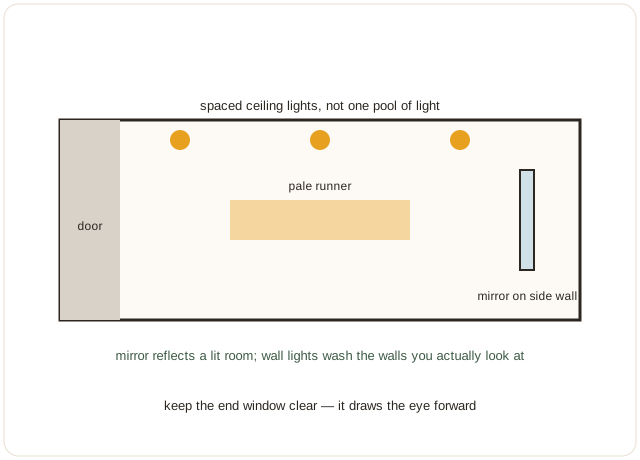
If the hallway has a window at one end, protect it fiercely. Do not put a tall cupboard in front of it, do not hang a heavy curtain over it, and keep the glass clean. A single bright window at the end of a corridor draws the eye forward and makes the whole passage feel like it is going somewhere, which is the opposite of the trapped feeling a dark hallway gives.
Layer artificial light properly
A single ceiling light in the middle of a long hallway is the classic mistake: it creates one bright pool and leaves both ends in shadow, so the corridor reads as a tunnel with a lamp in it. Layer instead. Two or three smaller lights spaced along the corridor beat one big one, and wall lights at picture height beat ceiling lights alone, because they wash the walls — the surfaces you actually look at — rather than the floor. Put them on a dimmer if you can, and use warm white bulbs: a cold white corridor feels like an office passage, not a home.
Run the lights on a sensor or a timer in the evening, so the hallway is never the dark gap between lit rooms. This matters more than it sounds: a house where every room is lit but the hallway is dark feels disjointed, because the connecting space is the one space that is not welcoming. A lit hallway is the thread that ties lit rooms together.
Colour: pale, warm, and unbroken
Hallway colour should be pale and warm: soft white, warm cream, pale sage, light warm grey. Dark colours in a narrow, windowless corridor absorb the little light there is and make the walls close in. If you love a strong colour, use it on one short wall at the end of the corridor as an accent — a destination for the eye — and keep the long walls pale. The colours guide has the full warm palette.
Keep the colour unbroken. A hallway painted in two different colours where an extension joins, or with a dark dado rail cutting it in half, reads as chopped up, and a chopped-up corridor feels shorter and darker. One pale colour, floor to ceiling, with white trim, makes the corridor read as one continuous space, which is the longest and lightest it can read.
Mirrors: the hallway's best friend, placed carefully
A mirror is the most effective single object in a dark hallway, because it does two jobs: it reflects whatever light exists, and it doubles the visible space. Hang a large mirror on a side wall, where it reflects a lit room or a window, not on the end wall facing the front door — a mirror facing the door bounces the entrance straight back out, and tradition dislikes it for that reason. A mirror at the end of a long corridor, reflecting the corridor back at you, doubles the tunnel feeling rather than curing it, so side walls are the place. See the mirror guide for the general placement rules that apply here too.
A mirrored wall panel or a pair of matching mirrors along a long corridor works even better than one, because each one catches light from a different angle. Keep the glass clean — a dusty mirror in a dark hallway reflects gloom, not light — and frame it simply, so the mirror itself does not become the dark object in the room.
Floors, clutter, and the feeling of movement
A light floor — pale wood, light tiles, a pale runner — reflects light upward and makes the corridor feel wider. A dark floor absorbs it. If replacing the floor is too much, a pale runner down the centre does much of the same work and has a second benefit: it gives the corridor a direction, a path that leads the eye forward instead of letting it stall in the gloom.
Clutter is the dark hallway's accomplice. Shoes, coats, bags, and boxes piled along a corridor narrow it physically and visually, and a narrowed corridor is a darker corridor. Give the hallway one proper storage piece — a bench with shoe storage, a row of hooks, a slim console — and enforce it: everything else lives in a room. A clear corridor with a runner and a mirror feels twice as wide as the same corridor with a row of shoes along it.
Give the hallway something to look at
The last fix is the one people skip: decoration. A bare, pale corridor is brighter than a dark one, but it is still a corridor, and corridors nobody looks at feel like service passages. Hang pictures at eye level along the long wall — a series, not one lost frame — or put a small console with a plant and a lamp at a turn. The plants guide notes which plants tolerate low light; a hallway plant that survives is worth more than a hallway plant that dies and becomes another gloomy object.
A hallway that is lit, pale, mirrored, clear, and decorated stops being the dark gap between rooms and becomes a room in its own right — the room that welcomes you into all the others. That is the real payoff: not a brighter corridor, but a house that feels connected instead of divided, because the space that joins everything is finally pulling its weight.
Go deeper with the book
Feng Shui Made Simple covers every room this way — bedroom, living room, kitchen, office, entryway — with diagrams and a 7-day plan for doing the whole house.
Frequently asked questions
How do I light a hallway with no windows?
Layer artificial light: two or three smaller lights spaced along the corridor, plus wall lights at picture height, on a dimmer with warm white bulbs. Borrow light too — glass-panelled interior doors and an open fanlight above the front door let room light spill in.
Where should a mirror go in a hallway?
On a side wall, reflecting a lit room or a window — never facing the front door, and not on the end wall where it would reflect the corridor back at you and double the tunnel feeling.
What colour is best for a dark hallway?
Pale and warm: soft white, warm cream, pale sage, or light warm grey, unbroken from floor to ceiling. A strong colour works only as an accent on one short end wall, as a destination for the eye.
Does a runner really make a hallway feel brighter?
Yes, in two ways: a pale runner reflects light upward, and it gives the corridor a visible direction, leading the eye forward instead of letting it stall. It also protects the floor, which is a practical bonus in the highest-traffic space in the house.
My hallway is full of shoes and coats. What helps?
One proper storage piece — a bench with shoe storage, a row of hooks, or a slim console — and a rule that everything else lives in a room. Clutter narrows a corridor physically and visually, and a narrowed corridor is a darker one.