What Is Qi? Energy Flow in Your Home Explained
Qi (pronounced "chee") is the central idea in feng shui — the energy, or life force, that flows through every space. Once you understand qi, the rest of feng shui falls into place, because almost every rule is really about helping qi flow well.
Qi in plain English
The Chinese character for qi originally pictured steam rising from rice — something invisible but real, produced by living things. Traditional Chinese thought treats qi as the vital force behind everything: the breath in your body, the wind across a field, the feeling in a room. In feng shui, we are concerned with the qi of a place.
If "energy" sounds vague, try a direct experiment. Walk into a sunlit café with high ceilings, plants, and music at just the right volume. Then walk into a windowless storage room with flickering lights and stale air. You feel the difference instantly — shoulders drop in the first place, tighten in the second. That difference is what feng shui calls qi.
Notice what you just did: you read a room without any instruments. Humans are good at this. Every "vibe check" you have ever done walking into a place was an informal qi reading. Feng shui simply gives you a vocabulary for it and a set of fixes for when the feeling is wrong.
A useful way to think about qi is water. Good qi moves like a gentle stream: steady, fresh, and winding. It reaches every part of the home without rushing or pooling. Bad qi comes in two forms, and both are familiar from real water.
The three kinds of qi
1. Flowing qi — the good kind. A home with flowing qi feels bright, fresh, and easy to move through. Paths are clear. Light reaches the corners. Air moves. Nothing feels stuck, and nothing feels chaotic. This is the goal, and most of feng shui is just ways to get here.
2. Stagnant qi — the stuck kind. Like a pond nobody tends, stagnant qi feels heavy, dull, and stale. The signs are physical: clutter piled in corners, rooms nobody enters, windows that never open, broken things left unrepaired. Stagnant rooms feel tiring to sit in, and people avoid them without knowing why.
3. Rushing qi — the chaotic kind. Like a wind tunnel, rushing qi feels agitating. It happens where energy moves too fast in a straight line: a long straight hallway from the front door to the back door, a bed directly in line with a door, a desk facing a busy corridor. People in rushing qi feel restless, distracted, or on edge.
Almost every feng shui rule you will meet is about encouraging the first kind and fixing the other two. Keep that in mind and the rules stop feeling like superstition and start feeling like common sense.
Where qi enters your home
Qi enters mainly through the front door — feng shui calls it the "mouth of qi." That is why the entryway gets so much attention in this tradition. A bright, clean, welcoming entry invites good qi in. A dark, cluttered, or blocked entry chokes it at the threshold.
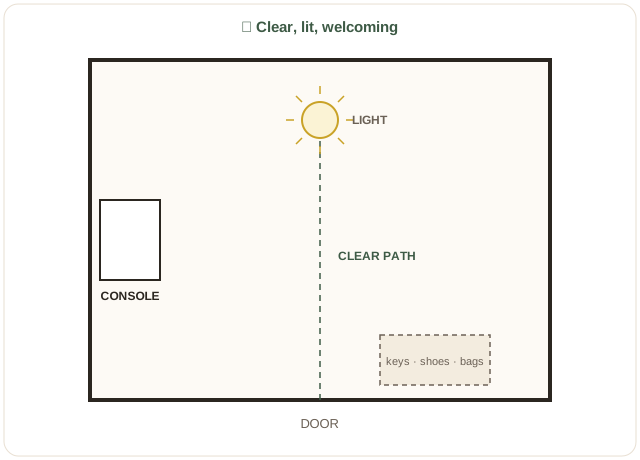
From the door, qi travels along the paths people actually walk: hallways, open doorways, the gaps between furniture. It does not travel through walls or through solid blocks of clutter. So the layout of your home is also the map of your qi flow. If a hallway is a storage shelf, qi — and you — cannot get through.
Windows matter too. Qi also enters and leaves through windows, which is why fresh air and natural light change how a room feels so quickly. A room with a window that opens is a room that can breathe. Our entryway guide covers the front door in detail, and the bedroom guide shows how the same ideas apply where you sleep.
How to read the qi in a room
You do not need special sensitivity. Walk into a room and ask five questions:
- Can I move easily? Clear paths mean flowing qi. Furniture you must squeeze past means blocked qi.
- Can I breathe? Fresh air and a comfortable temperature mean healthy qi. Stuffiness and stale smells mean stagnation.
- Can I see? Good light — daylight by day, warm lamps by night — means lively qi. Dark corners mean dead zones.
- Do I want to stay? A room you linger in has good qi. A room you hurry through has a problem, even if you cannot name it.
- What does my body do? Relaxed shoulders and easy breathing mean the room supports you. Tension and restlessness mean it does not.
Do this room by room. You will quickly find your home has a qi map: some rooms feel great, some feel flat, one or two feel actively unpleasant. That map is your work list, and it costs nothing to draw.
Simple ways to improve qi flow
Clear the paths. This is the single highest-impact fix. Remove anything blocking doorways, hallways, and the space around your bed and desk. Qi — and daily life — needs room to move.
Open windows regularly. Even ten minutes of fresh air changes a room. Stagnation is often just stale air plus closed curtains plus nobody entering for days.
Fix light. Replace dead bulbs, clean windows, and add a lamp to any corner that stays dark. Light is the fastest way to wake up a dead zone.
Slow rushing qi. If a door faces another door straight down a hall, slow the line: a rug, a plant, a small table, or a piece of art on the wall breaks the straight run and calms the flow. The same trick works for a staircase facing the front door.
Add life. Living plants are the classic qi cure because they literally move air, add green, and need your attention — which means you enter the room and tend it. A healthy plant is both a symbol of good qi and a practical cause of it. See the plants guide for which ones suit which rooms.
Repair what is broken. A dripping tap, a sticking door, a cracked tile — broken things are stagnant qi made visible. Fixing them is feng shui, even if it looks like ordinary housekeeping. That is the point: good housekeeping and good qi are mostly the same thing.
Qi and the rest of feng shui
Qi connects to everything else in the system. Yin and yang describe qi's two modes: active and quiet. The five elements describe qi's five flavors: growth, excitement, stability, clarity, and flow. The bagua map shows where each kind of qi sits in your home. And the flying stars describe how qi changes over time, year by year.
None of this requires belief in anything invisible. Think of qi as a practical shorthand for "how this space affects the people in it." That framing is honest, it is testable by your own senses, and it is enough to transform a home. If you want the full system — the room-by-room rules, the diagrams, and a 7-day plan for putting it all into practice — that is what the book is for.
Go deeper with the book
Feng Shui Made Simple explains qi, yin and yang, and the five elements in plain English, then walks every room in your home with the full rules, 9 original diagrams, and a 7-day reset plan.
Frequently asked questions
Is qi a real thing you can measure?
Qi is a traditional Chinese concept, not a laboratory measurement. In feng shui it works as a practical way to describe how a space feels: fresh or stale, calm or chaotic, welcoming or tense. You judge it by observation, not by instruments.
How do I know if the qi in my home is good?
Walk in through the front door and notice what you feel. Good qi feels bright, fresh, and easy to move through. Rooms that feel dark, cramped, stuffy, or chaotic usually have a qi problem — and usually a simple physical cause, like clutter, poor light, or blocked paths.
Can I improve qi without buying anything?
Yes. The most effective qi fixes are free: clear clutter, open paths, clean windows, fix broken lights, and let fresh air in. Qi follows movement, light, and air — all of which cost nothing.
Does qi flow through the whole house at once?
Think of it room by room. Qi enters through the front door and travels along hallways and open paths. Each room has its own flow, and each room's flow should match what you do there — calm in the bedroom, lively in the living room.