How Flying Stars Work: The Basics Before the 2027 Chart
Flying stars are the part of feng shui that most confuses beginners — and the part that most rewards understanding. They are simply a timing system: nine energies that move around your home each year, telling you which rooms deserve attention and which deserve quiet.
The core idea: your home's energy is not fixed
Most feng shui is spatial: where the bed goes, which way the desk faces, how the entry is arranged. Flying stars add time. The claim is that the energy in each sector of your home changes from year to year, following a predictable pattern. A room that was favorable last year may need quiet this year; a room you ignored for years may be this year's best room.
That is the whole system in one sentence. Everything else — the numbers, the colors, the charts — is bookkeeping for that idea. And the idea itself is easy to use without superstition: treat the annual chart as a schedule for attention. Each year, it tells you which rooms to brighten and use more, and which rooms to keep calm and undisturbed. The actions are ordinary; the chart just organizes them.
Flying stars belong to the Compass School, so they need directions. You need a compass reading for your home's facing direction and a floor plan divided into eight sectors plus the center. If you have not done those two steps, do them first — the chart has nowhere to land without them.
The nine stars
Each star has a number, a color, an element, and a traditional character. Here they are in plain English:
| Star | Element | Traditional character |
|---|---|---|
| 1 White | Water | Favorable — career, wisdom, new opportunities |
| 2 Black | Earth | Challenging — traditionally linked with illness; keep quiet |
| 3 Jade | Wood | Challenging — arguments and disputes; keep calm |
| 4 Green | Wood | Favorable — study, creativity, romance, writing |
| 5 Yellow | Earth | Most challenging — keep still, avoid renovation |
| 6 White | Metal | Favorable — authority, career support, helpful people |
| 7 Red | Metal | Challenging — theft, gossip, minor losses; keep secure |
| 8 White | Earth | Most favorable — wealth, prosperity, steady progress |
| 9 Purple | Fire | Favorable — visibility, recognition, joy, celebration |
Do not memorize this table. What matters is the pattern: three stars are traditionally favorable (1, 8, 9), two more are mildly favorable (4, 6), and the rest call for caution (2, 3, 5, 7). The practical advice follows directly: brighten and use the favorable sectors, quiet and stabilize the challenging ones.
One important note on language. Traditional texts describe the challenging stars in dramatic terms — illness, misfortune, disaster. This site deliberately does not repeat those claims as predictions. The honest framing is: these sectors are traditionally treated with caution, so keep them quiet, clean, and undisturbed, and avoid major renovation there. That advice is harmless and often sensible regardless of what you believe about the stars.
How the annual chart is built
Each year, one star occupies the center of the home, and the other eight fly out to the eight directions following a fixed path called the Lo Shu sequence. The path is always the same: from the center, the stars move in a set order — Southeast, East, Northeast, South, North, Southwest, West, Northwest, and back to center — with the numbers following a simple pattern.
Because the path is fixed, the whole annual chart is determined by a single fact: which star sits in the center that year. The center star changes each year in a descending sequence: 9, 8, 7, 6, 5, 4, 3, 2, 1, then back to 9. So if you know the center star, you can derive the entire chart — or, more practically, you can look it up on a site like this one and skip the arithmetic.
The year changes not on January 1 but on Lichun, the start of spring in the Chinese solar calendar, around February 4. The 2027 chart, for example, runs from Lichun on 4 February 2027 to 3 February 2028. If you apply a chart in January, make sure you are using the right year's chart — the solar year, not the calendar year, is what counts.
The 2027 chart as an example
Here is the verified 2027 annual chart, so you can see the system in action:
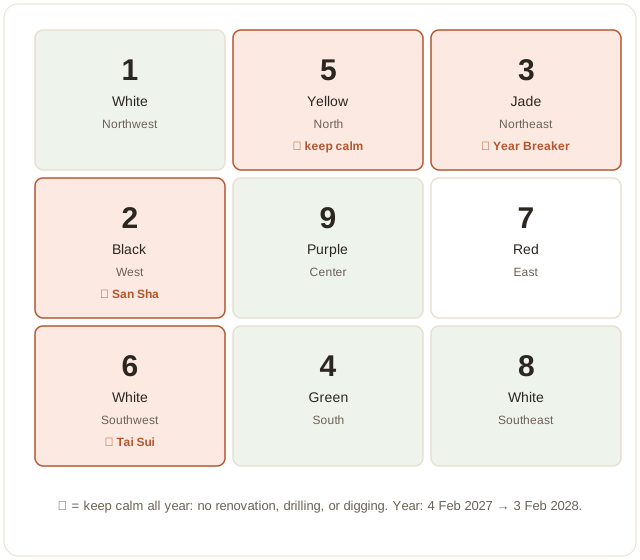
| Sector | Star | Traditional reading |
|---|---|---|
| Center | 9 Purple | Favorable — keep bright and open |
| Southeast | 8 White | Most favorable — use and brighten |
| Northwest | 1 White | Favorable — good for work and study |
| Southwest | 6 White + Tai Sui | Favorable, but respect Tai Sui: no major digging or renovation |
| South | 4 Green | Favorable — study, creativity, romance |
| North | 5 Yellow | Challenging — keep quiet, avoid renovation |
| West | 2 Black + San Sha | Challenging — keep calm and undisturbed |
| Northeast | 3 Jade + Year Breaker | Challenging — keep calm, avoid confrontation |
| East | 7 Red | Challenging — keep secure, watch gossip |
Notice how the chart immediately suggests a plan: spend time in the Southeast, Northwest, and center; keep the North and West quiet; treat the Southwest with respect because Tai Sui sits there. The full year guide, with room-by-room advice, is on the 2027 page.
Two extra terms appear in that chart and deserve a note. Tai Sui is the "Grand Duke" of the year — a traditional directional energy that moves each year (Southwest in 2027) and is treated with respect: no major ground-breaking or renovation facing it. San Sha, the "Three Killings," is a similar caution zone (West in 2027). The practical rule for both is the same: do not start major disruptive work in those sectors that year. That is easy to follow and costs nothing.
How to use the chart without fear
Flying stars cause anxiety when they are presented as fate. They should not be. Here is a sane way to use them:
- Find the year's chart. Use a verified source — this site's annual guide — and confirm the year runs from Lichun to Lichun.
- Locate the favorable sectors in your home. Brighten them, use them more, put your desk or your favorite chair there if it fits naturally.
- Locate the challenging sectors. Keep them clean, quiet, and undisturbed. Postpone major renovation there until next year. That is the entire "cure" for most challenging stars.
- Do not rearrange your life around the chart. If the 5 Yellow lands in your bedroom, you do not need to move bedrooms. Keep the room calm, clean, and well-maintained, and sleep as usual. The chart is a nudge, not an eviction notice.
- Combine with the basics. The annual stars refine the room rules; they do not replace them. A bedroom still needs darkness and quiet, a desk still needs a solid wall behind it, whatever the stars say. The bedroom guide and office guide remain the foundation.
Used this way, flying stars are a genuinely useful annual ritual: once a year, you walk your home with a new map, notice rooms you have been neglecting, and give the good rooms a little more love. That is worth doing even if you treat the stars as pure scheduling fiction. And if the traditional framework resonates with you, it is worth doing for that reason too. Either way, the home gets better — which is the only test that matters.
Go deeper with the book
Feng Shui Made Simple explains the flying stars system in plain English alongside the room-by-room rules, with 9 original diagrams and a 7-day reset plan. For the full 2027 chart, see the companion guide Flying Stars 2027.
Frequently asked questions
What are flying stars?
Flying stars are nine energies — numbered 1 to 9, each with a color and an element — that move around the nine sectors of your home each year. The system is feng shui's timing layer: it says which parts of your home deserve attention in a given year.
Do the flying stars change every year?
Yes. Each year, on Lichun (the start of spring in the Chinese solar calendar, around 4 February), the stars shift to new sectors. The 2027 chart runs from 4 February 2027 to 3 February 2028.
Are some stars bad?
Traditionally, some stars are treated with more caution — especially the 5 Yellow and 2 Black — while others, like the 8 White, 9 Purple, and 1 White, are treated as favorable. The practical advice is simple: keep challenging sectors quiet and undisturbed, and keep favorable sectors bright and active.
Do I need a compass to use the flying stars?
Yes, for the compass version. You need your home's facing direction and a floor plan divided into eight sectors plus the center. The compass reading guide shows how to get the facing direction with a phone.