Feng Shui Staircase Facing the Door: Cures That Work
Open your front door and look in. If the first thing you see is a staircase climbing straight up, you have one of feng shui's classic entrance problems. Energy entering the home — the qi that comes through the "mouth of qi" — rushes straight up the stairs and away, instead of spreading through the floor you actually live on. Traditional texts say opportunity and wealth rush away with it. The practical version is simpler and just as real: your first view of home is a steep climb, not a welcome, and the ground floor feels bypassed rather than inhabited.
This is a flow problem, and flow problems have practical fixes. You do not need to move the staircase, rebuild the entry, or buy anything symbolic. The five cures below all do the same job in different ways: slow the rush, give the eye somewhere pleasant to land, and spread energy through the ground floor. Start with the cheapest and add more until the entrance feels right.
Why the rush happens
Think about how a staircase works visually. It is a strong diagonal line, and the human eye follows strong lines automatically. When that line starts at your front door, your eye — and your attention — shoots upward the moment you walk in. Nothing on the ground floor gets a chance to register: not the living room to the left, not the art on the wall, not the plant by the door. The entrance becomes a corridor to somewhere else, and corridors are not welcoming.
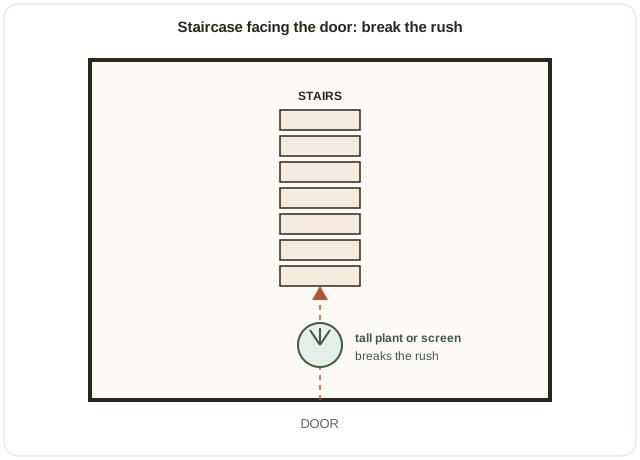
The same logic applies to the other straight-shot entrance problems: a door aligned with a back door or a big window, where energy rushes straight through and out the back. In every case the cure is the same principle: do not block the path — redirect it. You are giving energy, and your eyes, a reason to linger. A staircase you cannot move can still be slowed, softened, and visually broken up.
Distance matters. If there is a hallway or a room between the door and the stairs, the problem is already much smaller — the energy has somewhere to spread before it reaches the climb. The worst case is the door opening directly onto the staircase, with the first step a pace or two inside. Judge your cures by your distance: direct alignment needs several cures; a distant staircase may need only one.
Cure 1: A runner rug on the stairs
The simplest, highest-impact cure. A runner rug changes the staircase in three ways at once: it softens the hard edges of the steps, it adds color and pattern that break the staircase into segments rather than one long diagonal, and it physically slows the ascent — carpeted steps invite a slower pace than bare wood or stone. Choose a warm color and a pattern with some visual weight; a pale, thin runner on pale steps will not break the line enough to matter.
The runner also marks the staircase as part of the home's living space rather than an escape route. Bare, echoing stairs feel institutional; carpeted stairs feel domestic. That shift in feeling is exactly what the cure is for. If a full runner is beyond budget, even a few stair treads — the individual carpet pads for the lower steps — begin the effect where it matters most: at the base, where the eye first meets the climb.
Cure 2: A plant at the base
Place a substantial plant — a tall leafy one in a solid pot — at the base of the stairs, on the side away from the walking path. The plant does two jobs: it softens the hard corner where the staircase meets the floor, and it gives the entering eye a living thing to land on before the staircase takes over. Plants are Wood energy in living form, and a thriving plant at the threshold says "life is welcome here" in a way no object can.
Keep it real and healthy. A dying plant at the base of the stairs sends the opposite message, and you will see it every time you come home. If you kill plants, start with the unkillable trio — pothos, snake plant, ZZ plant — which survive low light and irregular watering. The plant should be big enough to register: a tiny succulent on the bottom step is decoration, not a cure.
Cure 3: Art on the stair wall
Hang artwork along the stair wall, following the rise of the stairs. This breaks the single diagonal into a series of visual stops: the eye climbs step by step, pausing at each picture, instead of shooting to the top in one motion. Choose art you genuinely like and that suits the climb — a series of related prints works better than one large piece, because a series creates rhythm.
Light the art if you can. A small picture light or a well-placed wall washer turns the stair wall into a gallery, and a lit wall is a wall the eye wants to linger on. This cure pairs beautifully with the runner: the runner slows the feet, the art slows the eyes, and together they convert a rush into a stroll.
Cure 4: Redirect the eye at the entrance
If the staircase still dominates, give the entrance a competing focal point. A console table with a lamp and a piece of art on the wall beside the door, a folding screen angled to soften the direct view, or a beautiful rug in the entry itself — any of these tells the entering eye "look here first." The entryway guide covers the landing-zone setup that makes this work: keys, shoes, and bags contained, light bright, doormat clean.
A screen deserves a caution: do not block the path or the light. An angled screen that softens the view is a cure; a screen that turns the entrance into a maze is a new problem. The goal is redirection, not obstruction. The same applies to furniture: a console that gently angles foot traffic is good; a bookcase shoved across the doorway is not.
Cure 5: Light the landing, not just the stairs
Dark staircases feel like tunnels, and tunnels accelerate movement. Light the landing and the ground-floor space around the base of the stairs, so the eye has a bright, welcoming area to settle in before it climbs. A warm lamp at the base, a lit piece of art, or a brighter ceiling fixture in the entry all work. Light is feng shui's most reliable cure for heaviness and rush — before buying any cure for any problem, ask whether the spot is just dark.
What not to do: do not hang a mirror at the top of the stairs facing down, or facing the door from the stair wall — mirrors bounce energy, and in this layout they bounce it straight back out the door or create a startling reflection on the climb. Do not place a sharp, spiky plant at the base either; the goal is softening, and spikes add aggression where you want calm. And do not spend money on symbolic cures — coins, crystals, trinkets hung on the staircase — before trying the structural fixes above. A runner rug and a plant solve the actual problem; a trinket decorates it.
Start this weekend: a runner or stair treads, a plant at the base, one piece of art on the stair wall. Three changes, one afternoon, and the entrance stops feeling like a launch ramp and starts feeling like an arrival. From there, the rest of the ground floor follows the same thinking — see the living room guide and the kitchen guide, or take the whole house through the 7-day reset plan.
Go deeper with the book
Feng Shui Made Simple covers every room this way — bedroom, living room, kitchen, office, entryway — with diagrams and a 7-day plan for doing the whole house.
Frequently asked questions
Is a staircase facing the front door bad feng shui?
It is considered a problem because energy entering the home rushes straight up the stairs instead of spreading through the ground floor. Practically, it also means your first view of home is a steep climb rather than a welcoming room. It is a flow problem, and flow problems have practical fixes.
What is the simplest cure for a staircase facing the door?
A runner rug on the stairs. It visually and physically slows the ascent, softens the hard lines, and makes the staircase feel like part of the home rather than an escape route. Add a plant at the base and artwork on the stair wall for the full effect.
Does a staircase facing the door drain wealth?
Traditional texts say energy — and with it opportunity — rushes up and away instead of settling. No cure promises wealth. What the cures actually do is slow the flow so the ground floor feels lived-in and welcoming, which is a real, felt improvement.
Can I fix it if I rent and cannot change the stairs?
Yes. Every cure on this page is renter-friendly: a runner rug, a plant at the base, art on the wall, a light at the landing, and a screen or console that redirects the eye. None of them require drilling into the staircase or altering the structure.
What if the stairs face the door but are far away?
Distance helps a lot. If there is a hallway or a room between the door and the stairs, the energy already has somewhere to spread. A rug or plant in the intervening space is usually enough — the problem is worst when the door opens directly onto the staircase.