Southwest Sector: Love and Relationships
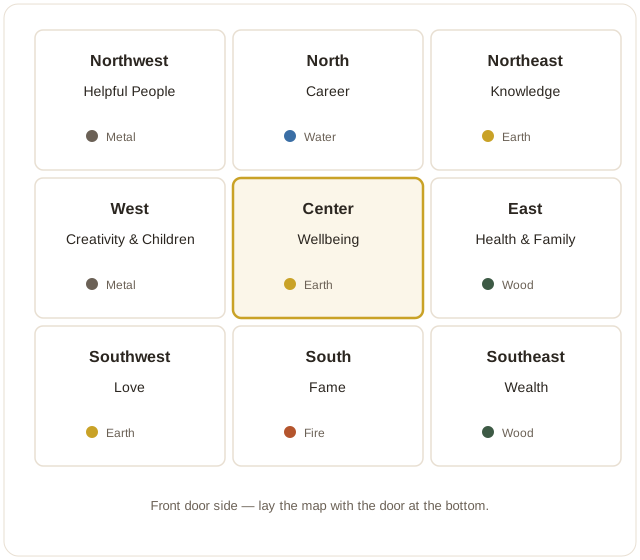
The southwest sector is linked with love and relationships — partnership above all, but also the wider web of close relationships: family, deep friendship, the people a household is built around. Its element is earth, and earth here means receptivity and steadiness: the ground that supports a relationship rather than the spark that starts one. A southwest sector that feels warm, comfortable, and shared supports the unglamorous daily work of getting along. A southwest sector that is neglected, used as storage, or furnished for one person only quietly says the opposite.
Finding the southwest sector
From the center of your home, the area lying to the southwest is the sector — the bottom-left square on a three-by-three bagua grid drawn with north at the top. Southwest rooms get afternoon and evening sun, which suits rooms used later in the day: bedrooms and living rooms above all. The bagua map guide and the floor-plan guide explain the mapping for irregular plans.
If your southwest is a bedroom, you have the classic arrangement, and this guide's bedroom advice applies directly. If it is a living room, the same principles apply in shared form. If it is a kitchen, bathroom, or hallway, keep it warm, clean, and in repair, and the sector will do its work quietly — the bagua does not demand that every sector be a showcase.
Earth, warmth, and pairs
Southwest earth is warm and receptive: its colors are yellow, sand, terracotta, and warm brown, with pink as a traditional accent for this sector. Its shapes are square and low; its materials are ceramic, stone, and solid wood. A southwest room furnished this way feels settled and sheltering — a room you sink into rather than pass through.
Fire feeds earth, so warm accents — candlelight, coral or red cushions, a warm lamp — strengthen the sector gently. The traditional symbol of the southwest is pairs: two cushions, two candles, two bedside tables, two cups. The practical point behind the symbol is worth stating plainly: a room furnished for two people, with space and comfort for both, feels shared, while a room with one chair, one bedside table, and one lamp feels like one person's room that someone else visits. Furnish for both people, whether or not a partner currently shares the room. The feng shui for love guide covers the relationship side in more depth, and the pink and purple guide covers the accent colors.
The southwest bedroom
If the southwest is a bedroom, it deserves the most care of any room in this guide, because it is where partnership is most daily. Both sides of the bed should be accessible, with a bedside table and a lamp on each side — not one side against the wall, which makes one person climb over the other and quietly assigns the room to a single occupant. The bedroom guide covers the bed position and the command position in full.
Bedding should be comfortable for both sleepers, in warm, soft colors — sand, blush pink, warm cream, muted terracotta — rather than one person's favorite color imposed on both. Keep work out of the southwest bedroom as far as possible: a laptop on the bed or a desk facing the bed imports the working day into the room meant for rest and closeness, and both suffer.
Art in a southwest bedroom should depict togetherness in a way that feels true to the household: a photo of the couple, a landscape with two figures, a pair of birds — not a single figure alone, and not a crowded gallery wall. One or two pieces, chosen together, beat a wall of art chosen by one person.
The southwest living room
If the southwest is a living room, the same shared-room logic applies at larger scale: seating for conversation, not just for television. Two armchairs facing each other, or a sofa with chairs arranged so people can see each other's faces, invites talk; a single row of seats facing a screen invites silence. The living room guide covers the seating layout.
Warmth matters here more than formality. A southwest living room should be the room where people actually sit in the evening: warm light, soft textiles, a rug underfoot, and something pleasant to look at that is not a screen. If the room is currently the household's least-used room, ask why — is it cold, dark, cluttered, or furnished for display rather than sitting? Fixing that one room often does more for a household's shared life than any symbolic gesture.
For single people, the southwest still matters. Furnishing it for two — two chairs, two settings at the table, space for a guest — is not superstition; it is a practical statement that the household has room for another person, and guests notice the difference immediately.
What to avoid in the southwest
The storage-room trap is the main one: spare rooms and quiet corners collect boxes, and the southwest, being calm, collects them readily. A southwest full of boxes says the household's shared life has no room of its own. Clearing it is the single most effective change available.
Also avoid: a bedroom furnished for one person — one bedside table, one lamp, one side of the bed blocked; sharp, aggressive decor dominating a room meant for closeness; a television as the room's focus in a bedroom; and images of solitude or conflict as the main art. None of these dooms a relationship, but all of them shape the daily feeling of the room, and daily feeling is what a relationship is made of.
Finally, avoid the idea that the sector does the work alone. A beautiful southwest bedroom does not repair a relationship that is not being tended elsewhere. What it does is remove friction from the daily hours — comfortable, shared, warm — so that tending the relationship is easier. That is a real contribution, and it is enough.
A brief note on the annual stars
The southwest carries a special annual note in both years: it holds Tai Sui, the Grand Duke, in both 2027 and 2028, alongside 6 White in 2027 (4 February 2027 to 3 February 2028) and 5 Yellow in 2028 (4 February 2028 to 3 February 2029). Tradition advises against noisy renovation and ground-breaking in a Tai Sui sector, and against sitting with your back to it for long periods. Keep the southwest calm, well-kept, and in good repair in both years, and use it for rest and quiet shared time rather than disruption.
The permanent sector does not change: southwest is earth, linked with love and relationships, in both years. The 2027 flying stars guide, the 2028 chart, and the Tai Sui 2027 guide cover the annual layer.
Go deeper with the book
Feng Shui Made Simple covers every room this way — bedroom, living room, kitchen, office, entryway — with diagrams and a 7-day plan for doing the whole house.
Frequently asked questions
What element is the southwest sector?
Earth. Its colors are yellow, sand, terracotta, and warm brown, with pink as a traditional accent. Fire colors (red, coral, candlelight) support it, since fire feeds earth.
Why pairs in the southwest?
Pairs symbolize partnership, but the practical point matters more: a room furnished for two people — two bedside tables, two lamps, both sides of the bed accessible — feels shared, while a room furnished for one feels like one person's room.
Is the southwest good for a bedroom?
Yes — it is the classic fit, especially for couples. Both sides of the bed accessible, warm soft colors, work kept out, and art that depicts togetherness are the key choices.
What if I am single? Does the southwest still matter?
Yes. Furnishing the southwest for two — two chairs, space for a guest — is a practical statement that the household has room for another person, and guests notice the difference.