Walk-in Closet and Storage Feng Shui: Clutter's Last Stand
Every house has a place where clutter makes its last stand, and it is usually the closet. The rest of the home gets tidied for guests, but the closet door closes, and behind it anything goes: clothes that no longer fit, bags from three holidays ago, a box labelled "misc" that nobody has opened since moving in. Feng shui calls this stagnant qi — energy that cannot move — and you do not need to believe in qi to feel it. You open the closet every morning, and a chaotic closet starts the day with a dozen small decisions and a low-grade feeling of being behind.
A good closet does the opposite: it makes mornings easy. You can see what you own, reach what you wear, and ignore the rest because the rest is properly stored. This guide covers the three zones that make that possible, the light and air a closet needs, the mirror question, and the one rule that stops the closet refilling after you clear it.
Zone it: daily, seasonal, and out the door
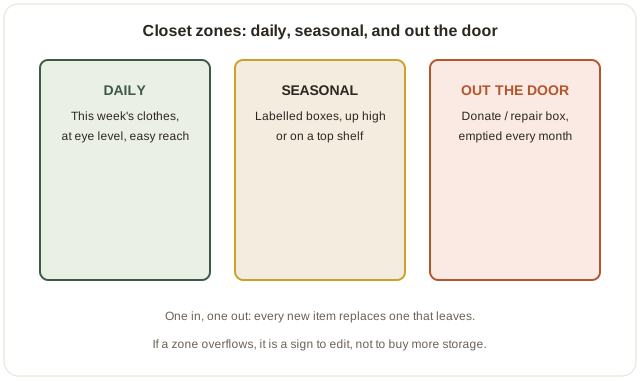
Divide the closet into three zones, and be strict about the boundaries. The daily zone holds what you wear this week, at eye level and within easy reach: hanging clothes grouped by type, everyday shoes on a low rack, accessories in one drawer or tray. If getting dressed takes more than a few minutes of choosing, the daily zone is too big — it has absorbed things you do not actually wear.
The seasonal zone holds everything else you keep, in labelled boxes or on a high shelf: winter coats in summer, summer clothes in winter, occasion wear, spare bedding. Label the boxes on the outside, not just the lid, so you can find things without opening five boxes. The point of the seasonal zone is that you visit it a few times a year, not every morning, so it can live up high and out of the way.
The third zone is the one most closets lack: the out-the-door zone. A bag or box, permanently in or beside the closet, for things leaving the house — donations, repairs, returns. When you try something on and it does not fit or you do not love it, it goes in the box immediately, not back on the rail "for now." Empty the box monthly. Without this zone, decluttering is a rare event; with it, it is a habit.
Closed storage beats open piles
Open shelving in a closet looks good in showrooms and chaotic in real life, because folded clothes slump, stacks topple, and dust settles on everything. Use closed storage wherever you can: drawers for folded clothes, boxes with lids for small items, doors on the closet itself. Closed storage does two things at once: it keeps dust off, and it hides the visual noise so the closet feels calm when you open it.
That calm matters more than it seems. A closet is a small room, and a small room full of visible clutter feels cramped in a way a large room does not. Doors and drawers turn a hundred objects into a few clean surfaces, and clean surfaces let your eye find what you need. If your closet has no doors, a curtain across the opening does much of the same work — and it also keeps the closet's contents from facing the bed, which matters if the closet opens directly onto the bedroom.
The floor of the closet deserves the same treatment. Shoes on a rack, not in a pile by the door; nothing stored directly on the floor except in a sealed box. A closet floor you can see is a closet floor you can clean, and a closet you can clean is a closet that does not smell musty. Our small apartments guide applies the same closed-storage rule to the whole home.
Light, air, and the mirror
Closets are often the darkest, stuffiest rooms in the house, and dark stuffy rooms hide problems: moths, damp, a stain you did not notice. If the closet has a light, use a bright one, and put it on a switch you will actually use — a light you have to fumble for stays off. If there is no wired light, a battery motion-sensor light on the ceiling costs little and changes the room completely. You cannot choose clothes well in the dark, and you cannot spot what needs repair or cleaning.
Air the closet regularly. Open the door for a few hours on a dry day, especially after a damp season, and do not pack clothes so tightly that air cannot move between them. Clothes crammed shoulder to shoulder trap moisture and wrinkle each other; leave a finger's width between hangers where you can. A small sachet of cedar or lavender is fine for scent, but it is not a substitute for air and space — and strong chemical fresheners in a small enclosed space are worse than the problem they claim to solve.
A full-length mirror inside the closet, or just outside it, is practical: you check the outfit where you put it on. The one caution is placement relative to the bed. If the closet opens onto the bedroom, do not mount a mirror on the closet door facing the bed — reflected movement at night is the same problem covered in our mirror-facing-bed guide. Put the mirror on a side wall inside the closet, or on the bedroom wall beside the closet, instead. Our mirrors guide covers the wider mirror rules.
What to remove, and the one-in-one-out rule
Clearing a closet is not hard; keeping it clear is. Start with the obvious: anything damaged beyond repair, anything you have not worn in a year, anything kept out of guilt — the gift you never liked, the expensive mistake you keep hoping to grow into. Guilt is not a storage category. Photograph sentimental items if you need to, then let the object go; the memory survives without the sweater.
Then adopt the rule that keeps the closet clear: one in, one out. Every new item replaces one that leaves, immediately, not eventually. Buy a shirt, donate a shirt the same day. This rule sounds strict and feels easy once it is a habit, because it ties the pleasant act of buying to the small act of letting go, and it caps the closet at its current size. Without a rule, a cleared closet refills in a season — not because you are careless, but because clothes keep arriving and nothing keeps leaving.
Apply the same logic to storage beyond the closet. The spare room, the garage, the top of the wardrobe — all of them fill by the same mechanism: things arrive, nothing leaves, and the space slowly stops being usable. Our garage guide and basement guide cover those rooms, and the rule is identical. Storage is not a place where things go to be forgotten; it is a place where things wait to be used, and things that will not be used should leave.
Small closets and no closet at all
No walk-in closet? The same zones work in a wardrobe or even a single rail. Daily clothes at eye level on the rail, seasonal clothes in a box on top of the wardrobe, a donate bag hanging on the wardrobe door. A small, well-zoned wardrobe beats a large chaotic closet every time, because the constraint forces decisions. If you can only keep fifty hangers, you keep the fifty you wear.
If you share a closet, divide it fairly and visibly — one side each, or one rail each — and respect the boundary. Shared closets fail when one person's overflow colonizes the other's space, and the argument that follows is rarely about the clothes. A clear division, agreed once, prevents a hundred small resentments. The same fairness applies to shared storage elsewhere in the house.
Start this weekend with one bag and one hour. Fill the bag with what you do not wear, put a permanent donate box in the closet, and move the seasonal boxes up high. The closet will not stay perfect — no closet does — but with zones and one-in-one-out, it will stay usable, and usable is what a closet is for.
Go deeper with the book
Feng Shui Made Simple covers every room this way — bedroom, living room, kitchen, office, entryway — with diagrams and a 7-day plan for doing the whole house.
Frequently asked questions
Why does feng shui care about closets if the door is closed?
Because you open that door every morning, and a chaotic closet starts the day with a dozen small decisions and a feeling of being behind. Hidden clutter still affects you: it is the first thing you see, and the thing you avoid dealing with.
Should a closet have a mirror?
A full-length mirror inside the closet or just outside it is practical for checking an outfit. Do not put a mirror facing the bed if the closet opens onto the bedroom, and keep mirrors off the closet door if that door faces the bed.
How do I stop a closet filling up again after I clear it?
Use one-in-one-out: every new item replaces one that leaves, immediately, not eventually. Keep a permanent donate box in or near the closet, and empty it monthly. Without a rule, a cleared closet refills in a season.
What if I have no walk-in closet, just a wardrobe?
The same zones apply in miniature: daily clothes at eye level, seasonal boxes up high, a donate bag on the wardrobe door. A small, well-zoned wardrobe beats a large chaotic closet every time.
Should broken or unworn clothes stay in the closet?
No. Clothes needing repair go in one small repair box with a deadline, and clothes unworn for a year go in the donate box. A closet should hold what you wear now, not a record of past sizes, past jobs, and past intentions.