What Is Feng Shui? A Beginner's Guide in Plain English
Feng shui (pronounced "fung shway") began in ancient China more than 3,000 years ago. The words literally mean "wind" and "water" — the two natural forces that shaped where people built their homes.
Three thousand years in five minutes
Choosing a homesite was once a survival decision. Farmers watched how wind moved across a valley, where water collected after rain, which slopes caught the morning sun and which stayed damp and cold. Villages that read the land well thrived. Villages that didn't got sick, flooded, or frozen out.
Over centuries — through the Han, Tang, and Ming dynasties — these observations grew into a detailed system. Scholars wrote manuals on arranging homes, courtyards, villages, and eventually entire imperial capitals. Beijing's Forbidden City, built in the 1400s, is essentially a giant feng shui diagram in stone and timber: south-facing gates, protective hills behind, water features placed with intention.
Feng shui reached the West in the 1970s and 80s, carried by architects, travelers, and a growing appetite for Eastern ideas about well-being. Like many imports, it got simplified, commercialized, and occasionally mangled along the way. This site is an attempt to bring it back to what it actually is: practical wisdom about spaces, minus the mystique markup.
Here is the key insight those ancient observers landed on: the spaces we live in shape how we feel, think, and act. A dark, cramped room makes people tense. An open room with good light makes them relax. Feng shui is simply the oldest organized attempt to get this right on purpose.
Qi: the energy of a place
The central idea in feng shui is qi (pronounced "chee"). Qi is the energy — or life force — that flows through every space.
If "energy" sounds vague, try this. Walk into a sunlit café with high ceilings, plants everywhere, and music at just the right volume. Now walk into a windowless basement storage room with flickering lights and a smell of damp cardboard. You feel the difference instantly. Your shoulders drop in the first place and tighten in the second.
That difference is what feng shui calls qi. Good qi feels fresh, bright, and easy to move through — like a mountain stream. Stagnant qi feels heavy and dull — like a pond nobody has tended. Rushing qi feels chaotic and agitating — like standing in a wind tunnel. Almost everything in feng shui is about encouraging the first kind and fixing the other two.
Notice these are metaphors, not measurements. That is fine. You don't need to see qi or quantify it. You just need to notice how rooms feel — which, it turns out, you are already good at. Every "vibe check" you have ever done walking into a room was an informal qi reading.
Yin and yang: the two modes
Everything in feng shui comes in two modes: yin and yang. Yang is active energy: daylight, noise, movement, bright colors, social buzz, heat. Yin is quiet energy: darkness, stillness, soft textures, solitude, coolness.
Neither is good or bad — they are a pair, like inhale and exhale. A lively restaurant should lean yang. A bedroom should lean yin. A home office needs a working balance: yang enough to stay alert, yin enough to think deeply.
Problems start when a room has the wrong mode for its job. Trying to sleep in a room buzzing with yang energy — bright lights, a humming computer, visual chaos — is fighting your own nervous system. Trying to host a dinner party in a dim, silent, cave-like room kills the mood before anyone arrives.
A quick mode guide for your home:
- Front door & entryway: gently yang — bright, welcoming, alive
- Living room: balanced, leaning yang in the evening — social and warm
- Kitchen: yang while cooking, calm otherwise — functional and warm
- Bedroom: strongly yin — dark, quiet, still
- Bathroom: yin with good light — clean and calm
- Home office: balanced yang — alert but not agitated
Most feng shui "rules" are really just this: match the room's energy to what you do in it. Once you see that, the whole system starts to make sense — and you can improvise your own rules with confidence.
The five elements: five flavors of energy
Feng shui describes the world through five elements: Wood, Fire, Earth, Metal, and Water. Don't think of these as literal substances. Think of them as five flavors of energy, each with its own colors, shapes, materials, and mood.
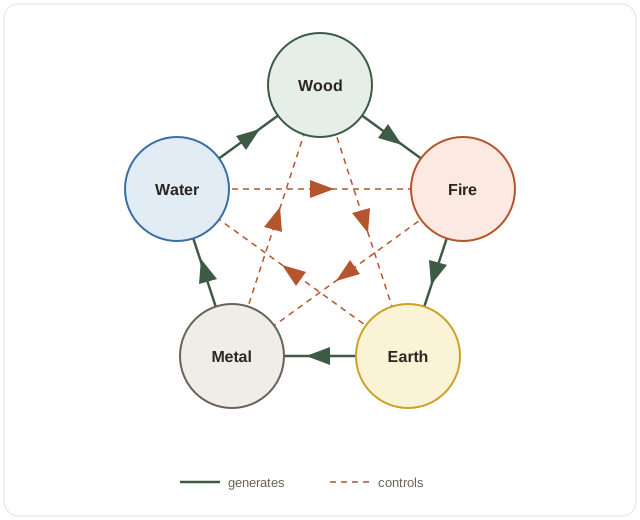
- Wood is growth — plants, green colors, tall columnar shapes, the feeling of spring.
- Fire is excitement — candles and sunlight, reds and oranges, triangular shapes, the feeling of a celebration.
- Earth is stability — stone and clay, yellows and browns, square shapes, the feeling of solid ground.
- Metal is clarity — white and gray, round shapes, clean lines and reflective surfaces, the feeling of a crisp morning.
- Water is flow — blues and black, wavy and irregular shapes, mirrors and glass, the feeling of a quiet lake.
These five elements are the decorating language behind the whole system. The full guide — including how the elements feed and control each other — is on the Five Elements page, and the color version of the same idea is the Feng Shui Colors Cheat Sheet.
What feng shui is not
Three honest disclaimers, because the internet is full of the opposite:
- It is not fortune-telling. Feng shui does not predict your future, read your fate, or replace your decisions. It arranges your environment; you still run your life.
- It is not shopping. A cure is an adjustment — moving furniture, adding light, clearing a corner — not a purchase. Anyone who tells you a specific expensive object is required is selling, not teaching.
- It is not a guarantee. No arrangement of furniture promises wealth, love, or health. What good feng shui reliably does is make your home calmer, easier to use, and better matched to what you do in each room. That is a real benefit, and it is enough.
How to start tonight
You don't need a course, a consultation, or a single purchase. Do three things:
- Walk your home like a guest. Enter through the front door and notice what you see, smell, and trip over. The entry sets the tone for everything behind it.
- Pick the room that bothers you most — usually the bedroom — and apply its rules. The bedroom guide has ten, and none of them cost money.
- Lay the bagua map over your floor plan. It takes ten minutes and shows you which part of your home connects to money, love, health, or career — and what that part of your home looks like right now.
Then notice what changes. Not in your bank account — in your sleep, your mornings, and how the house feels when you walk in. That feeling is the whole point.
Go deeper with the book
This guide is the introduction. Feng Shui Made Simple walks every room in your home — entryway, living room, bedroom, kitchen, office — with the full rules, 9 original diagrams, and a 7-day reset plan.
Frequently asked questions
Is feng shui a religion?
No. Feng shui is a traditional Chinese practice of arranging space. It grew out of observations about land, light, wind, and water, and it works as a design philosophy whether or not you hold any spiritual beliefs.
Do I need to believe in qi for feng shui to work?
No. Most feng shui rules have a practical core: a bed facing the door helps you feel safe, a bright entry feels welcoming, a cluttered room feels stressful. You can use the rules for those reasons alone.
How much does it cost to start with feng shui?
Nothing. The highest-impact changes — moving a bed, clearing clutter, fixing a broken lamp, closing a door at night — are free. Feng shui is mostly about arrangement, not shopping.
Can feng shui make me rich or healthy?
No, and any source promising that is selling something. Feng shui can make your home calmer, your sleep better, and your rooms easier to use — and those things genuinely support a better life. Guarantees of wealth or health are not part of honest feng shui.