House Facing Directions: What Each of the 8 Facings Means
Every house faces somewhere. Stand at your front door, look outward, and the direction you face is your house's facing direction — the single most basic fact in feng shui, and the one people most often get wrong by guessing instead of measuring. This guide explains how to find yours, what each of the eight facings traditionally means, and — just as important — how much weight to give it.
First, a note on expectations. Facing direction is one layer of feng shui, not the whole of it. A south-facing house is not automatically fortunate, and a north-facing house is not automatically unfortunate. Light, layout, noise, and the rooms you actually live in matter at least as much. Read the eight meanings below as traditional associations — tendencies and characters, not verdicts — and use them to understand your home better, not to judge it.
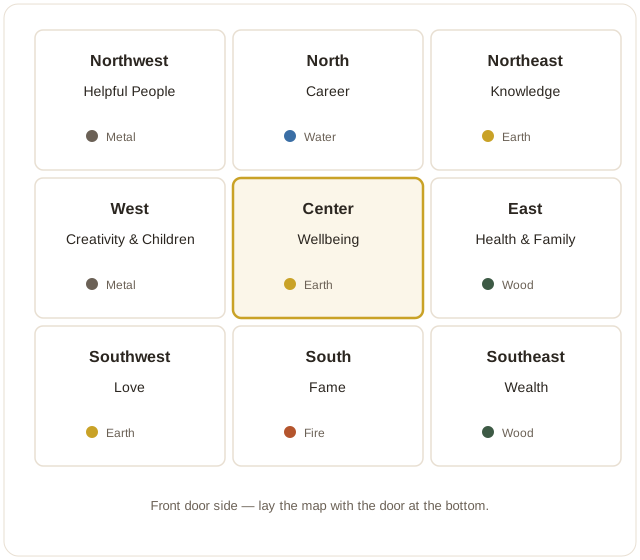
The eight facings map to the eight sectors of the bagua, the energy map of the home. Each sector has an element, a life area, and a character. When your house faces a direction, that sector's character is said to color the home's public face — what the world meets first when it comes to your door.
How to find your facing direction
Stand at your front door, facing outward, and read a compass — a phone compass works fine if you hold it flat and away from metal. The direction you face is your facing direction. If the reading falls near a boundary between two directions, step back from the door's metal fittings and try again from the garden or street, facing the same way; metal and electronics can skew a phone compass by several degrees.
Two complications are common. First, if your home's main entrance is not the front door — if you actually enter through a side door or a garage door every day — then that door's direction is the practical facing, because it is the mouth through which the household's daily life flows. Second, apartments: use your own front door, not the building's entrance, unless you want the building's character rather than your home's. The compass guide and the facing-versus-sitting guide cover the technique and the facing-sitting distinction in full.
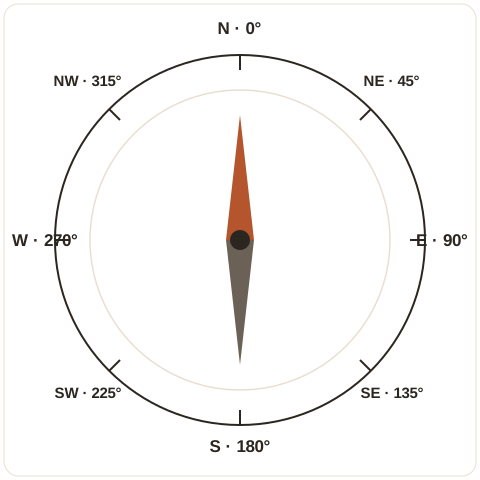
The eight facings
Facing North — Career, Water. A north-facing home looks toward the career sector, and tradition associates it with a steady, reflective character: good for people building a career or a quiet professional life. Practically, north-facing fronts get the least direct sun in the northern hemisphere, so the entry may be cool and dim — brighten it with good lighting and light colors, as the entryway guide suggests.
Facing Northeast — Knowledge, Earth. The northeast is the knowledge sector, associated with study, reflection, and careful decisions. A northeast-facing home is said to suit students, writers, and anyone whose work needs concentration. Its element is Earth, so earthy tones and stone or ceramic at the entry suit it naturally.
Facing East — Health and Family, Wood. East is the health and family sector, Wood's direction, and the direction of the sunrise. An east-facing home gets morning light at the front, which suits early risers and families with children — the front rooms wake up bright. Wood's colors are green, and plants at an east-facing entry thrive in the morning sun.
Facing Southeast — Wealth, Wood. The southeast is the wealth sector, also Wood. Tradition links a southeast-facing home with growth and prosperity, and the morning-to-midday light suits living rooms and studies placed at the front. Keep the entry clear and welcoming: a blocked southeast entry is traditionally read as blocked growth, and practically, a blocked entry is unwelcoming whatever direction it faces.
The eight facings, continued
Facing South — Fame, Fire. South is the fame sector and Fire's direction, and in the northern hemisphere it is the brightest facing of all. A south-facing home gets sun through the middle of the day, which suits living rooms and makes the whole house feel warm and visible — fitting for fame's association with recognition and reputation. The trade-off is summer heat: south-facing rooms need shading, curtains, or shutters in hot months, or the brightness becomes glare.
Facing Southwest — Love, Earth. The southwest is the love and relationships sector, Earth's direction. Tradition associates a southwest-facing home with partnership and family harmony, and its afternoon light suits living rooms where people gather at the end of the day. Earth tones — warm browns, terracotta, soft gold — suit a southwest entry.
Facing West — Creativity and Children, Metal. West is the creativity and children sector, Metal's direction, and the direction of the sunset. A west-facing home gets strong evening light, which suits dining rooms and living rooms used in the evening, but it also gets the day's heat late — west-facing rooms are the ones that roast on summer evenings. Good shading matters more here than in any other facing.
Facing Northwest — Helpful People, Metal. The northwest is the helpful people sector, also Metal, associated with mentors, friends, and support. Tradition says a northwest-facing home attracts helpful connections, and its late-day light suits an entry or study used in the evening. Metal colors — white and gold — suit the entry, and a tidy, well-lit front suits the sector's character of reliable support.
The Center — Wellbeing, Earth. The center is not a facing — no front door faces the center — but it completes the map. The center is wellbeing and Earth, the balance point of the home, and it is affected by whatever the whole house does: keep it open, uncluttered, and well-lit, and the rest of the map works better. The bagua guide shows the full map with all nine sectors.
What facing direction does not do
Facing direction does not decide your fortune, and it does not override the rest of the house. A south-facing home with a dark entry, a cramped layout, and a bedroom beside a noisy road is still a difficult home; a north-facing home with a bright entry, a sensible layout, and quiet bedrooms is still a good one. The annual flying stars are a separate layer too: in 2027 the center holds 9 Purple, the north holds 5 Yellow, and the west holds 2 Black with San Sha, and in 2028 the center holds 8 White and the southwest holds 5 Yellow with Tai Sui — these year stars sit in their sectors regardless of which way your front door faces.
Nor should facing direction decide a purchase on its own. When choosing an apartment or a house, weigh facing alongside light, noise, layout, and location. A facing you love on a noisy road is a worse choice than a facing you feel neutral about on a quiet street. And if you already live in a home whose facing you dislike, do not try to change the facing — change what you can: the entry's light, the front garden, the colors at the door. The front door color guide shows how a door's color can support its direction without rebuilding anything.
Use facing direction the way a good doctor uses a single test result: as one piece of information among many, interesting in context and misleading alone. Find your facing, learn its character, and then get on with the work that matters more — the entry, the light, the layout, and the rooms you actually live in.
Go deeper with the book
Feng Shui Made Simple covers every room this way — bedroom, living room, kitchen, office, entryway — with diagrams and a 7-day plan for doing the whole house.
Frequently asked questions
How do I find my house's facing direction?
Stand at your front door, facing outward, and read a compass. The direction you face is your house's facing direction. For most homes this is the direction of the front door; if your home's main entrance is a side or back door you actually use, that door's direction is the practical facing.
What is the difference between facing and sitting direction?
Facing is the direction the front of the house looks toward; sitting is the opposite direction, the direction the back of the house rests against. If your house faces south, it sits north. Both are used in feng shui, but facing is the one most people mean when they ask about their house's direction.
Is there a best facing direction?
No single best direction exists. South-facing homes get the most light in the northern hemisphere, which suits most people, but the best facing for you depends on your climate, your street, and which rooms face which way. A north-facing home with a bright, sheltered garden can be better than a south-facing home on a noisy road.
Does facing direction affect the annual flying stars?
Annual flying stars are mapped by sector of the home, not by facing direction alone. For example, in 2027 the center holds 9 Purple, the north holds 5 Yellow, and the west holds 2 Black with San Sha, regardless of which way your front door faces. Facing direction and annual stars are two separate layers.
Can I change my house's facing direction?
Not without rebuilding, so do not try. If you dislike your facing, work with what it gives you: improve the light, the entryway, and the rooms on the side you like best. Facing direction is one factor among many, and a well-arranged home with an ordinary facing beats a poorly arranged home with a celebrated one.