How to Choose a Feng Shui-Friendly Apartment
An apartment viewing lasts twenty minutes, but you will live with the choice for years. Most buyers and renters spend those twenty minutes looking at the kitchen worktops and the bathroom tiles — the things that are easiest to change — and almost no time on the things that are hardest to change: the entryway, the light, the shape, and the noise. Feng shui is a useful viewing checklist precisely because it asks about the unchangeable things first.
This guide is ordered the way a viewing should be: start outside the front door, then work inward. Bring it on your phone, and check the items in order. No single item should decide the purchase alone.
One note before you start: no apartment is perfect, and a perfect apartment at the wrong price or in the wrong neighborhood is not a good choice. Use this list to compare two real options, not to disqualify everything on the market.
Outside the door: the building and the street
Start before you enter. Is the building's entrance welcoming — clean, lit, and easy to find — or dark, cluttered, and confusing? You will walk through it twice a day, and a grim entrance drags the mood down before you even reach your door. Check the street too: a busy road means noise, dust, and headlights, while a quiet side street means calmer sleep. Visit at rush hour and at night if you can; a street that is peaceful at 11 a.m. on a Saturday may be a delivery route at 7 a.m. on a weekday.
Look at what the apartment faces. A view of a park, trees, or open sky is genuinely restorative — people pay for it for good reason. A view of a blank wall, a rubbish area, or a sharp building corner is not a disaster, but it is something you will look at every day, and curtains can only soften it so much. If the apartment faces a T-junction or a road pointing straight at it, read the T-junction guide for how that fast, head-on energy is traditionally handled and what actually helps.
The front door and entryway
The front door is the most important single feature in apartment feng shui, because it is where everything enters: you, your guests, your groceries, and, in feng shui terms, the home's energy. Open it fully during the viewing. Does it hit furniture, a wall, or a shoe rack? A door that cannot open all the way is a daily frustration and a bad first impression, and it is often a sign the entryway is too small for the apartment's real life.
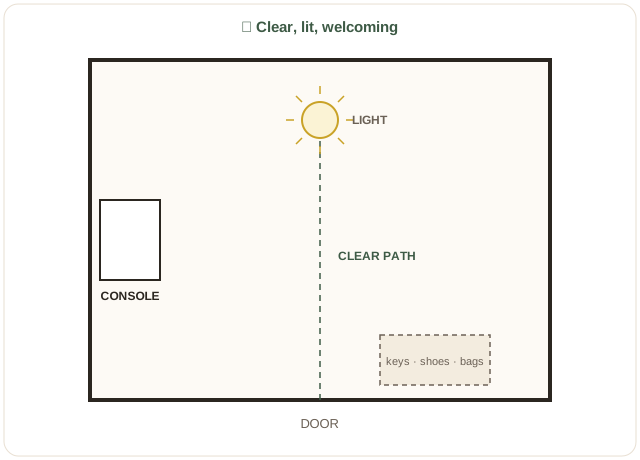
Step inside and look: does the entry open into a real room, or into a long, dark corridor? An entry that opens into light and space feels welcoming; an entry that funnels you down a tunnel feels cramped from the first second. Check for a place to put shoes, coats, and keys — if there is none, clutter will pile up by the door within a week. The entryway guide covers the fixes, but during a viewing you are judging whether the space allows a fix at all.
Light, air, and noise
Light is the second great unchangeable. Visit during the day and notice which rooms get sun and when. A living room that gets morning light feels energetic; one that gets only late-afternoon sun in winter can feel dim for months. South-facing rooms get the most light in the northern hemisphere, but they also get the most summer heat — check whether the windows have shutters, curtains, or external shading, and whether the apartment overheats in summer.
Open a window. Can you hear traffic, a bar, a school playground, or a neighbor's television? Noise is the most common reason people regret an apartment, and it is the hardest to fix after moving in. Check the window seals: double glazing that is old or poorly fitted lets in far more noise than new units. And check ventilation — can you get a through-draft by opening windows on two sides, or does air sit still? A home that cannot be aired feels stale no matter how it is decorated.
While you are at it, look at the ceiling height. Low ceilings press down on a room and make it feel smaller than its floor area suggests; the low-ceilings guide has fixes, but a viewing is the time to notice the problem. High ceilings are a genuine asset in a small apartment, because they give the eye room to breathe.
Shape and layout
Now look at the shape. A roughly square or rectangular apartment is the easiest to lay out: furniture fits naturally, rooms connect sensibly, and there are few dead corners. A very long, narrow apartment — the classic "railway" layout — forces you to walk through one room to reach another, which costs privacy and makes the middle rooms dark. An L-shaped apartment can be wonderful, with a natural separation between living and sleeping areas, but it may have a missing area that needs attention; the L-shaped and U-shaped guide explains how to work with that.
Walk the layout as you would live it. From the front door, can you reach the bathroom at night without crossing the living room? Is the kitchen near the dining area, or will every meal be a trek? Is the bedroom far enough from the front door that a guest arriving late does not wake the sleeper? These flow questions are feng shui in practical form: a home whose rooms connect sensibly feels calm, and one whose rooms fight each other feels tiring.
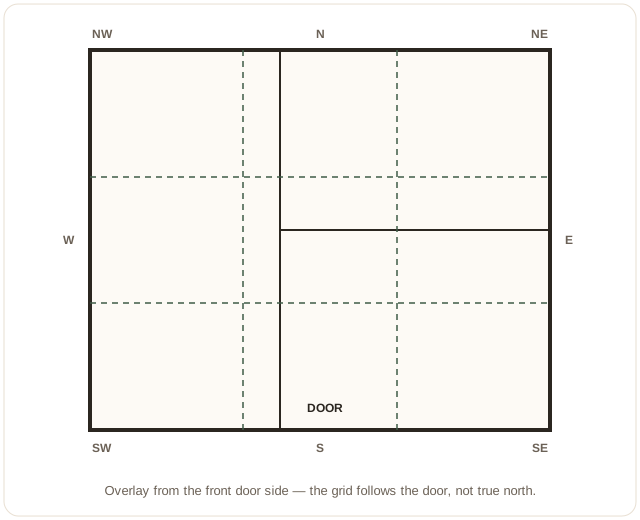
Check the bathroom and kitchen positions too. A bathroom door facing the front door, or a kitchen directly above or below a neighbor's bathroom, is traditionally flagged — and practically, a bathroom visible from the entry is simply unappealing. The floor plan guide shows how to read a plan with the bagua overlaid, which is a useful exercise for any apartment you are seriously considering.
The rooms that decide it
The bedroom decides sleep, so check it carefully. Is it quiet — not facing the road, the lift, or a neighbor's living room wall? Is there space for a bed with room on both sides, and a solid wall for the headboard rather than a wall shared with a bathroom or a window? A bedroom that fails these tests will cost you sleep, and no amount of decoration fixes a bedroom beside a lift shaft. The bedroom guide lists the full setup, but the viewing questions are just these three: quiet, solid wall, and space on both sides.
The kitchen decides daily ease. Is there enough counter space to actually cook, and enough storage that the counters can stay clear? A kitchen that forces everything onto the counter will look cluttered no matter how tidy you are. The living room decides whether the apartment feels generous: is there a wall long enough for the sofa, a place for a rug that fits the seating group, and a window that gives the room a view rather than a blank wall? The small-apartments guide is essential reading if the apartment is compact, because it shows how small spaces can still feel calm.
Finally, check storage. Apartments fail on storage more than on anything else, and a home without storage becomes a home full of visible clutter. Count the cupboards, check the hallway for a closet, and ask about basement or attic space. If the apartment has no storage, your furniture will have to provide it, and that costs floor space you may not have.
Using the checklist
Score each apartment you view on the five things you cannot change: entryway, light, noise, shape, and bedroom quiet. Everything else — paint, curtains, rugs, furniture — is fixable, and the renters guide shows how much can be changed without the landlord's permission. If two apartments are close on price and location, the one that scores better on the unchangeable five is the one you will be happier in a year from now.
And if you fall in love with an apartment that fails one item — a noisy road, a dark entry, an awkward shape — ask whether the fix is real. Noise can be fixed with better glazing; a dark entry can be fixed with lighting; an awkward shape can be fixed with furniture. But a fix that costs money you do not have, or permission you cannot get, is not a fix. Be honest about which category each flaw falls into, and choose the apartment whose flaws you can actually live with — or actually fix.
Go deeper with the book
Feng Shui Made Simple covers every room this way — bedroom, living room, kitchen, office, entryway — with diagrams and a 7-day plan for doing the whole house.
Frequently asked questions
What is the most important feng shui feature when choosing an apartment?
The entryway and the front door. You will use them every day, and they set the tone for the whole home. A bright, unobstructed entry that opens into a real room beats a dark corridor entry every time, and a front door that opens fully without hitting furniture is a small detail that affects daily life constantly.
Is a top-floor or ground-floor apartment better for feng shui?
Neither is universally better — each has trade-offs. Top floors get more light and less street noise but more heat and wind exposure; ground floors offer step-free access and garden space but less privacy and more noise. Middle floors are the balanced default. See the floor-level guide for the full comparison.
Should I avoid an apartment facing a busy road?
A busy road means noise, dust, and headlights, which affect sleep and calm regardless of feng shui. If the price is right and the windows are well sealed, it can still work — but visit at rush hour and at night before deciding, and check whether the bedrooms face the road or the quiet side.
Does apartment shape matter in feng shui?
Yes, but shape is fixable. A roughly square or rectangular apartment is easiest to lay out, while L-shaped or very long, narrow apartments need more thought about missing areas and dark corners. Shape should be a tie-breaker between two good options, not a reason to reject an otherwise excellent apartment.
Can bad feng shui in a rented apartment be fixed?
Most of it, yes. Layout, lighting, curtains, rugs, and furniture placement are all renter-friendly changes that do not need the landlord's permission. What you cannot change — the building's position, the floor, the facing direction — is worth checking before you sign, because those are the things you will live with.