Fire Element at Home: Light, Red, and Triangles
Fire is the element of summer, warmth, and being seen. In the five-element system it stands for passion, liveliness, reputation, and joy — the energy of a gathering around a table, a bright room on a winter evening, a home that feels alive. At home, fire shows up as light itself, as red and warm tones, as candles and fireplaces, and as triangular and pointed shapes. It is the most powerful element to add, and the easiest to overdo.
Fire is different from the other elements because its main form is not an object but a condition: light. A bright, warmly lit room already has fire energy before you add a single red cushion. A dark room with red walls but poor lighting feels heavy, not fiery. Keep that in mind and most fire decisions get easier. The five elements guide explains the cycle; the practical version is this: wood feeds fire, fire feeds earth, water controls fire, and fire controls metal.
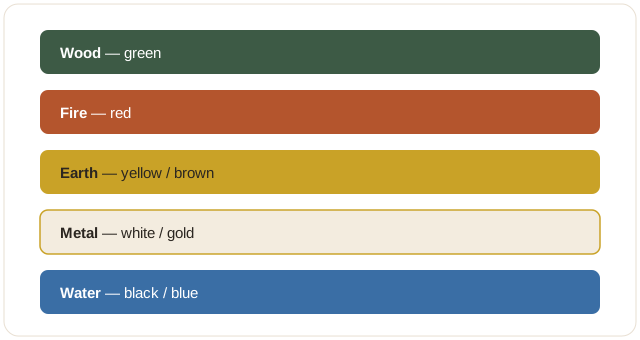
That cycle is your instruction manual. Want more fire in a room? Add wood nearby — a plant, a wooden frame — and the wood will feed it. Want less fire? Add water tones — black, dark blue, a mirror — and the water will calm it. Fire's own color is red, with orange, strong pink, and purple as close relatives. Its shape is the triangle and the point: a pyramid ornament, a pointed lamp shade, a zigzag pattern. Its bagua home is the south, the Fame sector.
Light first: the real fire element
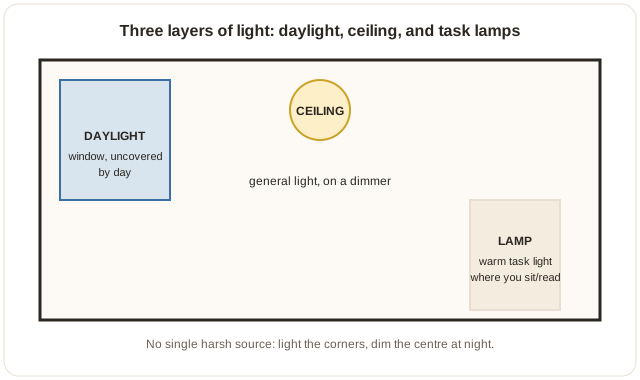
If you take one idea from this guide, take this: fix the lighting before you buy anything red. Most homes are underlit, especially in the evening, and underlit rooms feel flat no matter what color the walls are. The light guide covers the techniques, but the fire-element version is simple: layer your light. One overhead light on full blast is harsh fire — glaring, flattening, tiring. Several smaller warm lights at different heights — a floor lamp, a table lamp, a candle — is good fire: warm, inviting, and easy to be in.
Warmth of light matters as much as brightness. Bulbs around 2700 Kelvin give a warm, golden light that suits living rooms and dining rooms. Cool white daylight bulbs, around 5000 Kelvin, suit task areas like a desk or a kitchen counter, but they make a relaxing room feel like an office. Dimmer switches are the cheapest fire control you can buy: they let you turn the same room from bright and active in the afternoon to soft and warm in the evening, which is exactly what a living space needs to do across a day.
Natural light counts too. A south-facing room gets the most sun, which is why the south is fire's direction. Keep south windows uncovered during the day, and let the sun do the work. In a dark home, mirrors placed to bounce daylight deeper into a room are a genuine fire remedy, not a decoration trick — they literally bring more light in. The mirrors guide shows safe placements.
Red, candles, and the fireplace
Red is fire's color, and it is strong medicine. A little red wakes a room up: a red cushion, a red throw, a bowl of red apples, a single red accent wall behind a sofa. A lot of red winds a room up: red walls on all sides, red furniture, red curtains together can make a space feel tense, loud, and hard to relax in. The rule is proportion. In a living room, red should be an accent, roughly a tenth of what you see. In a dining room, where liveliness is welcome, you can go further — red suits appetite and conversation.
Candles are the classic small fire cure, and they work because they are real flames at human scale. A candle on a dining table or a bathroom shelf adds warmth, movement, and a focal point, and the flicker itself is calming in a way electric light is not. Use them safely — never unattended, away from curtains — and use them regularly rather than saving them for special occasions. A candle burned only at Christmas is not part of your home's daily life.
A fireplace, working or not, is the room's fire center. Keep it clean and visible, not blocked by furniture or piled with stored items. An unused fireplace can still hold candles or a small arrangement, so the focal point stays alive. If your fireplace is the room's main feature, arrange seating to face it; a fire that nobody sits near is wasted energy, and a room arranged with its back to the fireplace always feels slightly wrong.
Triangles, points, and where fire belongs
Triangular and pointed shapes carry fire energy in smaller doses than color or light. A pyramid-shaped ornament, a pointed finial, a chevron or zigzag textile, a star-shaped decoration — each adds a small spark. These are useful when a room needs a little lift but cannot take more red or more light. A child's playroom, for instance, can take triangular bunting and bright accents happily. A bedroom should take almost none: pointed shapes above or facing a bed feel sharp and unsettled, and bedrooms need calm above all.
Fire belongs in social rooms: living rooms, dining rooms, kitchens, and the south sector of the home generally. It is the element of being seen, so it also suits a space where you receive guests or present your work, like an entryway that needs warmth on arrival. The entryway guide shows how a warm lamp by the door changes the whole feeling of coming home.
Fire is least welcome in bedrooms and in rooms that already run hot — a sunny south room in summer, a small room with poor ventilation, a home office where you already struggle to concentrate. In those rooms, too much fire shows up as restlessness, irritability, or difficulty winding down at night. If a bedroom feels too stimulating, check for red bedding, bright overhead lights, and glowing screens first; those are fire sources you can remove tonight.
Too much fire, and how to cool it
The signs of excess fire are easy to recognize once you know them: a room that feels loud even when it is quiet, arguments that seem to start more easily there, difficulty sleeping in a room full of red and bright light, or a general feeling of being "on" all the time. The balancing element is water, which controls fire. Add water tones — black, dark blue, a mirror, a small water feature — or simply remove some fire: swap red cushions for neutral ones, dim the lights, take the candles off the mantel for a while.
Fire is also the element most tied to the annual flying stars, because the most attention-grabbing stars are fire stars. In 2027, for example, the center holds the 9 Purple star, a fire star, and the east holds the 7 Red star. If you are adding fire to a room, it is worth checking the 2027 flying stars chart first, so you do not pour red and bright light into a sector that is already hot. The same applies in 2028, when the northwest holds the 9 Purple star. Fire rewards respect: used in the right amount, in the right room, it makes a home feel joyful and alive. Used without measure, it burns.
Go deeper with the book
Feng Shui Made Simple covers every room this way — bedroom, living room, kitchen, office, entryway — with diagrams and a 7-day plan for doing the whole house.
Frequently asked questions
What is the fire element in feng shui?
Fire is the element of warmth, liveliness, reputation, and joy. At home it appears as light itself, red and warm tones, candles and fireplaces, and triangular or pointed shapes.
Is red paint enough to add fire to a room?
Light matters more than paint. A well-lit room with warm layered lighting already has fire energy; a dark room with red walls feels heavy, not fiery. Fix lighting first, then add red as an accent.
How much red is too much?
In a living room, red works best as an accent — roughly a tenth of what you see. Whole rooms of red on every wall and surface tend to feel tense and hard to relax in.
Which rooms suit the fire element best?
Social rooms: living rooms, dining rooms, and kitchens, plus the south (Fame) sector. Fire is least welcome in bedrooms and in rooms that already run hot or bright.
How do I calm a room with too much fire?
Add water tones — black, dark blue, a mirror — or simply remove fire: swap red cushions for neutral ones, dim the lights, and reduce candles for a while. Water controls fire in the five-element cycle.