Feng Shui for Family Harmony
Family harmony is not the absence of arguments. It is a home where arguments are about real things, not about the house — not about who left what where, whose stuff is in whose space, or why there is nowhere to sit together.
Most household friction is spatial before it is personal. A dining table buried in clutter cannot host a meal. A living room arranged around a television cannot host a conversation. A home with no place for each person to be alone guarantees that people will seek aloneness by withdrawing from each other. This guide is about fixing the spatial part. One honest limit first: no arrangement guarantees harmony or resolves serious conflict — that needs honest conversation and, where needed, counseling. What a well-arranged home does is lower the daily friction and raise the number of easy moments together, and that is a genuine contribution.
The dining table: the family's daily meeting
The dining table is the family's most important piece of furniture, because it is where the day gets told back to itself. A round or oval table suits families best: everyone can see everyone else, nobody sits at the head or foot, and conversation flows around the circle. A rectangular table works in a long room — just leave room on every side so nobody is squeezed. The dining room guide covers shape, size, and the host seat in full.
The rule that matters most is not the table's shape but its use: one shared, screen-free meal a day. It does not need to be long or elaborate — twenty minutes, everyone present, phones elsewhere, television off. Families that eat together daily have a built-in moment of contact that catches small problems before they grow: a bad day at school, a worry at work, a plan that needs discussing. Without that moment, small problems grow in silence until they arrive as big ones. Keep the table clear between meals, so the meal never requires a prior cleaning project that becomes an excuse to skip it.
The living room: seating for conversation
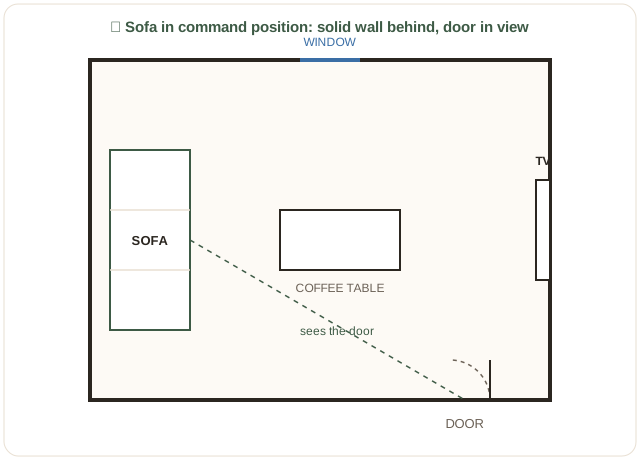
Arrange the living room so people face each other, not just the television. A sofa and chairs angled toward each other, with a coffee table between them, invite conversation; a row of seats all facing a screen invites parallel silence. This does not mean banning the television — families enjoy watching together — but it means the room should have a conversation mode as well as a viewing mode. The living room guide shows the arrangement, and the television question is worth reading for the bedroom too.
Give the living room a shared activity that is not a screen: a board game shelf, a puzzle table, books within reach, a musical instrument that is allowed to be played. Shared activities are how families build the habit of being together without an agenda, and that habit is what carries a family through the weeks when conversation is hard. A room with nothing to do together except watch is a room that trains a family to be together without talking.
Everyone has a place
Harmony depends on everyone having a place that is recognizably theirs. For adults, that may be a desk, a chair, a shelf. For children, it may be their bed, their corner of a shared room, their drawer. The children's room guide covers children's spaces in detail. The principle is the same at every age: a person with a place does not need to fight for space, and a person who has a place learns to respect others' places.
In shared rooms, mark the zones clearly: a rug for one child's area, a shelf each, a desk divided by a small organizer rather than a wall. Children who share a room argue less about space when the division is visible and agreed, and more when it is vague and constantly renegotiated. The same applies to shared bathrooms and kitchens: a shelf each, a hook each, a drawer each — small, visible fairness that prevents a hundred tiny resentments.
And everyone needs a place to be alone. A home with no quiet corner — no chair by a window, no room where a person can close a door — forces its members to seek solitude by leaving or by shutting down. If space is tight, a single comfortable chair in a quiet corner, respected as "do not disturb" space, does real work. The small apartments guide has more on carving out zones in tight homes.
The east sector: family in the bagua
In the bagua map, family belongs to the east sector, shared with health, and its element is Wood — green, tall, growing. Keep the east tidy, green, and well-lit: a healthy plant, green textiles, wooden objects, natural light. Water produces Wood, so blue and black accents or a small water feature can support the east if they suit the room. The east sector guide covers the sector in full. But as with every sector, the rooms matter more than the symbol: a green east corner in a home with no shared meals is decoration, while a home with a daily shared meal and a cluttered east is already doing the real work.
The center sector matters for families too. The middle of the home should be clear and easy to move through, because family life is constant crossing — children to kitchen, parents to door, everyone to everyone. The center sector guide explains why clear central passage lowers the whole home's stress. A home whose center is a dumping ground feels chaotic to everyone, including children who cannot name why.
Noise, clutter, and the arguments they cause
Two background factors cause more family arguments than any other: noise and clutter. Noise — a television at full volume, a washing machine at night, thin walls between a teenager's music and a parent's work — frays patience daily. The fixes are practical: doors that close, rugs that soften sound, agreed quiet hours, headphones for personal listening. Clutter causes the other classic argument: whose things are in the shared space, and who should move them. The fix is shared rules, not one person's heroic tidying: a basket per person for stray items, a daily ten-minute family tidy, and a rule that shared surfaces (dining table, kitchen counters, sofa) are cleared nightly.
Keep shared spaces in repair, too. A broken chair, a sticking door, a dripping tap — each is a small daily irritation, and small daily irritations are what turn a normal day into an argument about nothing. Fixing them is family care disguised as maintenance.
Small changes this week
- One screen-free meal a day, everyone present, phones in another room.
- One conversation seat: angle two chairs toward each other somewhere, with a small table for tea.
- One place each: give every family member a defined shelf, hook, or corner that is theirs.
- One clear shared surface: the dining table, cleared nightly, kept clear between meals.
- One quiet hour: an agreed time when noise drops and anyone may be alone without explanation.
Families do not become harmonious by rearranging furniture. They become harmonious by talking, forgiving, and showing up for each other daily — and a home that gives them a table to eat at, chairs that face each other, a place each, and a little quiet makes all of that easier. Start with the table tonight. The rest follows from the habit of sitting down together.
Go deeper with the book
Feng Shui Made Simple covers every room this way — bedroom, living room, kitchen, office, entryway — with diagrams and a 7-day plan for doing the whole house.
Frequently asked questions
What is the family sector of the bagua?
The east sector, shared with health, whose element is Wood. Keep the east of your home tidy, green, and well-lit. Family harmony also depends heavily on the center sector — keep the middle of your home clear so everyone can move through it easily.
How can the dining table help family harmony?
A round or oval table lets everyone see everyone else, so conversation flows around the whole table instead of splitting into ends. One screen-free shared meal a day — even a short one — gives the family a daily moment of real contact.
Can feng shui fix family arguments?
No arrangement guarantees harmony or resolves serious conflict, and a room cannot replace honest conversation or, where needed, counseling. What a well-arranged home can do is lower daily friction — fewer arguments about clutter, space, and noise — and give the family more easy moments together.
What about children sharing rooms or small homes?
Give each child a defined zone of their own, even in a shared room: their bed, their shelf, their corner of the desk. Children who have a place that is recognizably theirs argue less about space, and they learn to respect others' places by having one of their own.