Children's Room Feng Shui: Sleep, Study, and Play
A child's room has three jobs, and they pull in opposite directions. Sleep wants calm, dark, and quiet. Study wants focus and light. Play wants color, space, and a little chaos. Most children's rooms fail at all three because they mix them together: toys under the bed, homework on the pillow, screens glowing where sleep should happen.
The solution is zones. Even in a small room, you can give sleep, study, and play their own places — and once each activity has a place, the room starts to work the way a good room should. Children, like adults, behave better in spaces that make the right thing easy.
The principles here are the same ones that govern an adult bedroom and a home office, adjusted for a person who is still growing. Children are naturally high-yang — active, loud, growing energy — so a child's room needs a little more calm built in than an adult's, not less.
Zone one: sleep
The bed follows the same rules as an adult's: command position if possible (seeing the door from the pillow, not directly in line with it), headboard against a solid wall, and nothing stored underneath except bedding. The reason is the same too — a child who can see the door feels safe, and a child who feels safe falls asleep faster. Night-time fears often shrink noticeably when the bed moves out of the door's direct line and against a solid wall.
Keep the sleep zone visually quiet. The wall the child faces while falling asleep should not be covered in bright posters, flashing toys, or a glowing screen. One or two calm pictures are fine. A night light is fine — small, warm, and low. But the bed area should read as "rest" the moment the child gets into it, not as "one more thing to look at."
Bunk beds deserve a note. They are practical, and children love them, but the lower bunk can feel heavy and enclosed, especially with a low ceiling. If bunks are necessary, give the lower bunk good light (a small wall lamp), keep the space under the upper bunk uncluttered, and let children swap bunks sometimes so neither child is permanently "underneath." Avoid placing a bunk bed under a ceiling beam — beams pressing down over a bed are uncomfortable for anyone, and the beams guide explains the fixes.
Zone two: study
The study desk is the second anchor of the room, and its placement matters as much as the bed's. The desk should sit where the child can see the door — the command position again — without facing a blank wall inches from their nose. A child facing a wall all homework session feels boxed in; a child who can see the room feels in control of it.
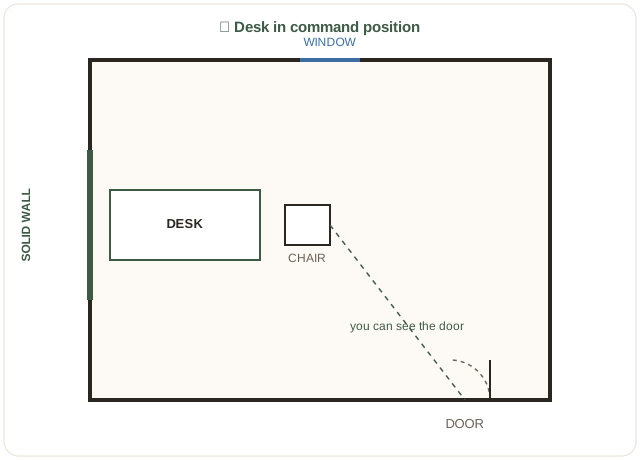
If the room's layout forces the desk against a wall, leave enough space for a small shelf or a pinboard the child controls, and keep the door visible with a small mirror if needed. The mirror trick — placing a mirror so the seated child can see the door's reflection — works for homework desks exactly as it works for adult desks.
Light the desk properly: daylight from the side if possible, a task lamp for evenings, and no screen glare. Keep the desk surface clear except for the current task. A desk buried under last term's papers teaches a child that work is a pile, not a process. A small tray or drawer for "done" papers, emptied weekly, is a habit worth more than any organizer you can buy.
Zone three: play
Play needs floor space and permission to be messy — contained mess, not eliminated mess. The most useful thing in a child's room is not a toy box but a system: open bins or low shelves, one per category, labeled with pictures for younger children and words for older ones. When everything has a visible home, tidying becomes a matching game instead of a negotiation.
Rotate toys rather than displaying all of them. A child with forty toys out plays with none of them deeply; a child with ten out, swapped every few weeks, plays with all ten. Store the rest in closed boxes elsewhere — a closet, a high shelf, or another room. Rotation also makes old toys feel new again, which is free.
Leave one patch of genuinely empty floor. Children play on floors — building, drawing, wrestling, spreading out. A room so full of furniture and toy storage that there is no empty floor is a room where play has nowhere to happen, and play will then happen somewhere you like less, like the living room sofa.
Colors: lively, but zoned
Children's rooms can handle more color than adult bedrooms — bright accents, cheerful art, a feature wall in a favorite color. But keep the bright colors in the play zone and the calm colors in the sleep zone. A red wall behind the bed fights sleep; the same red on the play wall fuels it. Soft blues, greens, and warm neutrals around the bed, brighter tones where play happens, is the split that works. The colors cheat sheet covers the full palette.
Let the child choose within limits. A child who picked their own bedding or wall color feels ownership of the room, and ownership is the root of tidiness. Offer two or three options you can live with, and let them pick. "Do you want the blue or the green wall?" beats "What color do you want?" — the second question ends with a black ceiling.
Safety and sharp corners
Feng shui's rule about sharp corners — "poison arrows" — is mostly about comfort, and it matters most for children, who move fast and fall often. Round the corners you can: soft corner guards on low tables, bookshelves anchored to the wall, no sharp-edged furniture at head height near the bed or the play floor. Anchor every tall bookcase and dresser — this is a safety rule first and a feng shui rule second, and it is non-negotiable. See sharp corners for the full picture.
Keep screens out of the sleep zone. A tablet charging on the nightstand is a homework tool that becomes a midnight companion. Charge devices in the study zone or outside the room, and set a real off-time. This is the same advice as the adult TV in the bedroom rule, and it works better on children when the rule applies to the whole household.
Shared rooms
Two children in one room need what adult sharers need: a defined zone each. Even a small room can give each child a bed zone, a desk or homework spot, and a shelf that is theirs alone. A curtain, a bookshelf as a divider, or even different bedding colors can mark "mine" clearly enough to prevent the low-grade turf wars that shared rooms breed.
Fairness matters more than symmetry. If one child gets the window bed and the other gets the door bed, rotate periodically or balance it with something else — the better desk, the bigger shelf. Children notice unfairness instantly, and a room that feels unfair feels bad no matter how well arranged it is.
Start with the bed: move it to the command position against a solid wall, clear the space under it, and quiet the wall the child faces at night. That one change often improves sleep within days. Then the desk, then the toy system. A child's room does not need to be perfect — it needs to make sleep easy, study possible, and play welcome, each in its own place.
Go deeper with the book
Feng Shui Made Simple covers every room this way — bedroom, living room, kitchen, office, entryway — with diagrams and a 7-day plan for doing the whole house.
Frequently asked questions
Where should a child's bed go?
In the command position if possible: the child can see the door from the pillow but is not directly in line with it, with the headboard against a solid wall. Children who can see the door feel safer and usually fall asleep faster.
Should a child's desk face the wall or the room?
The room, with the door in view — the command position. Facing a blank wall inches away feels boxed in. If the layout forces a wall-facing desk, a small mirror that shows the door's reflection is a good workaround.
Are bunk beds bad feng shui?
They are practical, not unlucky. Give the lower bunk good light and uncluttered space, avoid placing bunks under a ceiling beam, and let children swap bunks sometimes so neither child is permanently underneath.
How many toys should be out at once?
Fewer than you think. About ten toys out, rotated every few weeks, beats forty toys out all the time. Children play more deeply with fewer choices, and tidying becomes a matching game when every toy has a visible home.
Should children have screens in their bedroom?
Better not in the sleep zone. Charge tablets and phones in the study zone or outside the room, with a real off-time. A glowing screen by the pillow competes directly with sleep, for children exactly as for adults.