Feng Shui for Small Apartments
Small apartments do not need different feng shui. They need the same feng shui, applied tighter. Every rule in this site's room guides still holds — command position, clear flow, calm bedrooms, bright entries — but in a studio or one-bedroom, every violation is closer to you and every fix is magnified. That is bad news if you ignore the rules, and very good news if you follow them: small fixes pay off fast.
The three problems that dominate small spaces are always the same: everything bleeds into everything else (you sleep where you work where you eat), clutter has nowhere to hide, and the room never gets a chance to feel like one thing at a time. This page solves all three with furniture, light, and habit — no renovation, no landlord permission required.
Rule 1: Give every activity a zone
In a house, walls do this job. In a small apartment, you do it yourself. A zone is not a room — it is a visible signal that says "this patch of floor is for sleeping" or "this patch is for working." Without zones, your brain never switches off: the desk stares at the bed all night, the bed tempts you all workday, and nothing ever feels quite finished.
The cheapest zone-maker is a rug. A rug under the bed marks the sleeping zone; a different rug under the desk marks the work zone. Your feet learn the boundary before your mind does. Next, add a divider that does not block light: an open bookshelf, a folding screen, a tall plant, or even a curtain on a ceiling track. A bookshelf divider is the best of these because it also stores things — and storage is the second great small-apartment problem.
Finally, give each zone its own light. A warm lamp by the bed, a bright task lamp at the desk, a soft lamp in the sitting corner. When you switch the lamp, you switch the zone. This one habit — lighting only the zone you are in — does more for small-space sanity than any single purchase.
Rule 2: Protect the bed
The bed is the hardest piece to place in a small apartment and the most important to get right. The bedroom rules apply in full: command position first (see the door from the pillow, not directly in line with it), headboard against a solid wall, nothing stored under the bed, no mirror facing it. Prioritize in exactly that order when the room forces compromises.
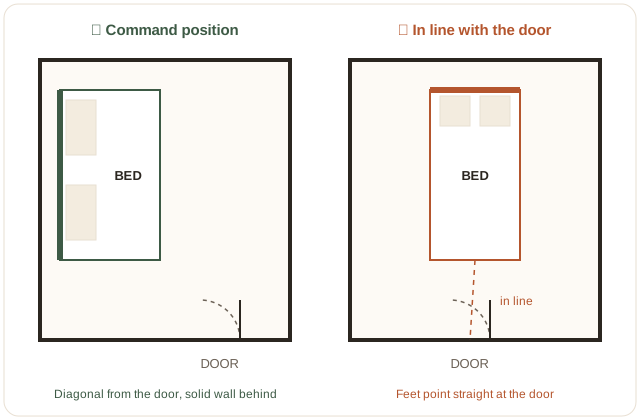
If the bed must face the door directly, angle it slightly — even a few inches off direct alignment helps, and in a tiny room a small angle reads as a real change. If no angle is possible, place a low bench or a soft fabric drape at the foot of the bed to break the direct line. And keep work out of the bed zone with real discipline: no laptop in bed, no work papers on the nightstand. In a studio, the bed is the only yin space you have. Defend it.
Under-bed storage deserves a special warning. In a small apartment, the space under the bed is tempting — it is the largest unused volume in the room. But feng shui's rule is clear: qi needs to flow under the bed, and boxes block it. Practically, under-bed boxes also become the place things go to be forgotten, which is clutter with a lid on it. If you truly must use the space, use it for one category only — bedding, for example — in flat, lidded boxes you open weekly. Never for old paperwork, dead electronics, or things you are avoiding deciding about.
Rule 3: Clutter is the whole room
In a large home, a cluttered corner is a corner problem. In a small apartment, a cluttered corner is a whole-room problem, because you can see it from everywhere and it crowds every activity. That is why clutter control is not one item on the small-apartment list — it is the list, and everything else sits on top of it.
The rule is one-in, one-out, enforced ruthlessly. A small apartment has a fixed carrying capacity, and every object beyond it costs you floor, light, and calm. Set a weekly fifteen-minute sweep: one bag, one timer, keep-donate-trash, no "maybe" pile. Maybe is how clutter reproduces, and in a small space it reproduces fast. Vertical storage is your friend — tall shelves, wall hooks, over-door racks — because the only direction a small apartment can grow is up. But vertical storage must stay tidy: an open shelf of chaos is worse than a closed cupboard of chaos, because you see it.
Choose furniture that does two jobs: a bed with a proper headboard that doubles as a shelf, an ottoman that stores blankets, a drop-leaf table that folds away. Every piece that does one job in a small apartment is a piece you will resent by month three.
Rule 4: Mirrors and light are your extra square feet
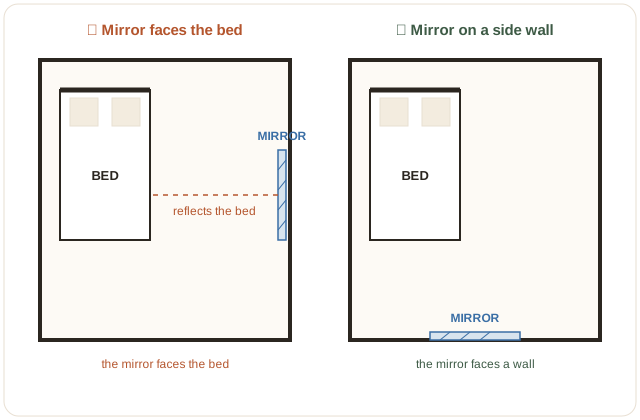
You cannot add floor, but you can add the feeling of floor. A large mirror on one wall can visually double a tiny room, and a mirror opposite a window bounces daylight deep into the space. This is the mirror cure at its best: light and spaciousness, the two things small rooms lack most. Keep the rules, though: never a mirror facing the bed (see the mirror facing bed page), never facing the front door directly, and never a wall tiled in mirror squares — fragmented reflection is agitating, not expansive. One good mirror, well placed, beats five bought out of anxiety.
Light is the same story. A dark corner in a small room does not read as "cozy" — it reads as "dead space," and dead space in a small apartment is space you cannot afford. Put a lamp in every dark corner, clean the windows, and use the brightest warm-white bulbs your fixtures allow. Before buying any cure for any problem, ask one question: "Is this spot just dark?" Nine times out of ten, the answer is yes, and the cure costs less than lunch.
Rule 5: The entry still matters — more, not less
A small apartment's entry is often a strip of floor by the door, not a room at all. That makes the entryway rules more important, not less: without a landing zone, shoes, bags, and mail colonize the whole apartment within a week. Claim the first three feet inside the door with a small rug, one hook for keys, and one tray for shoes. That tiny threshold is what stops the outside world from spreading across your living space.
One last small-apartment truth: the bagua map still applies, but loosely. In a studio, the map's nine areas overlap and share walls, and that is fine — lay it over the floor plan, pick the one or two areas tied to your current goals, and tend those. Trying to activate all nine areas in four hundred square feet is how you end up with a shrine in every corner and no room to live. Feng shui in a small apartment is editing: fewer objects, clearer zones, better light. Do those three things, and the apartment stops feeling small — it starts feeling intentional, which is the real goal all along.
Go deeper with the book
Feng Shui Made Simple covers every room this way — bedroom, living room, kitchen, office, entryway — with diagrams and a 7-day plan for doing the whole house.
Frequently asked questions
Does feng shui work in a studio apartment?
Yes — in fact the rules matter more, because every change is magnified in a small space. The same principles apply: command position, clear flow, zones for different activities, and clutter control. You just apply them with rugs, screens, and furniture instead of walls.
How do I separate the bedroom from the living area in a studio?
Use a rug under the bed zone, a bookshelf or folding screen as a divider, and different lighting for each zone. The goal is a visible threshold: your brain should know when it has entered the sleeping zone and when it has left it.
What is the first thing to fix in a small apartment?
Clutter. In a small space, clutter is not a background issue — it is the whole room. One cleared surface changes the feeling of the entire apartment. After that, prioritize command position for the bed, then light.
Can I use mirrors to make a small apartment feel bigger?
Yes. A large mirror on one wall can visually double a tiny room, and a mirror opposite a window bounces light deep into the space. Just never place one facing the bed, and never tile a wall in mirror squares — the fragmented reflection is agitating, not expansive.
What if my bed has to face the door?
Angle it slightly if you can — even a few inches off direct alignment helps. If the room truly allows no angle, hang a soft fabric or place a low bench at the foot of the bed to break the direct line. In a tiny room, approximate command position still beats none.