L-Shaped and U-Shaped Homes: Working With Missing Areas
Draw a rectangle around your home's floor plan. If the walls fill the rectangle, your home is regular. If a corner of the rectangle is empty — a notch cut out of the shape — your home has a missing area, and L-shaped and U-shaped homes are the most common way to get one. Before you worry, know this: some of the best homes in the world are L-shaped, and the missing corner is often the garden.
This guide explains how to find your missing area, what tradition says about it, and the fixes that actually work — most of which are gardening and lighting, not esoteric remedies. The shape of a home matters, but it matters the way a room's shape matters: it changes how you use the space, and good use beats a perfect shape.
Start with the floor plan. You need the whole home's outline, including any extensions, and a compass direction for orientation. If you do not have a plan, sketch one roughly to scale — it does not need to be architectural, just honest about which corners exist and which do not.
Finding the missing area
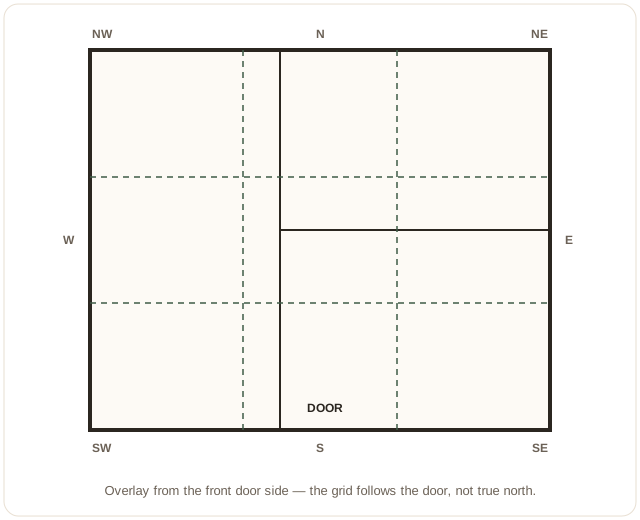
Overlay the bagua grid on the plan: divide the home's overall rectangle into nine equal sectors, three across and three down, aligned to the compass directions. The floor plan guide walks through this step by step, and the bagua guide gives the sector meanings. Any sector that falls mostly outside the walls is a missing area.
In an L-shaped home, one corner sector is missing — the corner where the two wings meet at a right angle but the building does not extend. In a U-shaped home, the missing area is larger and more central: the courtyard or lightwell between the two wings, which is often an entire sector or more. The size matters: a small notch, less than a third of a sector, is a minor quirk; a whole missing sector is a real feature of the home that deserves attention.
Note which sector is missing, because tradition reads each one differently. A missing north sector touches career; a missing southwest touches love and relationships; a missing east touches health and family. These are associations to be aware of, not verdicts — a home missing its southwest corner does not doom a marriage, any more than a home missing its north corner dooms a career. But knowing which sector is missing tells you where to put the remedy.
Why L-shapes are often good homes
Before the remedies, a defense of the shape. An L-shaped home naturally divides into two wings, and that division is genuinely useful: living areas in one wing, sleeping areas in the other, with the junction as a shared zone. Many families find this separation calmer than an open rectangle where every room bleeds into every other room. The open-plan guide shows the opposite problem — too little separation — and an L-shape solves it by architecture.
The missing corner is also often the best outdoor space in the home. An L-shape wraps around a garden, courtyard, or terrace on two sides, sheltering it from wind and giving it sun from two directions. That sheltered outdoor room is worth more to daily life than a geometrically perfect rectangle, and it is the reason L-shaped houses and courtyard houses have been built for centuries across many cultures.
U-shaped homes go further: the courtyard between the wings becomes the home's outdoor heart, visible from rooms on three sides. The traditional courtyard house is a U-shape, and its appeal — light, air, and a private outdoor room — is exactly what modern buyers pay a premium for. A U-shape is not a defect to be cured; it is a design with a missing sector as its price.
The practical fixes
The classic remedies for a missing area are light, life, and boundary, and all three are practical before they are symbolic. Light: illuminate the missing corner well, especially at night, so it does not become a dark gap in the home's shape. A garden light, a wall light, or a lantern in the missing corner makes the area feel included rather than abandoned.
Life: put something living in the missing area. A plant, a tree, a garden bed, or a row of pots brings the corner into the home's living system. If the missing area is indoors — a notch in an apartment's plan, for instance — a large plant or a tall bookshelf in the nearest room serves the same purpose, marking the sector's presence. The plants guide covers which plants suit which spots.
Boundary: mark the missing rectangle's edges so the eye completes the shape. Outdoors, a low hedge, a fence line, a row of pots, or a change in paving can trace the missing corner's outline. Indoors, the traditional remedy is a mirror on the wall facing the missing area, symbolically extending the room into the absent sector. A mirror works best when it reflects something pleasant — a garden, a window — not a blank wall, so place it with the reflection in mind, following the mirrors guide.
What not to do: do not fill a missing area with clutter, rubbish, or a dumping ground. A missing corner used as a junk store is the worst version of the problem — the sector is not just absent, it is neglected. Whatever the sector, a tidy, lit, planted corner beats a perfect shape with a neglected one.
Missing areas and the year's stars
One question comes up every year: what happens when an annual star lands in a missing sector? The answer is reassuring. Annual stars are mapped by sector regardless of shape — in 2027, for example, the north holds 5 Yellow, the northeast holds 3 Jade with Year Breaker, and the west holds 2 Black with San Sha; in 2028, the northeast holds 2 Black with Year Breaker and the south holds 3 Jade with San Sha. If one of those sectors is missing from your home, its star's area is outdoors, so the practical advice is simple: keep that outdoor area tidy, well-lit, and in use, rather than worrying about a room that does not exist.
The same logic applies to the bagua sectors generally. A missing sector is not a hole in your luck; it is a part of the home's map that happens to be outside. Tend it as outdoor space, and it contributes to the home like any other part of the garden. The missing corners guide goes deeper into sector-by-sector remedies if you want the full traditional detail.
Finally, keep perspective. Shape is one factor among many. A well-loved L-shaped home with a beautiful courtyard, good light, and a sensible layout is a better home than a geometrically perfect rectangle with a dark entry and a noisy road. Fix the missing corner with light, life, and a boundary, and then get on with enjoying the shape's real advantages — the separation of wings, the sheltered garden, and the courtyard at the heart of the home.
Go deeper with the book
Feng Shui Made Simple covers every room this way — bedroom, living room, kitchen, office, entryway — with diagrams and a 7-day plan for doing the whole house.
Frequently asked questions
What is a missing area in feng shui?
When you overlay the bagua grid on a floor plan, a missing area is a sector of the grid that falls outside the home's walls — for example, the corner that an L-shaped home does not have. Tradition says that life area gets less support from the home; practically, it means part of the home's shape is absent and the layout needs a little more thought.
Are L-shaped homes bad feng shui?
No. L-shaped homes are common and often excellent: the two wings naturally separate living from sleeping areas, and the missing corner is often a garden, courtyard, or balcony — outdoor space, not a void. The shape is only a problem when the missing area is large, dark, or neglected.
How do I fix a missing area?
The classic fixes are light, life, and boundary: light the missing corner well, put a plant or a garden feature there, and mark its edges — a low hedge, a row of pots, or a fence line that visually completes the rectangle. Indoors, a mirror on the wall facing the missing area is the traditional symbolic completion.
What is the difference between a missing area and a protruding corner?
A missing area is a sector the home does not have; a protruding corner is a sector that sticks out beyond the home's main rectangle. Missing areas are traditionally seen as under-supported, protruding corners as over-emphasized. Both are shape quirks, and both have simple, practical remedies.
Does a missing area affect the annual flying stars?
Annual stars are mapped by sector regardless of shape — in 2027, for example, the north holds 5 Yellow and the northeast holds 3 Jade with Year Breaker. If a sector is missing, its star's area is outdoors, so the practical advice is to keep that outdoor area tidy and well-lit rather than worrying about a room that does not exist.