Beams Over Your Bed: 5 Ways to Fix Them
Walk into a bedroom, look up, and check one thing: is there a beam running over the bed? In feng shui, this is one of the classic problems — a heavy structural beam pressing down over the place where you sleep. Traditional texts call it "pressing energy," and they warn that it disturbs sleep and, over time, health.
You do not need to believe in energy to understand why it bothers people. A beam over your head is a visual weight. It is a hard, sharp line crossing the room exactly where you lie still for eight hours, and your brain registers it even when you are not looking at it. Many people who sleep under a beam report the same vague complaints: restless sleep, waking with a headache, a feeling of pressure, or simply never quite feeling rested. Move the bed, and the complaints often stop. That is the whole argument, and it is a practical one.
The good news: this is one of the most fixable problems in feng shui. You do not need to move house or rebuild the ceiling. The five fixes below are ranked from free to full renovation. Start at the top and stop at the first one that works.
Why a beam over the bed is a problem
Feng shui judges a room by how it feels to the body, and a bedroom has one job: rest. Anything that makes rest harder is a problem, and a beam does it in three ways. First, it creates a sense of downward pressure — the ceiling is literally lower at that line, and the bed sits in its shadow. Second, a beam usually has sharp edges, and sharp edges pointed at a sleeper are the classic "poison arrow" pattern: an aggressive angle your eyes and body keep noticing. Third, a beam divides the room visually, cutting the bed's space in half or in quarters, which makes the sleeping area feel cramped even when the room is large.
Where the beam crosses matters too. A beam across the head of the bed is traditionally linked to headaches and restless thoughts; across the middle, to chest or stomach unease; across the feet, the least serious of the three. None of this is medical advice — if you have persistent headaches or sleep problems, see a doctor — but it is a useful map for deciding which fix to prioritize. The worst beam is the one over your head, and that is the one to fix first.
The bed matters more than any other piece of furniture because of time and vulnerability. You sit at a desk for hours too, but you are awake, moving, and alert. In bed you are still and unconscious for a third of your life. That is why the bedroom rules treat the bed as sacred ground, and why a beam over the bed outranks a beam over a desk or a sofa.
Fix 1: Move the bed (free)
The best cure is no beam at all. Before you buy anything, try rearranging the room so the bed sits between beams rather than under one, or so the beam runs parallel to the bed instead of across it. A beam running along the length of the bed, off to one side, is far less intrusive than one crossing it. Even shifting the bed a foot or two can move your head out from under the beam, and that alone may be enough.
Keep the command position in mind while you move things: ideally you can still see the door from the pillow without being directly in line with it, and the headboard still rests against a solid wall. If the only beam-free spot breaks the command position badly, use one of the fixes below instead. Feng shui is about the best overall arrangement, not about winning one rule while losing three others.
Fix 2: Soften it with fabric (cheap, renter-friendly)
If the bed cannot move, cover the beam's hard line. A fabric canopy — a light cloth draped from the ceiling or hung from a simple frame — is the classic cure, and it works for a straightforward reason: it turns a sharp, heavy line into a soft, curved surface. Your eye no longer tracks the beam; it sees fabric, and fabric reads as shelter, not pressure.
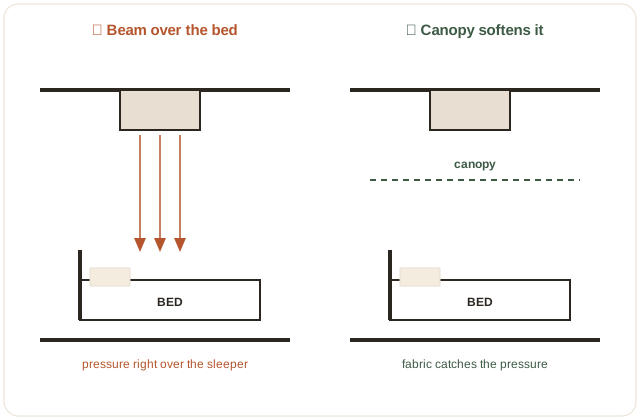
You do not need a full four-poster bed. A length of muslin or linen, fixed to the ceiling on either side of the beam and allowed to drape gently below it, does the job. Keep the fabric light in color and weight — heavy, dark drapes over the bed will feel like a second ceiling and defeat the purpose. This is the best fix for renters: no drilling into the beam itself is required if you use adhesive hooks or a tension frame, and it comes down without a trace.
Fix 3: Paint it the ceiling color (cheap, permanent)
Here is the fix most people underestimate. A beam usually bothers you because it contrasts with the ceiling — dark wood against white plaster, for example. That contrast is what makes your eye catch it every time you glance up. Paint the beam the exact same color as the ceiling, and it visually melts away. The beam is still there structurally, but the sense of a heavy line crossing the room drops sharply.
Use the same paint, same finish, same shade — not "close enough." Even a slight difference in tone will keep the beam visible. This fix pairs well with Fix 2: a painted beam under a light canopy is essentially gone. If you own the home, this is the highest-return fix for the money: one can of paint, one afternoon, and the room feels taller.
Fix 4: Round it or box it in (moderate)
Sharp edges are half the problem, so remove the sharpness. A rounded cover — a curved piece of wood, plaster, or even a length of fabric-wrapped padding fitted along the beam's lower edge — softens the profile. In feng shui terms, you are converting a cutting edge into a flowing curve. In practical terms, you are removing the aggressive angle your eye keeps snagging on.
Alternatively, box the beam in with a flat panel: a lightweight board fixed beneath it, flush with the ceiling on either side, so the ceiling reads as flat. This is a small carpentry job, not a renovation, and it works especially well when several beams cross the room — paneling the whole span gives you a clean, level ceiling. If you are handy, this is a weekend project; if not, a local carpenter can do it in a few hours.
Fix 5: Raise or remove it with a false ceiling (full solution)
The complete solution is a false ceiling — a flat ceiling installed just below the beams, hiding them entirely. This is the only fix that removes the problem rather than softening it, and in a low-ceilinged room it is worth considering seriously, because a low beam is the hardest case. The trade-off is ceiling height: you lose a few inches everywhere. In a room with generous height, that is invisible. In a room that is already low, weigh it against Fix 2 or 3 first.
One more trick for low rooms: uplighting. A strip of warm light along the top of the beam, washing the ceiling, lifts the eye upward and makes the ceiling feel higher than it is. Light is feng shui's most reliable cure for heaviness — a dark, heavy beam in a dim room feels twice as oppressive as the same beam in a bright one. Whatever fix you choose, add light to the ceiling and the room will feel lighter for it.
What not to do
Do not hang heavy objects from the beam over the bed — no hanging planters, no heavy mobiles, no wind chimes directly overhead. You are adding weight to a spot that already feels heavy, and anything hanging above a sleeper is a safety issue first and a feng shui issue second. Do not ignore the beam and hope you get used to it, either: people do adapt, but adaptation to a poor sleep environment is not the same as good sleep. And do not spend money on symbolic cures — crystals, coins, or trinkets hung from the beam — before trying the structural fixes above. A painted beam or a moved bed solves the actual problem; a trinket decorates it.
Start tonight with the free check: lie in bed, look up, and notice where the beam falls. If it crosses your head, move the bed if you can. If you cannot, paint the beam or drape it this weekend. Sleep is the foundation everything else in feng shui builds on — it is worth one afternoon of work. For the rest of the bedroom, the ten bedroom rules cover command position, mirrors, and colors.
Go deeper with the book
Feng Shui Made Simple covers every room this way — bedroom, living room, kitchen, office, entryway — with diagrams and a 7-day plan for doing the whole house.
Frequently asked questions
Is it really bad feng shui to sleep under a beam?
In traditional feng shui, yes: a beam pressing down over the bed is said to create heavy, downward energy that disturbs sleep and, over time, health. In practical terms, a beam over your head is visually heavy and subconsciously uncomfortable, and that alone is reason enough to fix it.
What if I cannot move my bed away from the beam?
Soften or hide the beam instead. A fabric canopy or draped cloth breaks the hard line, painting the beam the same color as the ceiling makes it visually disappear, and a flat ceiling panel removes it entirely. Any of these beats leaving a bare beam over your head.
Does a beam over a desk or sofa matter too?
The same principle applies anywhere you sit or sleep for hours: a beam overhead feels oppressive. The bed matters most because you spend a third of your life there, unconscious. Desks and sofas come next, in that order.
Will painting the beam really help?
Yes, more than you would expect. A beam that contrasts with the ceiling draws the eye and feels heavy. Painted the same color, it blends in and the sense of pressure drops sharply. It is the cheapest fix on this page and it works.
Are exposed beams ever good feng shui?
In a living room or a tall, open space, exposed beams can look beautiful and feel architectural rather than oppressive — especially if they are high and rounded. The problem is specific: a low, sharp beam directly over where you sleep or sit for long periods.