Bed Under a Window: Why It Bothers Sleep and What to Do
Sleeping with your head under a window is one of the most common bedroom complaints in feng shui, and one of the easiest to understand. The rule is simple: a bed needs a solid wall behind the headboard. When the wall is replaced by glass, sleep often feels lighter, more restless, and harder to settle into — even when the room looks fine.
None of this is mysterious. A window behind your head is a source of moving air, changing light, and outside noise, all arriving exactly where your head rests. On a cold night there is a draft down the back of your neck. In summer, the first light of morning lands straight on your face. Passing traffic, a neighbour's conversation, a dog barking — all of it comes through glass far more easily than through a wall. Your body notices these things even when your conscious mind has stopped paying attention, and light sleep is the result.
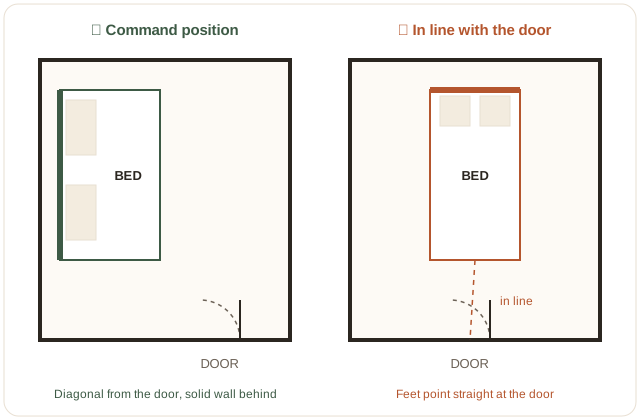
There is also a psychological side, and it is just as real. Humans sleep best with something solid behind them. It is the same instinct behind the command position in the bedroom guide: we rest more deeply when we can see the door and feel protected from behind. A window reverses that. Behind your head is open space, and the open space is outside your home, where you cannot control it. Some people feel this strongly and some barely notice it, but if you wake often, or feel oddly alert in bed at night, the window behind you is worth checking before anything else.
First, check whether you can move the bed
The cleanest fix is to move the bed to a solid wall. Before you rearrange anything else, walk the room and look for a wall that lets you do three things at once: put the headboard flat against it, see the bedroom door from the bed without turning your head sharply, and leave walking space on both sides if you share the bed. That combination is the command position described in the bed direction guide, and it solves the window problem completely.
Do not trade one problem for another. A solid wall shared with a noisy bathroom, or a wall directly under a heavy beam, is not an upgrade. And do not push the bed into a corner against two walls just to escape the window — one side blocked makes getting in and out awkward and makes changing the sheets a chore, which means the sheets get changed less often. A good wall position is one you can live with every day, not one that only looks right on paper.
If the bed cannot move: build a wall behind it
Many bedrooms leave no choice. The room may be small, the only solid wall may hold the wardrobe or the door, or the bed may be too large to turn. In that case, your job is to make the window behave as much like a wall as possible.
Start with a tall, solid headboard. This is the single most effective fix, and it works for a plain physical reason: it blocks the draft, shields your head from direct light and glare, and gives your back something solid to rest against. A headboard that rises well above pillow height — ideally to at least shoulder height when you sit up — does most of the work. Upholstered headboards are best here because they also soften sound slightly and feel warm against the head. A thin metal frame or a low wooden rail does not count; it leaves your head effectively still under glass.
Next, dress the window heavily. A blackout curtain that covers the whole window, floor to ceiling and wider than the frame, cuts drafts, blocks morning light, and muffles outside noise more than you might expect. Close it at night and the window stops being a window for sleeping purposes. Sheer curtains alone are not enough — they soften light but do nothing about drafts or the feeling of exposure. If you can only afford one upgrade, choose the blackout curtain over decorative bedding every time.
Seal the draft itself. Run your hand around the window frame on a cold or windy night. If you feel air moving, the window seal is failing, and no headboard will fix that. Self-adhesive foam draught strips cost very little and take minutes to fit. For older windows, a secondary glazing film — the clear plastic sheet you shrink-fit with a hairdryer — adds a real layer of insulation for one winter at a time.
Light, noise, and the view
Even with a headboard and curtains, two smaller issues remain. The first is light leaking around the curtain edges. A curtain track that curves back to the wall at both ends, or a simple pelmet board across the top, closes most of the gaps. The second is noise. Heavy curtains help, but if traffic noise is the real problem, the honest fix is acoustic: thick curtains plus a white-noise source, or, in a home you own, secondary glazing. Do not buy expensive "feng shui cures" for a noise problem that is really a glazing problem.
There is one more question people ask: what if the window has a beautiful view? A bed under a window facing the sea or the mountains feels romantic, and during the day it is lovely. The practical answer is that you can have both. Sleep with the blackout curtains closed and open them in the morning. The view is still there when you wake, and you get the best of both — the view by day, the protected feeling by night. A mirror facing the bed is a different problem and should not be added to this wall as compensation; keep mirrors off the wall opposite the bed.
Special cases: low windows, skylights, and children's beds
A low window, where the sill is at or below mattress height, is the hardest version of this problem, because a headboard cannot cover the glass beside your head. Here the curtain matters most: floor-to-ceiling blackout curtains that extend well past the window on both sides, closed every night. If the window is also the room's only ventilation, leave a small gap at the top of the curtain or open a window elsewhere in the room instead, so you still get fresh air without a draft directly on your head.
A skylight directly above the bed is a related but different case. It does not create the same exposed feeling, because it is above rather than behind you, but it does pour morning light onto your face and can make summer nights hot. A blackout blind made for the skylight solves it, and unlike a wall window, a skylight rarely brings drafts to head height.
For a child's bed under a window, take the rule more seriously, not less. Children are lighter sleepers and more sensitive to drafts and light changes. If the room layout forces a window bed, use the same fixes — solid headboard, full blackout curtain, sealed drafts — and check in winter that the wall and window area near the child's head is not cold to the touch. A cold head all night is a recipe for restless sleep and morning complaints.
Work through the fixes in order: move the bed if you can, add a tall headboard if you cannot, hang full blackout curtains, seal the drafts, and only then look at anything else. Most window beds are fixed by the first two steps. If sleep still does not improve after a week with all of them in place, the cause is probably elsewhere — look at the television in the room, the mattress itself, or your evening light and screen habits before blaming the window any further.
Go deeper with the book
Feng Shui Made Simple covers every room this way — bedroom, living room, kitchen, office, entryway — with diagrams and a 7-day plan for doing the whole house.
Frequently asked questions
Is it really bad feng shui to sleep under a window?
Tradition says yes, and the practical reasons back it up: drafts, light changes, and outside noise all reach your head more easily through glass than through a wall, and many people sleep more lightly as a result. It is a comfort problem first, not a superstition.
Will a tall headboard fix a bed under a window?
Mostly, yes. A solid headboard above pillow height blocks drafts, shields your head from light, and gives your back something solid to rest against. Pair it with full blackout curtains for the best result.
What if my bedroom layout gives me no other choice?
Use the full set of fixes: tall solid headboard, floor-to-ceiling blackout curtains wider than the window, and draught strips on the frame. Close the curtains every night so the window behaves like a wall while you sleep.
Is a skylight above the bed the same problem?
Not quite. A skylight is above you rather than behind you, so it does not create the same exposed feeling, but it does bring morning light and summer heat onto the bed. A blackout skylight blind handles it.
Should a child's bed ever go under a window?
Avoid it if you can, since children are more sensitive to drafts and light changes. If the room forces it, apply the same fixes and check on cold nights that the area near the child's head is not cold to the touch.