2027 Flying Stars for Apartments: Small Space, Same Stars
Good news for small homes: the 2027 stars do not care how big your home is. The chart is the same — Center 9 Purple, Southeast 8 White, Northwest 1 White, Southwest 6 White + Tai Sui, South 4 Green, North 5 Yellow, West 2 Black + San Sha, Northeast 3 Jade + Year Breaker, East 7 Red — and the cures are the same. What changes in an apartment is only the mapping: fewer rooms, more sharing, and a center that might be a hallway. This page is the small-home translation.
The year runs from Lichun, 4 February 2027, to 3 February 2028. The full chart is on the 2027 flying stars map. If you rent, also read the renters guide and the small apartments guide for the general rules — this page adds the 2027 layer.
Step 1: map your own unit, not the building
Stand in the center of your own unit with your phone's compass app. Not the building's center, not the floor's center — your front door and your walls define your map. The direction each room falls in is its sector. A bedroom in the north part of your unit sits in the North sector, under this year's 5 Yellow, whether you are on the 2nd floor or the 22nd.
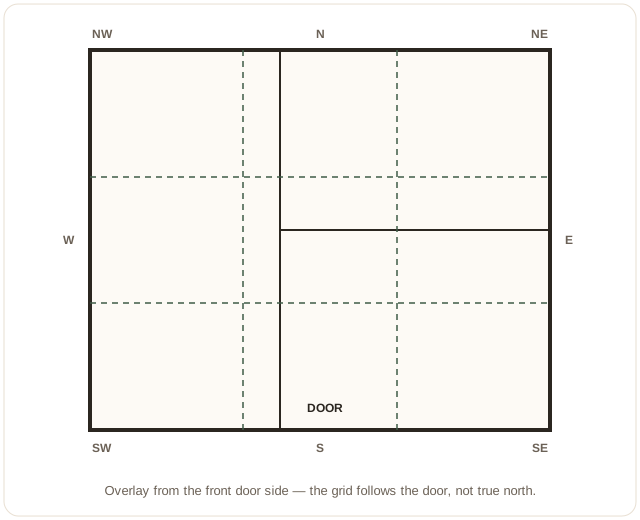
Use the center of your entire unit, including the hallway — not the center of the living room. And don't overthink irregular floor plans: assign each room to whichever sector covers most of it. Close enough is genuinely enough; the stars work on neighborhoods, not millimeters.
Step 2: accept missing sectors and shared rooms
Missing sectors are fine. A studio or one-bedroom flat will not have a room in every sector. Some sectors will fall on a bathroom, a corridor, or outside the unit entirely. That is not a problem — it simply means that star has no room of yours to work through. Skip it. You do not need to "activate" a sector you do not have, and you do not need to worry about a no-go sector that is just a hallway wall. Focus on the sectors you do have rooms in.
Shared rooms are normal. In most apartments, one room does two or three jobs: living room plus office, bedroom plus study, kitchen plus dining. That means one room can carry two stars' advice at once — and sometimes the advice conflicts. A living room that is both South (study star) and the television room is fine: carve out a creative corner for the South, and keep the rest of the room relaxed. The room does not need to be purely one thing; it needs one zone that honors its star.
Open-plan spaces span sectors. If your living-dining-kitchen is one big space, divide it the same way — the sofa end might be South while the cooking end is Southwest. Treat each zone by its own star, and mark the boundary with a rug or a change of lighting.
Step 3: place the cures that fit a small home
The full shopping list is on the 2027 cures shopping list. The small-home version is shorter, because some cures collapse into one object or one habit.
North and West metal cures — non-negotiable, but flexible in form. The North 5 Yellow and the West 2 Black both want a metal cure: a 6-rod hollow metal wind chime, or a bowl of salt water with 6 coins. In a small home, the salt-water bowl is often easier — it sits on a shelf, needs no hanging, and makes no sound. If the North or West sector is a bathroom or corridor with no room for either, place the cure in the nearest North or West room you do have.
Northeast red lamp — one lamp, big effect. The Northeast 3 Jade wants warm red lamplight. In a small home this can be a single red-shaded table lamp that also serves as the evening light. Warm light plus low volume is the whole Northeast practice.
East blues — textiles, not furniture. The East 7 Red wants blue and black accents. In a small home, a navy throw or two blue cushions do it — no new furniture, no repaint. If the East is your entry, the designated spot for keys and wallet matters more than any color.
Center brightness — the hallway trick. The Center 9 Purple wants bright light and open space. In many apartments the center is a hallway with no window — so lighting is the whole activation. A bright bulb on a timer, plus a clear floor (no shoe mountains, no box storage), is the complete center cure for a small home.
South plant and Southeast light — small-footprint wins. The South 4 Green wants one healthy plant and a clear desk; the Southeast 8 White wants bright warm light and tidy surfaces. In a studio, the South corner can be the desk zone and the Southeast corner the reading zone — two zones, one room.
The renter's shortcut
If you rent, you are mostly exempt from the hardest rule already — you are not renovating anyway. Your entire no-go practice for the North, Northeast, West, and Southwest is: don't hang heavy things with power tools in those sectors, and if your landlord schedules works in one of them, ask whether the noisy phase can move to a safe sector. You cannot control building works, and no tradition worth following asks you to fight your landlord over a compass direction. Keep your own home calm around the work, tidy up after, and return the sector to quiet use.
Renters should also skip painting: textiles do the same color work and move with you. The 2027 lucky colors page is written for textiles first for exactly this reason.
Small-home traps to avoid
Don't try to fit all nine sectors into four rooms. You will drive yourself mad drawing lines on a floor plan that does not have nine rooms. Assign each room one sector (its largest share), honor that sector, and let the rest go. A four-room flat with four well-handled sectors beats a four-room flat with nine half-handled anxieties.
Don't let the center become storage. Small homes are short of storage, and the center hallway is tempting. Resist it. A blocked center drags the whole flat down — and in a small home, "the whole flat" is everything you own. Find storage elsewhere, even if it is less convenient; the center's job is passage and light.
Don't put the loud life in a calm sector. If the television and gaming setup live in a West or North room, move the loudest use to the Center or Southeast where the year's good stars sit — even if it means rearranging furniture once.
The 20-minute apartment setup
- Map your unit's sectors with the compass method (five minutes).
- Place the North and West metal cures — chime or salt-water bowl.
- Put the red lamp in the Northeast; move blue textiles to the East.
- Brighten the Center (timer bulb) and the Southeast (warm light, tidy surfaces).
- Check the no-go zones: no drilling or heavy hanging planned in the North, Northeast, West, or Southwest.
That is the apartment version of the year's setup, and it is the same five steps as the full before-Lichun checklist — because small space changes the mapping, not the medicine. Do it before Lichun on 4 February 2027, and the layout works until 3 February 2028.
Go deeper with the book
Flying Stars 2027 gives every star its own chapter — what to do, what to avoid, and why — plus the four no-go zones in full, a pre-Lichun setup checklist, and a seasonal check-in routine for the year.
Frequently asked questions
Do flying stars work in an apartment?
Yes. The annual stars are the same for every home. In an apartment, use your own unit's center — not the building's — and assign each room to whichever sector covers most of it.
What if my apartment has no room in a sector?
Then that sector has no room to activate or calm, and you skip it. A missing sector is not a problem; it simply means that star has no room of yours to work through. Focus on the sectors you do have.
What if one room spans two sectors?
Divide it by zone: treat each part by its own star. In an open-plan living-dining-kitchen, the sofa end might be South while the cooking end is Southwest. Color and use each zone by its own sector.
Do renters need to follow the no-go zones?
Mostly you are already exempt — you are not renovating anyway. Your entire no-go practice is: do not hang heavy things with power tools in the North, Northeast, West, or Southwest, and do not agree to landlord works there without checking.