Zodiac Signs and Home Energy: General Patterns
Readers often ask whether their zodiac sign should change how they arrange their home: should a Tiger sleep in the East, should a Horse favor the South, should a Rat avoid the North? Tradition does have answers to those questions, but they are general patterns about how the system connects signs, directions, and elements — not personal instructions. This guide explains those patterns, so you can understand what traditional sources mean when they link a sign to a room. It is general cultural information about a traditional system, not a personal prediction or a prescription for any individual reader.
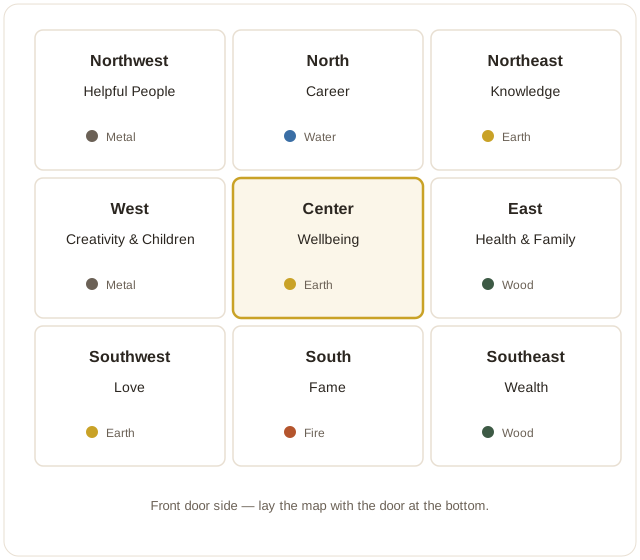
The connection between signs and the home runs through two shared maps. The first is the bagua, the eight-sector compass map of the home: North for Career, Northeast for Knowledge, East for Health and Family, Southeast for Wealth, South for Fame, Southwest for Love, West for Creativity and Children, Northwest for Helpful People, and the Center for Wellbeing. The second is the five elements, which link every sign to an element and every sector to an element. Put the two maps together and you get the traditional logic: a sign's direction is the direction its branch occupies on the compass, and a sign's element suggests the colors and materials traditionally associated with it.
Signs and their directions
Each earthly branch occupies a compass direction, and the twelve divide the compass evenly. In the traditional arrangement, Rat sits in the North, Ox and Tiger in the Northeast, Rabbit in the East, Dragon and Snake in the Southeast, Horse in the South, Goat and Monkey in the Southwest, Rooster in the West, and Dog and Pig in the Northwest. These are the branch directions used in compass-based feng shui, and they are why a traditional source might say a sign "belongs" to a sector: it means the sign's branch direction falls in that sector, nothing more mystical than that.
Two consequences follow, and both are worth understanding before applying anything. First, a sign's direction is a fixed property of the system, not a personal lucky direction: tradition does not say that everyone born in a Horse year should sleep facing South. Personal directions in classical feng shui come from a separate calculation, the Kua number, based on birth year and gender in the traditional formula — a different system from the zodiac, and one this site does not use to give individual advice. Second, the branch directions are most useful for understanding annual advice: when a year's Tai Sui sits in the Southwest, as in 2027, it sits there because the Goat's branch direction is Southwest, and the Year Breaker sits opposite, in the Northeast. The 2027 clash-sign guide explains that year's arrangement.
Signs and their elements in the home
Each sign's fixed element — Rat Water, Ox Earth, Tiger Wood, Rabbit Wood, Dragon Earth, Snake Fire, Horse Fire, Goat Earth, Monkey Metal, Rooster Metal, Dog Earth, Pig Water — suggests the colors and materials traditionally linked with it: Wood green, Fire red, Earth yellow and brown, Metal white and gold, Water black and blue. In home terms, that vocabulary is most useful in the general way the site already uses it: a room's colors and materials can echo or balance the element of its sector. The five elements guide explains the generation and control cycles — Wood feeds Fire, Fire makes Earth, Earth bears Metal, Metal carries Water, Water nourishes Wood; and Wood controls Earth, Earth controls Water, Water controls Fire, Fire controls Metal, Metal controls Wood — and the colors guide turns those cycles into room-by-room color choices.
Where sign elements enter home advice, it is usually as a gentle nudge rather than a rule. A traditional source might note that a household with a strong Wood presence — say, several members born in Tiger or Rabbit years — tends to favor green, plants, and wooden furniture, and that such a home benefits from keeping its Wood balanced with enough Metal or Earth so the greenery does not take over every room. That is a description of taste patterns in folk terms, not a diagnosis of the household. If you like the colors and materials your sign is linked with, use them; if you do not, the room's sector, its light, and its use matter far more than any sign association. The living room and bedroom guides both start from room function, not birth years, for exactly that reason.
Household patterns: what tradition actually notices
Traditional writing about households and signs tends to notice combinations, not individuals. A household where several members share a harmonious trio — for example, Rabbit, Goat, and Pig — is described in folk terms as naturally easygoing, while a household mixing opposite signs — say, Rat and Horse — is described as lively but prone to different rhythms, one early riser and one night owl, one planner and one improviser. These are observations about how different temperaments share space, dressed in zodiac language. The practical advice that follows from them is the same advice any household guide would give: give different rhythms their own space where possible, agree on quiet hours, and let shared rooms serve the household's actual routines rather than an ideal of constant togetherness.
The same logic applies to rooms. Tradition links the East with family and health, the Southwest with love and relationships, and the West with children and creativity, and those sector meanings — not anyone's birth sign — are what the site's room guides use when they suggest, for instance, keeping the East bright and healthy with plants, or the Southwest calm and paired in its decoration. If your home's East sector happens to be a kitchen and its Southwest a bedroom, those rooms already serve the sector meanings well by being lived-in, cared-for spaces. The bagua map guide is the place to work out which sector each of your rooms falls in, using a compass reading from the center of the home, as the compass reading guide explains.
What not to do with sign-and-home patterns
Three misuses are worth naming, because they come up often. First, do not redecorate a room to match a birth sign against the room's actual needs: a north-facing bedroom painted black and blue because its occupant is a Rat will feel cold and dark, whatever the element association says. Second, do not use sign combinations to judge relationships — deciding a household will clash because two members' signs sit opposite each other on the wheel is a misuse of a system designed to categorize years, not people. Third, do not buy cures "for your sign" from sellers who promise that a specific object will fix a specific year's fortune; the site's myths guide explains why purchased cures are the weakest part of the tradition and why arrangement, light, and cleanliness do the real work.
Used well, the sign-and-home patterns are a lens, not a set of orders. They give you a vocabulary for noticing that your home's Southwest is where you and your partner actually spend evenings together, or that the East room where the family gathers is also the healthiest, brightest room in the house. When the traditional pattern matches your lived experience, it can be a satisfying way to describe it. When it does not match, trust your lived experience. The home you actually live in outranks any wheel.
Go deeper with the book
Feng Shui Made Simple covers every room this way — bedroom, living room, kitchen, office, entryway — with diagrams and a 7-day plan for doing the whole house.
Frequently asked questions
Should I decorate my bedroom according to my zodiac sign?
Not as a rule. A sign's element suggests colors in tradition — for example, Wood signs suggest green — but the room's direction, light, and use matter far more. A cold, dark north-facing room should not be painted black and blue just because its occupant is a Water sign.
What direction does each zodiac sign belong to?
By branch direction: Rat North; Ox and Tiger Northeast; Rabbit East; Dragon and Snake Southeast; Horse South; Goat and Monkey Southwest; Rooster West; Dog and Pig Northwest. These are fixed properties of the traditional compass system, not personal lucky directions.
Do opposite signs clash in a household?
Tradition describes opposite signs as having different approaches, not as being doomed to conflict. In practical terms, different rhythms in a household — early risers and night owls, planners and improvisers — need their own space and agreed quiet hours, whatever anyone's sign.
Is my Kua number the same as my zodiac sign?
No. Personal directions in classical feng shui come from the Kua number, a separate calculation based on birth year and gender in the traditional formula. It is a different system from the twelve-animal zodiac.
Can sign-and-home patterns predict anything about my household?
No. This guide presents general traditional patterns for understanding the system. It does not predict any individual's fortune, health, wealth, or relationships, and it does not prescribe arrangements for any particular person.