Wu Lou Gourd: The Classic Health Cure
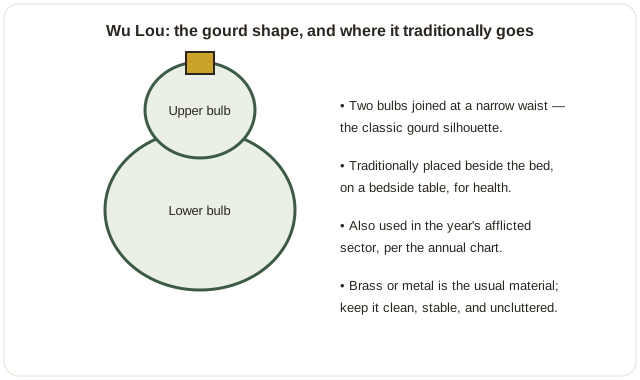
If feng shui has a single most recognizable health symbol, it is the Wu Lou: a small gourd with two bulbs joined at a narrow waist, usually in brass, sitting on a bedside table. The shape is not arbitrary. In old China, dried gourds were hollowed out and used to carry medicine, water, and wine — the gourd was literally the container that kept healing things safe. Over centuries that practical object became a symbol: a vessel that holds good health in and keeps illness out. Today the Wu Lou is used in two traditional ways — beside the bed for health in general, and in the year's afflicted sector as a metal cure — and both are worth understanding before you buy one.
This guide covers what the Wu Lou is, why it is usually metal, where it goes, and — plainly — what it cannot do.
From medicine bottle to symbol
The gourd's history explains its meaning better than any mystical claim. A dried calabash gourd is light, tough, waterproof once sealed, and naturally hollow — an ideal travelling bottle in a world before glass and plastic. Doctors carried medicines in gourds, travellers carried water in them, and the gourd became associated with the people who healed: the Daoist immortals are often pictured carrying gourds, and the god of medicine is shown with one. A symbol that starts as a real tool carries more weight than one invented for decoration, and the Wu Lou's longevity owes something to that honest origin.
The shape matters too. Two bulbs, one large and one small, joined at a narrow waist, read visually as a vessel with a neck — something that can be filled and sealed. Tradition sometimes describes the Wu Lou as "absorbing" negative energy into its belly, the way a bottle absorbs what you pour into it. Stated plainly, that is symbolism: a shape that suggests containment. The practical value of a bedside Wu Lou is closer to home — it is a small, deliberate object that marks the bedroom as a place where rest and recovery matter, and it prompts the person who sees it each night to take sleep and health seriously. Symbols work by reminding, and a reminder beside the bed is not nothing.
Real dried gourds are still sold as Wu Lou, and they are beautiful, but they are fragile, they crack, and they do not suit the annual-star purpose, which calls for metal. Most people who buy a Wu Lou today buy brass, and that is the right choice for the uses in this guide.
Why metal, and the five elements
When a Wu Lou is used in an afflicted sector, its material matters for the same reason a metal wind chime's material matters. The 5 Yellow and 2 Black are Earth stars, and Metal weakens Earth by the exhaustion principle in the five-element cycles: Earth produces Metal, so Earth spends itself making Metal. Our five elements guide lays out both cycles, and the Wu Lou's role follows directly from them. A brass Wu Lou in an Earth sector is a piece of Metal doing the same traditional job as a chime or a set of coins, in a quieter, more decorative form.
That is also why a Wu Lou is a good alternative when other metal cures do not fit. A salt water cure needs a safe, spill-proof spot and is unsuitable around small children; a wind chime needs a breeze and must not disturb sleep. A Wu Lou needs only a stable surface. In a bedroom, a small brass gourd on the bedside table is unobtrusive, silent, and safe — which is exactly why it is the traditional bedside choice, and why it suits the health purpose better than a noisy or spillable cure in a sleeping room.
Wooden, crystal, and ceramic Wu Lou exist and are sold as health symbols. They are fine as symbols — the gourd shape itself carries the health association regardless of material — but for the annual-star purpose, metal is the traditional choice, and a non-metal Wu Lou in an afflicted sector is a symbol, not a metal cure. If you buy one for the sector, buy metal; if you buy one for the bedside as a general health symbol, choose the material you like looking at.
Where it goes: bedside and annual sectors
The classic placement is the bedside table, on the side of the bed you sleep on, where you can see it last thing at night and first thing in the morning. Tradition does not demand a particular side, and practicality favors the side with space: a Wu Lou crowded among chargers, books, and a glass of water is a Wu Lou waiting to be knocked onto the floor. Give it a clear spot, keep it upright, and keep it clean — tarnished brass is fine aesthetically, but a dusty, cluttered bedside table undermines the calm the bedroom needs. The bedroom guide covers that wider calm.
The second placement is the year's afflicted sector. In 2027, that means the North for the 5 Yellow or the West for the 2 Black; in 2028, the Southwest for the 5 Yellow or the Northeast for the 2 Black. Place the Wu Lou in a quiet spot in that sector — a shelf, a side table, a corner unit — not in a walkway and not where it will be hidden behind clutter. One Wu Lou per sector is enough; filling a sector with gourds does not multiply the effect, and a shelf of identical objects looks like a shop display, not a cure.
If the afflicted sector falls in the bedroom, the two placements coincide neatly: the bedside table in that sector serves both purposes. If the bedroom is elsewhere, you may use two Wu Lou — one bedside, one in the sector — which is the common arrangement. Do not hang a Wu Lou over a bed or a door. It is a placed object, not a hanging one, and a heavy brass object above a sleeping person is a hazard regardless of tradition. The same caution applies to beams over the bed: nothing heavy above the sleeper.
Buying, caring for, and the honest limit
Buy a size that fits its spot. A bedside Wu Lou should be small — palm-sized to about fifteen centimeters tall — so it sits comfortably on a table without dominating it. A sector Wu Lou can be larger if the shelf allows, but bigger is not stronger; tradition does not scale the effect with size. Check that it stands stably, especially the brass kind, which is heavier than it looks, and avoid sharp or rough castings if children will handle it.
Care is simple: dust it, polish the brass if you like the shine or let it patinate if you prefer the aged look, and keep it where it will not be knocked over. If a Wu Lou breaks, tradition generally says to replace it rather than repair it with visible glue — and practically, a cracked brass object with a sharp edge belongs in recycling, not on a bedside table. Replacement is not a bad omen; it is housekeeping.
Finally, the honest limit, stated without hedging: a Wu Lou does not cure illness, prevent disease, or substitute for medical care. It is a traditional symbol and, in afflicted sectors, a traditional metal cure. It can mark a bedroom as a place of rest, remind you to protect your sleep, and give you a deliberate, calm response to a worrying annual star. Those are real, modest benefits. Anyone claiming more — guaranteed health, recovery, protection — is selling something the tradition itself does not promise. If you are unwell, see a doctor; let the Wu Lou sit on the table while you do.
Go deeper with the book
Feng Shui Made Simple covers every room this way — bedroom, living room, kitchen, office, entryway — with diagrams and a 7-day plan for doing the whole house.
Frequently asked questions
What is a Wu Lou?
A gourd-shaped object — two bulbs joined at a narrow waist — traditionally used in feng shui as a health symbol. Real dried gourds were once used to carry medicine and water; today most Wu Lou are brass or metal.
Where should a Wu Lou go?
Traditionally beside the bed on a bedside table, for health, or in the year's afflicted sector — in 2027 the North (5 Yellow) or West (2 Black); in 2028 the Southwest (5 Yellow) or Northeast (2 Black).
Does a Wu Lou have to be brass?
Brass or another metal is the usual choice, because metal suits the cure's role in earth-afflicted sectors. Wooden, crystal, and ceramic versions exist and are used as health symbols, but for the annual-star purpose, metal is the traditional material.
Can I carry a small Wu Lou as a pendant?
Yes — small Wu Lou pendants and keychains are common, and tradition treats them as personal health symbols. A pendant is a personal item, not a room cure, so it does not replace a cure placed in an afflicted sector.
Does a Wu Lou cure illness?
No. It is a traditional symbol, not a medical treatment. It does not prevent, diagnose, or treat any illness. Anyone unwell should see a doctor; a Wu Lou can sit on the bedside table, but it is not a substitute for care.