Metal Wind Chimes: How They Weaken Bad Stars
A wind chime is the most musical cure in feng shui, and the most misunderstood. People hang them anywhere — by the front door, in a lucky corner, because they like the sound — and then wonder why nothing changed. A metal wind chime used as a cure has a specific job, a specific material, and a specific place, and all three matter. Used correctly, it is a moving piece of Metal placed in an Earth-afflicted sector, where tradition holds that Metal weakens Earth. Used anywhere else, it is just a pleasant decoration, which is fine too — but it is not a cure.
This guide explains the elemental reasoning, where the chimes go in 2027 and 2028, how to choose one you will not hate, and the limits of what a chime can do.
Why metal weakens earth stars
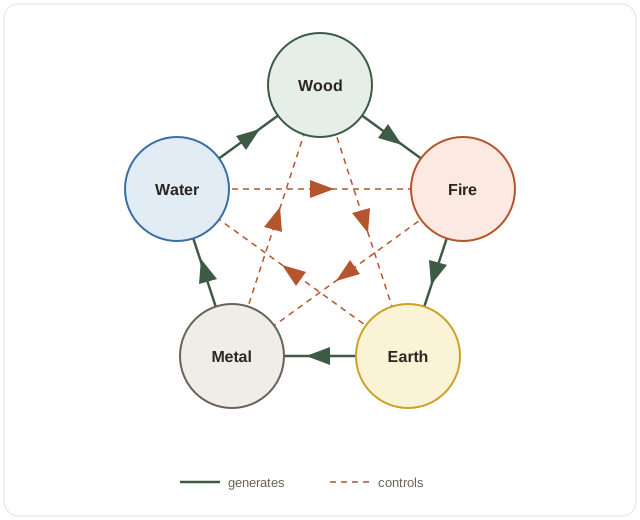
The reasoning comes from the five-element cycles. In the generation cycle — Wood feeds Fire, Fire creates Earth, Earth produces Metal, Metal collects Water, Water nourishes Wood — Earth gives birth to Metal, which means Earth spends its energy producing Metal and is thereby weakened. In the control cycle, Metal is also the element that acts on Wood, but for the earth-afflicted stars the relevant mechanism is exhaustion: surround Earth with Metal, and Earth exhausts itself making Metal instead of expressing its own troublesome character. That is the traditional claim, stated as tradition, and it is why the material is not negotiable for this cure.
A wooden chime is Wood, which controls Earth in the control cycle — a different mechanism, and not the one this cure uses. A ceramic chime is Earth itself, which would strengthen the very element you are trying to calm. A glass or bamboo chime belongs to other elements again. Only metal — brass, copper, steel, aluminium — carries the Metal element for this purpose. This is also why the salt water cure uses coins: the coins are the metal in that cure too, and the two cures are cousins, both placing Metal in an Earth sector.
The movement matters as well. A chime is not a static lump of metal; it moves, it sounds, it breaks up stillness. In feng shui terms, sound and movement disperse stagnant energy, and in practical terms, a chime that rings when the wind moves tells you the sector has air and life rather than being a sealed, forgotten corner. Our sound as a cure guide covers this wider principle — bells, chimes, and music as ways of changing how a room feels.
Where to hang them: 2027 and 2028
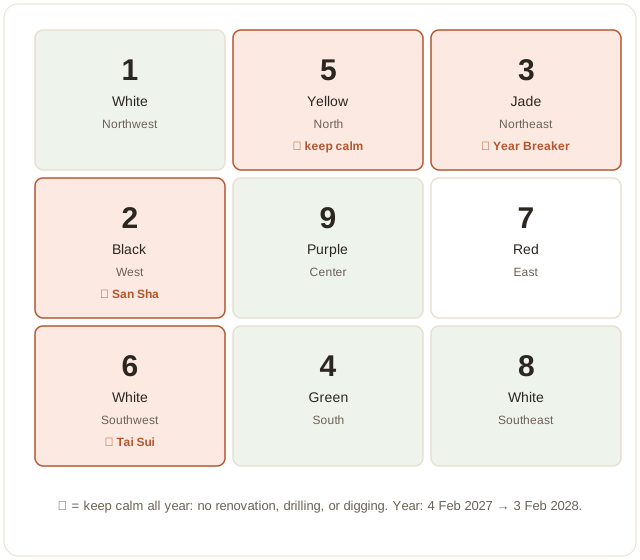
Placement follows the annual stars, so it changes every year. In 2027, the 5 Yellow is in the North and the 2 Black is in the West, with San Sha also in the West. Hang a metal chime in the North for the 5 Yellow, in the West for the 2 Black, or both if you have two chimes. The North placement is the priority if you only hang one, because the 5 Yellow is traditionally the stronger affliction. See our 5 Yellow North 2027 guide and West 2 Black 2027 guide for the full sector advice.
In 2028, the chart moves: the 5 Yellow sits in the Southwest with Tai Sui, and the 2 Black sits in the Northeast with the Year Breaker. Move the chimes accordingly at Lichun, 4 February 2028. A chime left hanging in last year's sector is not harmful, but it is no longer doing its traditional job — and if it hangs in a sector that has become favorable, its sound is just sound, not a cure. The full 2028 chart is on our 2028 flying stars page.
Within the sector, hang the chime where air moves: near a window, by a door, in a hallway draught. A chime in a sealed cupboard never rings, and a cure that never acts is easy to forget. But do not hang it where it will disturb sleep — not over a bed, not in a bedroom doorway where night draughts will ring it at 3 a.m. The sector is a zone of the whole home, not a single room, so if the North falls in your bedroom, hang the chime in the North part of another room, or in a North-facing hallway, rather than over the bed.
Choosing a chime you can live with
Tradition favors six rods for this cure, because six is associated with Metal in the traditional number system; five rods is also used. Do not obsess over the count. The material matters more, the tone matters more still, and a chime you enjoy hearing will stay up, while a chime you hate will come down within a month — and a cure in a drawer cures nothing.
Listen before you buy, if you can. A good cure chime has a soft, low, sustained tone — the kind of sound that fades gently rather than clanging. High, sharp, tinny chimes irritate quickly, especially indoors, and large chimes designed for a garden will overpower a living room. Smaller is usually better indoors: a chime sized for the room, hung where the breeze is gentle rather than gusty. If you buy online and the tone is wrong, return it. The sound is the cure's daily presence in your home; it must be pleasant, or it fails its practical purpose even if it passes its traditional one.
Hang it securely. A chime that falls is a hazard, especially a brass one, and a chime hung from a weak hook over a walkway is an accident waiting for a draught. Use a proper hook or bracket, check it after the first windy week, and keep the chime clear of curtains and blinds it could tangle with.
What chimes cannot do, and what to pair them with
A wind chime does not guarantee protection from anything, and it does not substitute for the practical steps in an afflicted sector: no renovation or digging there during the year, keep the sector calm and tidy, fix hazards promptly. The chime's honest role is a traditional metal presence plus a pleasant sound plus a daily reminder to leave the sector alone. That is enough to justify it, if you like the sound — but it is not a shield, and anyone selling chimes with promises attached is overselling.
Chimes pair well with other metal cures in the same sector: a Wu Lou gourd on a nearby table, a metal ornament, or the salt water cure in a safe spot. They do not need to be used together — one well-placed metal cure is enough for most people — but they do not conflict, because they all work through the same element. What you should not do is fill an afflicted sector with Fire and Earth objects — red decor, ceramics, crystals in earth tones — while expecting a chime to cancel them out. Cures work with the sector's treatment, not against a room full of contradictions.
At year's end, take the chime down, clean it, and rehang it in the new sector if the new chart calls for it. A chime is a reusable cure, unlike the salt water setup, which is replaced — one more practical reason it is many people's first cure.
Go deeper with the book
Feng Shui Made Simple covers every room this way — bedroom, living room, kitchen, office, entryway — with diagrams and a 7-day plan for doing the whole house.
Frequently asked questions
Why must a feng shui wind chime be metal?
Because the cure works through the Metal element: metal weakens the Earth element of the 5 Yellow and 2 Black stars by the control and exhaustion principle. Wooden or ceramic chimes belong to other elements and do not serve this particular purpose.
Where do I hang a metal wind chime in 2027?
In the North for the 5 Yellow, or the West for the 2 Black — ideally where it can catch a breeze, such as near a window or door in that sector. In 2028 the placements move to the Southwest (5 Yellow) and Northeast (2 Black).
How many rods should a feng shui wind chime have?
Six is the traditional number for this cure, because six belongs to Metal in the traditional number associations. Five rods is also used. The material matters more than the exact count — a metal chime that sounds pleasant beats a correctly counted one that grates.
What if my wind chime never moves?
A chime in still air is still a metal object in the sector, so tradition still counts it. But movement is part of the point: hang it where air moves, or tap it gently when you pass. A chime that never sounds is easy to forget, and a forgotten cure does no behavioral work.
Can a wind chime be annoying?
Yes, and an annoying chime is a failed cure: if the sound irritates everyone in the house, it raises tension instead of calming the sector. Choose a soft, low tone, hang it where the breeze is gentle, and take it down if it disturbs sleep — a quiet metal object is a better cure than a noisy one.