T-Junction Houses: What to Do When the Road Points at You
A T-junction house sits exactly where a road ends: the street runs straight at your front door, and every car that comes down it points its headlights at your house. In feng shui this is one of the classic problem positions, and it is easy to see why — the house takes the full force of the street, with nothing to slow it down first.
But a T-junction is not a verdict. It is a set of practical problems — glare, noise, dust, a feeling of exposure — and every one of them has a practical fix. Some T-junction houses are also genuinely desirable: they are often quieter than houses mid-block because there is no through traffic past the door, and the end of the road can feel like a private turning circle. The work is to keep the advantages and soften the disadvantages.
What the road actually does
Stand in the front room of a T-junction house at night and the problem is obvious: headlights sweep across the windows every time a car turns. By day it is subtler — the house is the first thing every driver sees, which makes the front garden feel watched, and the road surface throws back dust and traffic noise with no neighbouring house to block it.
Tradition describes this as energy rushing straight at the house, too fast and too direct. The practical translation is the same: a straight, fast approach gives a home no buffer. Compare it with a house set back behind a bend, where the street arrives gradually. The T-junction house gets the street all at once. The fixes below all do the same job — they put something between the road and the house, so the approach slows down before it reaches you.
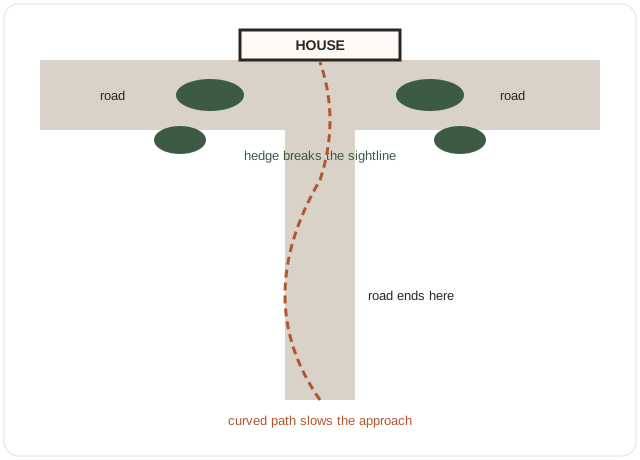
The first fix: break the straight line
The single most effective change is a barrier that is not a wall. A hedge, a row of shrubs, or a low fence with planting in front of it breaks the sightline from the road to the door without making the house look fortified. Drivers no longer see straight into your windows; you no longer see straight down the road. Planting works better than a bare wall here, because leaves filter light and sound while a flat wall bounces both back.
Height matters less than density. A hedge at chest height that is thick and evergreen does more than a tall, gappy fence. If you plant, choose something that keeps its leaves in winter — the headlight problem is worst on dark winter evenings, exactly when deciduous shrubs are bare. A pair of trees flanking the front path does similar work and frames the house nicely, which helps with the exposed feeling too.
Then curve the path. If the walk from the gate to the door runs dead straight, it repeats the road's line and carries the same rushed feeling right to the threshold. A gentle curve — even one shallow bend — changes how the approach feels. People slow down on curves without thinking about it. If rebuilding the path is too much, large planters or a stone placed to one side of a straight path can create the same gentle deflection.
Windows, light, and privacy
The front rooms take the brunt of the road, so treat their windows as the second line of defence. Sheer curtains or frosted film on the lower half of a front window cut glare and block the view in while keeping daylight. For bedrooms at the front, this is often the fix that matters most — a headlight sweeping across a bedroom wall at 2 a.m. is a sleep problem before it is a feng shui problem. See the bedroom guide for more on protecting sleep.
If you are replacing windows, consider smaller panes or a divided design on the road-facing side, and plant in front of the glass rather than relying on curtains alone. Planting filters light the way curtains do, but it also gives you something pleasant to look at instead of tarmac. A front garden that is worth looking at changes the whole relationship with the road.
The front door and the entry
A front door that faces straight down the road is the detail tradition worries about most, and it is also the easiest to soften. A porch, a canopy, or even a deep door recess creates a pause between the street and the threshold. The door stops being the end of the road and becomes the entrance to a house. Our entryway guide covers the inside of that transition.
Door colour is a smaller lever, but it is a real one: a door in a colour tied to the direction it faces looks intentional rather than exposed, and an intentional-looking entrance reads as cared-for to everyone who passes. The front door colour guide matches colours to compass directions. Keep the entrance lit at night, too — a well-lit porch says the house is occupied and looked after, which matters more on an exposed plot than anywhere else.
Noise, dust, and the garden as a filter
Traffic noise and dust are the least mystical and most stubborn parts of T-junction life. Dense planting helps a little; it will not silence a busy road. What does help is layering: hedge, then lawn or gravel, then the house wall, each layer absorbing a bit more. Inside, heavy curtains and draught-proofed windows cut more noise than any single cure. If the road is genuinely busy, secondary glazing on the front rooms is worth more than every symbolic fix combined — spend the money there first.
Use the front garden actively rather than treating it as a buffer zone you never enter. A bench, a seating nook, or a flower bed you tend daily turns the exposed front into a lived-in space. Houses whose fronts are used feel private in a way that houses whose fronts are merely screened do not. The garden is also where the garden guide's planting advice pays off most directly.
When to worry less
Not every T-junction is equal. A quiet residential cul-de-sac road ending at your house is a very different thing from a main road. Count the traffic: if only a handful of cars use the road each hour, the glare and noise problems are small, and the fixes above are mostly about privacy and looks. Also check the angle — if the road meets your plot slightly off-centre rather than dead-on, much of the direct-line effect is already gone. And remember the upside: no through traffic means children can play more safely out front, and parking is usually easier.
If you are buying rather than fixing, weigh the discount honestly. T-junction houses often sell for less, and that discount is real money that can pay for the hedge, the path, and the glazing. A T-junction house with good fixes applied is not a compromised house — it is a house whose one weakness has been thought about more carefully than most houses ever get. Start with the hedge and the path; they cost the least and change the most.
Go deeper with the book
Feng Shui Made Simple covers every room this way — bedroom, living room, kitchen, office, entryway — with diagrams and a 7-day plan for doing the whole house.
Frequently asked questions
Is a T-junction house really bad feng shui?
Tradition treats it as a difficult position because the road points straight at the house. In practice the problems are glare, noise, dust, and a feeling of exposure — all of which can be reduced with planting, a curved path, and good window treatments. It is a fixable layout, not a doomed one.
What is the single best fix for a T-junction house?
A dense evergreen hedge or planted barrier between the road and the house. It breaks the sightline, filters headlights and dust, and softens noise, all at once. Curve the front path as well so the approach does not repeat the road's straight line.
Does a T-junction affect resale value?
Often, yes — T-junction houses commonly sell at a discount, because buyers notice the road position immediately. Good screening, a well-kept front garden, and secondary glazing on front rooms all help a future buyer see a solved problem rather than an open one.
What if the road points at the back of the house instead?
That is a much milder version of the same pattern. The back garden takes the exposure rather than the front door, and a hedge or fence along the rear boundary usually handles it. Bedrooms at the back still benefit from the same window treatments.
Can a mirror or bagua mirror fix a T-junction?
Tradition sometimes recommends a bagua mirror above the door to deflect the road's energy. Treat it as a symbolic extra, not a substitute: it does nothing about headlights, noise, or dust. Do the planting and the path first, and add symbolism only if it means something to you.