Sloped Land: House on a Hill, Energy on the Move
A house on a slope gets the two things flat plots cannot offer: a view, and drainage that actually works. It also gets the two problems flat plots never have: a garden that wants to slide downhill, and a house that can feel as if it is perched rather than settled. Feng shui has strong opinions about slopes, and — unusually — most of them match the practical advice exactly.
The core idea is simple. In feng shui, a good site has support behind it and openness in front — the classic image is a mountain at the back and a gentle plain before the door. A slope can give you exactly that, or exactly the opposite, depending on which way the land falls. Everything in this guide comes back to that one question: does the slope support the house, or does it pull away from it?
Slope up behind, slope down in front: the good version
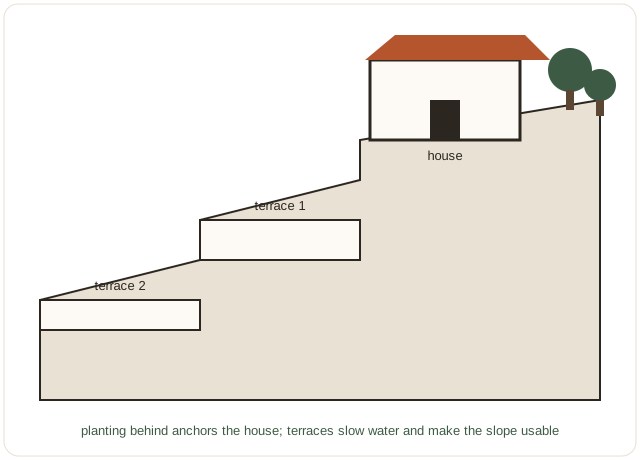
The favoured arrangement is land that rises behind the house and falls gently away in front. The rise behind acts as a windbreak and a visual anchor — the house looks sheltered, and it is sheltered, from the prevailing wind. The fall in front gives the view, the drainage, and a sense of openness when you step out of the door. If your plot works this way, the slope is an asset and your job is mostly to keep it that way: maintain the planting behind the house, and do not let the front slope become a dumping ground.
Terracing is the tool that turns a steep version of this into a usable garden. A slope that is one long slide is hard to plant, hard to mow, and hard to enjoy. Cut it into two or three level terraces with retaining walls, and each terrace becomes a room: a seating terrace near the house, a lawn or vegetable terrace below, planting at the edges. Terraces also slow water — instead of racing downhill, rain soaks into each level. This is both good gardening and, in feng shui terms, a way of keeping the site's energy from rushing away.
Slope down behind: the version to fix
The arrangement tradition warns about is the reverse: land that falls away behind the house, so the back of the property drops toward a road, a valley, or a neighbour below. The practical complaints are real — the back garden is overlooked from above, retaining walls at the rear need maintenance, and the house can feel exposed from behind. The symbolic complaint is that support is missing: nothing stands behind the house.
The fix is to build the support the land did not provide. A dense evergreen hedge or a row of trees along the rear boundary does the windbreak and privacy work. A solid fence helps, but planting in front of it helps more, because it softens the drop and gives birds and insects somewhere to live. If the rear drop is steep, a retaining wall with planting on top both holds the ground and raises the visual barrier. Inside the house, weight the back rooms with solid furniture and heavier curtains — the aim is that the rear of the house feels substantial, not like a glass box hanging over a drop.
The house itself on a slope
Slope houses often have split levels, and split levels have their own quirks. A front door that opens onto a staircase — up one way, down the other — can feel confusing, and guests hesitate at the threshold. If that is your layout, make the entrance level generous and well lit, with a clear sightline to the main living space, so arrivals know where to go. The entryway guide covers threshold fixes in detail.
Check the practical slope issues too, because they are the ones that cost money. Water runs downhill and finds the lowest point, which on a slope plot is often the downhill side of the house — check drainage there after heavy rain, and keep gutters and drains clear. Retaining walls need an eye kept on them: a leaning or bulging wall is a repair to schedule, not a feature to admire. And if the house is on stilts or a tall downhill foundation, make sure the under-house space is ventilated and not a damp trap.
Driveways, paths, and the approach
A steep driveway is a daily negotiation, and feng shui's complaint about it is the same as a driver's: a straight, steep run gives no pause before the house. If you can, break the drive with a bend or a level parking pad near the top, so cars arrive on the flat. A curved or stepped path to the front door does the same for people on foot — steps with a landing halfway up are far more welcoming than a single steep flight, and they are safer in wet or icy weather.
For the front door itself, the same door-colour and lighting advice as any exposed entrance applies — a lit, clearly marked door reads as cared-for, which matters more when the house is elevated and visible. See the front door colour guide for direction-matched colours, and the floor plan guide for how to read the whole plot on paper before you change anything.
Views are the payoff — use them
The reason people buy slope houses is the view, so do not waste it behind closed curtains or a cluttered window. Put the main seating where the view is, keep the glass clean, and frame it rather than blocking it with tall furniture. A view that you actually look at every day is the slope's gift; a view that is hidden behind a television and a bookshelf is a gift left unopened.
Balance the view with shelter, though. The room with the best view is often the most exposed to wind and sun, so it needs the counterweights: curtains or shades for glare, a rug and solid furniture to ground the space, and plants that thrive in bright light. A bright, windswept room with nothing soft in it feels exciting for a week and tiring after that. The living room guide covers grounding a bright room in more detail.
A slope is not a flaw to apologize for. It is a site with a direction, and once you know which way your slope runs, the work is clear: support the back, open the front, terrace the garden, and drain the water. Houses that do those four things sit on their hills the way they should — settled, sheltered, and looking out over something worth looking at.
Go deeper with the book
Feng Shui Made Simple covers every room this way — bedroom, living room, kitchen, office, entryway — with diagrams and a 7-day plan for doing the whole house.
Frequently asked questions
Is it bad feng shui to build on a slope?
It depends on the direction. Land rising behind the house and falling gently in front is the favoured arrangement — shelter at the back, view and openness at the front. Land falling away behind the house is the version to fix, with planting and solid boundaries at the rear.
What is the best fix for a steep garden?
Terracing: cut the slope into two or three level terraces with retaining walls. Each terrace becomes usable, water soaks in instead of racing downhill, and the garden stops feeling like a slide.
Does a house on a slope have drainage problems?
It can, on the downhill side, where water collects. Keep gutters and drains clear, check the downhill wall after heavy rain, and make sure retaining walls are sound. These are ordinary maintenance jobs, but they matter more on a slope.
What about a front door halfway up a staircase inside?
Make the entrance level generous and well lit, with a clear sightline to the main living space, so arrivals are not left hesitating between up and down. A landing halfway up an outside flight has the same welcoming effect.
Can planting really substitute for a hill behind the house?
For windbreak, privacy, and the feeling of shelter, yes — a dense evergreen hedge or a row of trees along the rear boundary does much of what a natural rise does. It will not change the geology, but it changes how the house feels and how it weathers wind.