Rugs and Carpets: Grounding a Room
Walk into a room with bare hard floors and furniture pushed to the edges, and it feels like a waiting room: echoing, cold, and slightly temporary. Lay down a rug, pull the furniture onto it, and the same room feels settled — like a place where people actually live. That change is the whole of rug feng shui. A rug grounds a room, and grounded rooms are calmer rooms.
In the five elements, rugs belong to Earth. Earth is stability, groundedness, and nourishment — the element that holds everything else up. A rug is literally a layer of Earth between you and the floor: it softens footsteps, absorbs sound, warms cold feet, and marks a zone as belonging together. None of that is mystical. It is what a rug physically does, and feng shui's language of "grounding" is simply a name for it.
Most rug mistakes are size mistakes. People buy rugs that are too small, because small rugs are cheaper and easier to carry home. This guide starts with size, because size is where a rug either works or fails, and then covers rooms, color, and care.
The size rule that matters
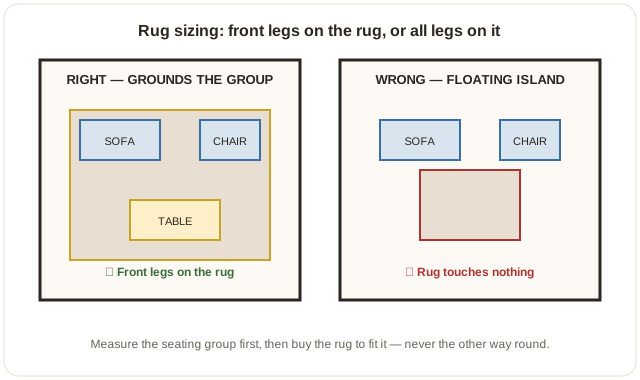
For a living room, the rule is simple: the rug must be big enough that the front legs of the sofa and chairs sit on it. All legs on the rug is even better, if you can afford the size. What fails is the "floating island" — a small rug in the middle of the floor that touches no furniture at all. A floating rug does not ground anything; it looks like a mat that drifted in from another room, and it makes the seating group feel scattered rather than gathered.
Measure before you buy. Arrange the seating group where you want it, measure the footprint including the front legs, and add 15 to 20 centimeters on each side. That is your minimum rug size. Then buy the largest size your budget and room allow above that minimum — a rug that is slightly too big is rarely a problem, while a rug that is slightly too small is always one. The living room guide shows how the rug anchors the whole seating arrangement.
Room by room
In the living room, the rug defines the conversation zone. In an open-plan space it does even more: it draws a boundary where there are no walls, telling everyone that this patch of floor is for sitting and talking, while the floor beyond it is for walking and cooking. This is one of the cheapest ways to create zones in an open-plan home, and it pairs well with the open-plan guide's other zoning tricks.
In the dining room, a rug works only if it is big enough for chairs to pull out and stay on it — add at least 60 centimeters on every side of the table. A rug that chairs slide half off is annoying at every meal, wears unevenly, and becomes a tripping edge. In a small dining space, skip the rug entirely and let the floor do the work; a rug that fails is worse than no rug. The dining room guide covers the table setup this rule serves.
In the bedroom, a rug is pure comfort. A soft rug beside the bed means your feet land on warmth instead of cold floor first thing in the morning, and the room feels softer and quieter all day. A large rug under the bed works too, provided it extends at least 45 centimeters on each side and at the foot, so you step onto rug, not bare floor. In the entryway, a flat, durable rug or runner catches dirt and marks the transition from outside to inside — one of the entryway guide's simplest upgrades.
Where rugs hurt
Rugs are not right everywhere. In a kitchen, a rug beside the sink gets wet, stained, and slippery; a washable flat mat in front of the sink is the practical alternative, and it should be thin enough not to catch a toe. In a bathroom, a rug that stays damp grows mildew — use a washable bath mat and hang it to dry, not a thick decorative rug.
Hallways and stairs deserve caution too. A loose runner on a smooth floor is a tripping hazard, especially for older visitors and children. If you use a hallway runner, it must have a non-slip backing or pad, lie flat with no curled edges, and leave enough clear floor on either side that nobody has to walk on its edge. The hallway guide covers lighting and width for the same spaces.
Thick, high-pile rugs also trap dust and allergens, which matters in a bedroom or a home with asthma. If anyone in the household struggles with dust, choose flat-weave or low-pile rugs that vacuum easily, and vacuum them properly — a rug that is never cleaned stops grounding a room and starts polluting it, however beautiful it looks.
Color, pattern, and material
Color is a gentle association, not a rule. Earth tones — beige, terracotta, warm brown, soft gold — suit most rooms and reinforce the rug's grounding role, since Earth colors are yellow and brown. A rug can also carry a room's element color: green in a space you want to feel fresh and growing, deep blue where you want calm and depth. The colors guide covers the full element palette, but the practical advice is simpler: choose a color you will not tire of, in a tone that hides the dirt your household actually produces.
Pattern matters for a different reason: it hides wear. A solid pale rug in a busy household shows every mark within a month, and a stained rug drags a room down faster than a bare floor. Patterned rugs, darker tones, and textured weaves forgive daily life. This is not a design lecture; it is the difference between a rug you love in year three and one you resent in month two.
Material is about feel and maintenance. Wool is warm, durable, and naturally stain-resistant, and it suits living rooms and bedrooms. Cotton flat-weaves are washable and practical for dining areas and children's rooms. Natural fibers like jute and sisal look beautiful and earthy, but they are rough underfoot and hard to clean — better in an entryway than a bedroom. Choose for the room's real life, not for a photograph.
Care is part of the feng shui
A rug's feng shui is only as good as its condition. A stained, curling, or smelly rug does the opposite of grounding a room: it draws the eye to the stain, catches toes on the curled corner, and quietly signals neglect. Vacuum weekly, deal with spills the day they happen, and rotate the rug every few months so wear spreads evenly instead of concentrating in one path.
Every year or two, take the rug outside for a proper beating or a professional clean, and check what is underneath — a rug pad that has flattened or bunched needs replacing, because a rug that slides or wrinkles is a hazard, not a comfort. And when a rug is truly worn out — threadbare, permanently stained, or curling no matter what you do — let it go. Keeping a ruined rug out of guilt is the same mistake as keeping a broken clock: the object has stopped serving the home, and the home is better without it.
Start with one room. Measure the seating group, buy the largest rug you can afford that fits it, and put the front legs on it. The room will feel settled within an hour, and you will wonder why the furniture ever floated on bare floor.
Go deeper with the book
Feng Shui Made Simple covers every room this way — bedroom, living room, kitchen, office, entryway — with diagrams and a 7-day plan for doing the whole house.
Frequently asked questions
What size rug should I buy for a living room?
Big enough that the front legs of the sofa and chairs sit on it, or all legs if you can afford the size. Measure the seating group first, then buy the rug to fit it. A rug that is too small floats in the middle of the floor and makes the room feel scattered; a rug that is too big is rarely a problem.
Are rugs good feng shui?
Yes — rugs are one of the simplest grounding tools in feng shui. They define a zone, soften hard floors, absorb sound, and make a seating group feel like one place instead of separate pieces of furniture. The element association is Earth: a rug literally grounds a room.
Should a rug go under a dining table?
Only if it is big enough for chairs to pull out and stay on the rug — add at least 60 centimeters on every side of the table. A rug that chairs slide half off is annoying at every meal and a tripping risk. In a small dining space, skip the rug and let the floor do the work.
What about rugs in bedrooms?
A soft rug beside the bed is one of the best small comforts in a home: your feet land on something warm instead of cold floor, and the room feels softer and quieter. A large rug under the bed works too, provided it extends at least 45 centimeters on each side so you step onto rug, not bare floor.
Do rug colors matter in feng shui?
Gently. Earth tones — beige, terracotta, warm brown — suit most rooms and reinforce the rug's grounding role. A rug can also carry a room's element color: green in a wood-friendly space, deep blue in a water-friendly one. But size, placement, and cleanliness matter far more than color.